Our mission is to help computational modelers develop, document, and share their computational models in accordance with community standards and good open science and software engineering practices. Model authors can publish their model source code in the Computational Model Library with narrative documentation as well as metadata that supports open science and emerging norms that facilitate software citation, computational reproducibility / frictionless reuse, and interoperability. Model authors can also request private peer review of their computational models. Models that pass peer review receive a DOI once published.
All users of models published in the library must cite model authors when they use and benefit from their code.
Please check out our model publishing tutorial and feel free to contact us if you have any questions or concerns about publishing your model(s) in the Computational Model Library.
Displaying 10 of 849 results NetLogo clear search
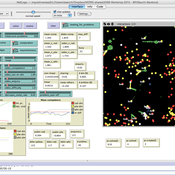
Inquisitiveness in ad hoc teams
Davide Secchi | Published Sunday, October 18, 2015 | Last modified Thursday, June 11, 2020This model builds on inquisitiveness as a key individual disposition to expand the bounds of their rationality. It represents a system where teams are formed around problems and inquisitive agents integrate competencies to find ‘emergent’ solutions.
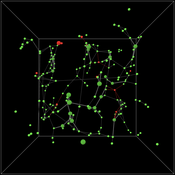
Intra-Organizational Bandwagon
Davide Secchi | Published Sunday, October 18, 2015The model simulates the process of widespread diffusion of something due to popularity (i.e., bandwagon) within an organization.
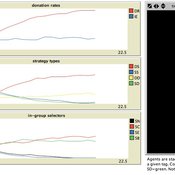
EthnoCultural Tag model (ECT)
David Hales Bruce Edmonds | Published Friday, October 16, 2015 | Last modified Wednesday, May 09, 2018Captures interplay between fixed ethnic markers and culturally evolved tags in the evolution of cooperation and ethnocentrism. Agents evolve cultural tags, behavioural game strategies and in-group definitions. Ethnic markers are fixed.
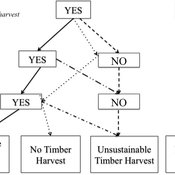
Private forest owner management behavior using social interactions, information flow, and peer-to-peer n
Emily Silver Huff Jessica Leahy Aaron R Weiskittel Caroline L Noblet David Hiebeler | Published Tuesday, October 13, 2015This theoretical model includes forested polygons and three types of agents: forest landowners, foresters, and peer leaders. Agent rules and characteristics were parameterized from existing literature and an empirical survey of forest landowners.
Ageing and Spending
Tony Lawson | Published Tuesday, October 06, 2015How natural population ageing affects UK household spending patterns.
SimDrink: An agent-based NetLogo model of young, heavy drinkers for conducting alcohol policy experiments
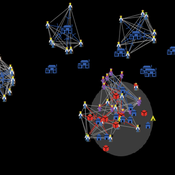
Nick Scott Michael Livingston Aaron Hart James Wilson David Moore Paul Dietze | Published Friday, September 25, 2015 | Last modified Thursday, October 15, 2015A proof-of-concept agent-based model ‘SimDrink’, which simulates a population of 18-25 year old heavy alcohol drinkers on a night out in Melbourne to provide a means for conducting policy experiments to inform policy decisions.
Peer Review with Multiple Reviewers
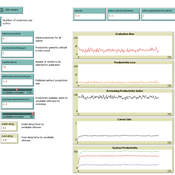
Federico Bianchi Flaminio Squazzoni | Published Thursday, September 10, 2015This ABM looks at the effect of multiple reviewers and their behavior on the quality and efficiency of peer review. It models a community of scientists who alternatively act as “author” or “reviewer” at each turn.
FlowLogo: An agent-based platform for simulating complex human-aquifer interactions in managed groundwater systems
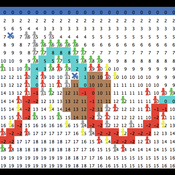
Juan Castilla-Rho | Published Sunday, August 30, 2015FlowLogo integrates agent-based and groundwater flow simulation. It aims to simplify the process of developing participatory ABMs in the groundwater space and begin the exploration of novel, bottom-up solutions to conflicts in shared aquifers.
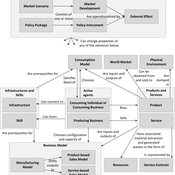
Generic servicising model (SPREE project)
Reinier Van Der Veen Kasper H Kisjes Igor Nikolic | Published Wednesday, August 26, 2015 | Last modified Wednesday, September 28, 2016This generic agent-based model allows the user to simulate and explore the influence of servicising policies on the uptake of servicising and on economic, environmental and social effects, notably absolute decoupling.
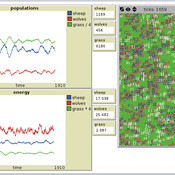
Peer reviewed PPHPC - Predator-Prey for High-Performance Computing
Nuno Fachada | Published Saturday, August 08, 2015 | Last modified Wednesday, November 25, 2015PPHPC is a conceptual model for studying and evaluating implementation strategies for spatial agent-based models (SABMs). It is a realization of a predator-prey dynamic system, and captures important SABMs characteristics.
Displaying 10 of 849 results NetLogo clear search