Our mission is to help computational modelers develop, document, and share their computational models in accordance with community standards and good open science and software engineering practices. Model authors can publish their model source code in the Computational Model Library with narrative documentation as well as metadata that supports open science and emerging norms that facilitate software citation, computational reproducibility / frictionless reuse, and interoperability. Model authors can also request private peer review of their computational models. Models that pass peer review receive a DOI once published.
All users of models published in the library must cite model authors when they use and benefit from their code.
Please check out our model publishing tutorial and feel free to contact us if you have any questions or concerns about publishing your model(s) in the Computational Model Library.
Displaying 10 of 33 results for "Jose Jimenez" clear search
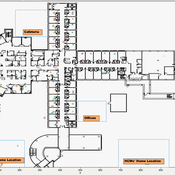
Knowledge Sharing in a Hospital
bpint Emily Molfino Joshua Goldstein Kathryn Schaefer Ziemer Mark Orr Bryan Lewis Jose Jimenez | Published Friday, January 27, 2023Organizations are complex systems comprised of many dynamic and evolving interaction patterns among individuals and groups. Understanding these interactions and how patterns, such as informal structures and knowledge sharing behavior, emerge are crucial to creating effective and efficient organizations. To explore such organizational dynamics, the agent-based model integrates a cognitive model, dynamic social networks, and a physical environment.
Zombies
Jennifer Badham | Published Tuesday, June 08, 2021Zombies move toward humans and humans move (faster) away from zombies. They fight if they meet, and humans who lose become zombies.
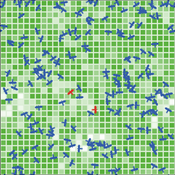
Spatial Game Theory
Kristin Crouse | Published Tuesday, November 05, 2019 | Last modified Wednesday, April 22, 2026This model is a spatial evolutionary game theory model in which animals with inherited red or blue phenotypes move, interact locally, gain or lose energy based on payoff structure, and reproduce across generations. Plants provide a stationary green component of the environment. The model can be used to examine how game payoffs, inheritance, and survival shape population and evolutionary dynamics over time.
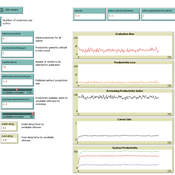
Peer Review with Multiple Reviewers
Federico Bianchi Flaminio Squazzoni | Published Thursday, September 10, 2015This ABM looks at the effect of multiple reviewers and their behavior on the quality and efficiency of peer review. It models a community of scientists who alternatively act as “author” or “reviewer” at each turn.
When should professional-development places be concentrated
yuhouchunsun | Published Sunday, October 25, 2026This Python agent-based model simulates the diffusion of instructional practices among primary-school science teachers connected through within-school and cross-school networks. It represents teachers as agents nested in schools and compares five adoption mechanisms: simple contagion, proportion thresholds, count thresholds, adaptive norm conformity, and an individual-only baseline. The model evaluates fixed-budget training allocations, including concentrated and distributed policies, and estimates when school-level dose-response evidence can support targeted allocation. Experiments examine peer interference, cross-school contact intensity, global critical transitions, allocation stability, and the distinction between participant-level and system-level outcomes. Teacher attributes are informed by a de-identified Beijing questionnaire, whereas team sizes and contact networks are explicit model assumptions. The package includes executable Python scripts, ODD documentation, parameter tables, experiment metadata, simulation outputs, and the authorized questionnaire workbook required to reproduce the questionnaire-informed analyses. Results are intended as model-based design evidence for future longitudinal research rather than forecasts of adoption rates.
Margin League: Elo forecasts, bookmaker margin and the favourite-longshot pattern
Edward | Published Sunday, November 15, 2026An agent-based model of a sports league, a public Elo forecaster and a bookmaker. Teams have hidden true strengths that drift between seasons; the forecaster updates Elo ratings after every game; the bookmaker prices each game from the Elo forecast plus a margin (overround), spread either proportionally or loaded onto longshot prices. The model asks where the favourite-longshot pattern in betting prices comes from. With a forecaster whose ratings lag true strength, longshots win more often than their de-vigged price implies; a bookmaker that loads its margin onto longshots cancels that bias, so favourite and longshot bets both lose roughly the margin. Outputs: a calibration table (de-vigged price band vs. observed win rate) and the average return of flat bets on favourites and longshots. Python 3 standard library only; all parameters are command-line arguments; the README documents the model with a short ODD protocol and an example run. Companion empirical study and open data (CC BY 4.0): Bet Better market calibration study. Teaching model, not a betting system.
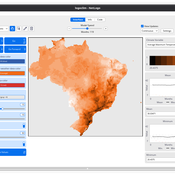
LogoClim: WorldClim in NetLogo
Daniel Vartanian Leandro Garcia Aline Aline Martins de Carvalho | Published Thursday, July 03, 2025 | Last modified Monday, July 13, 2026LogoClim is a NetLogo model designed to be integrated into other simulations through the LevelSpace extension (Hjorth et al., 2020), providing high resolution climate data from sources validated and used by the Intergovernmental Panel on Climate Change (IPCC).
The model simplifies and standardizes the integration of climate data into NetLogo, allowing researchers to focus their efforts on the model itself with the assurance of using reliable and widely recognized data. Although its main use is as a component of larger simulations, LogoClim also has its own graphical interface for monitoring and checking the datasets.
The climate data comes from the WorldClim 2.1 project (Fick & Hijmans, 2017), for which LogoClim works as an interface to NetLogo. The model supports all three WorldClim data series: (1) Historical Climate Data (1970 to 2000), with 12 monthly points for minimum, mean, and maximum temperature, precipitation, solar radiation, wind speed, vapor pressure, elevation, and bioclimatic variables; (2) Historical Monthly Weather Data (1951 to 2024), based on downscaling of CRU-TS-4.09, developed by the Climatic Research Unit at the University of East Anglia (Harris et al., 2020), with minimum and maximum temperature and total precipitation; and (3) Future Climate Data, based on downscaling climate projections derived from global climate models of the Coupled Model Intercomparison Project Phase 6 (CMIP6) (Eyring et al., 2016) for four future periods (2021 to 2040, 2041 to 2060, 2061 to 2080, and 2081 to 2100) and four scenarios based on the Shared Socioeconomic Pathways (SSPs 126, 245, 370, and 585), covering minimum and maximum temperature, total precipitation, and bioclimatic variables. All series are available at multiple spatial resolutions, from 10 minutes (about 340 km² at the equator) to 30 seconds (about 1 km² at the equator).
…
A preliminary extension of the Hemelrijk 1996 model of reciprocal behavior to include feeding
Sean Barton | Published Monday, December 13, 2010 | Last modified Saturday, April 27, 2013A more complete description of the model can be found in Appendix I as an ODD protocol. This model is an expansion of the Hemelrijk (1996) that was expanded to include a simple food seeking behavior.
An Agent-Based Model of Saving under Quasi-Hyperbolic Discounting on a Social Network.
Jose Alejandro Velazquez Monzon | Published Wednesday, June 24, 2026An agent-based model of saving and dissaving behaviour under quasi-hyperbolic (β–δ) discounting. Building on the individual decision problem of Cao and Werning (2018), the model embeds present-biased agents in a Watts–Strogatz small-world network and adds three configurable mechanisms of social influence — information diffusion, peer comparison, and social-norm conformity — across five heterogeneous behavioural profiles (Planners, Moderates, Procrastinators, Inverse Procrastinators, and Impulsive agents).
Each profile’s saving policy is approximated by value-function iteration over a discretised wealth grid; the solved policies are cached and applied as agents interact over their network neighbourhoods. The model tests whether each social mechanism can alter the saving and wealth trajectories that present-biased agents would otherwise follow in isolation, and characterises the direction and size of each effect on median wealth, wealth inequality (Gini), and the incidence of severely depleted agents.
The deposit includes the core model (Model.py), an analysis and visualisation pipeline (analyze_results.py), a standalone ODD description (ODD.md), and pinned dependencies.
Livestock drought insurance model
Felix John Birgit Müller Russell Toth Karin Frank Jürgen Groeneveld | Published Tuesday, December 19, 2017 | Last modified Saturday, April 14, 2018The model analyzes the economic and ecological effects of a provision of livestock drought insurance for dryland pastoralists. More precisely, it yields qualitative insights into how long-term herd and pasture dynamics change through insurance.
Displaying 10 of 33 results for "Jose Jimenez" clear search