Our mission is to help computational modelers develop, document, and share their computational models in accordance with community standards and good open science and software engineering practices. Model authors can publish their model source code in the Computational Model Library with narrative documentation as well as metadata that supports open science and emerging norms that facilitate software citation, computational reproducibility / frictionless reuse, and interoperability. Model authors can also request private peer review of their computational models. Models that pass peer review receive a DOI once published.
All users of models published in the library must cite model authors when they use and benefit from their code.
Please check out our model publishing tutorial and feel free to contact us if you have any questions or concerns about publishing your model(s) in the Computational Model Library.
Displaying 10 of 1007 results for "Bert Van Meeuwen" clear search
Between Pleasure and Contentment: Evolutionary Dynamics of Some Possible Parameters of Happiness
Yue Gao Shimon Edelman | Published Saturday, March 12, 2016 | Last modified Wednesday, March 16, 2016We build a computational model to investigate, in an evolutionary setting, a series of questions pertaining to happiness.
Machine Learning simulates Agent-based Model
Bernardo Furtado | Published Wednesday, March 07, 2018This is an initial exploratory exercise done for the class @ http://thiagomarzagao.com/teaching/ipea/ Text available here: https://arxiv.org/abs/1712.04429v1
The program:
Reads output from an ABM model and its parameters’ configuration
Creates a socioeconomic optimal output based on two ABM results of the modelers choice
Organizes the data as X and Y matrices
Trains some Machine Learning algorithms
…
St Anthony flu
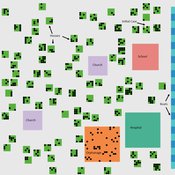
Lisa Sattenspiel | Published Monday, April 15, 2019The St Anthony flu model is an epidemiological model designed to test hypotheses related to the spread of the 1918 influenza pandemic among residents of a small fishing community in Newfoundland and Labrador. The 1921 census data from Newfoundland and Labrador are used to ensure a realistic model population; the community of St. Anthony, NL, located on the tip of the Northern Peninsula of the island of Newfoundland is the specific population modeled. Model agents are placed on a map-like grid that consists of houses, two churches, a school, an orphanage, a hospital, and several boats. They engage in daily activities that reflect known ethnographic patterns of behavior in St. Anthony and other similar communities. A pathogen is introduced into the community and then it spreads throughout the population as a consequence of individual agent movements and interactions.
A Simulation of Arab Spring Protests Informed by Qualitative Evidence
Bruce Edmonds Stephanie Dornschneider | Published Monday, April 29, 2019 | Last modified Friday, May 24, 2019The purpose of the simulation was to explore and better understand the process of bridging between an analysis of qualitative data and the specification of a simulation. This may be developed for more serious processes later but at the moment it is merely an illustration.
This exercise was done by Stephanie Dornschneider (School of Politics and International Relations, University College Dublin) and Bruce Edmonds to inform the discussion at the Lorentz workshop on “Integrating Qualitative and Quantitative Data using Social Simulation” at Leiden in April 2019. The qualitative data was collected and analysed by SD. The model specification was developed as the result of discussion by BE & SD. The model was programmed by BE. This is described in a paper submitted to Social Simulation 2019 and (to some extent) in the slides presented at the workshop.

Classical Swine Fever in wild boars
Volker Grimm Stephanie Kramer-Schadt Cédric Scherer Martin Lange Hans-Hermann Thulke | Published Friday, September 06, 2019The model is a combination of a spatially explicit, stochastic, agent-based model for wild boars (Sus scrofa L.) and an epidemiological model for the Classical Swine Fever (CSF) virus infecting the wild boars.
The original model (Kramer-Schadt et al. 2009) was used to assess intrinsic (system immanent host-pathogen interaction and host life-history) and extrinsic (spatial extent and density) factors contributing to the long-term persistence of the disease and has further been used to assess the effects of intrinsic dynamics (Lange et al. 2012a) and indirect transmission (Lange et al. 2016) on the disease course. In an applied context, the model was used to test the efficiency of spatiotemporal vaccination regimes (Lange et al. 2012b) as well as the risk of disease spread in the country of Denmark (Alban et al. 2005).
References: See ODD model description.
Agent-based model of WiFi tracking system in urban environment
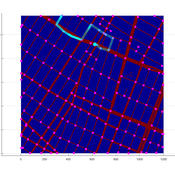
Christopher Thron Khoi Tran | Published Friday, April 21, 2017This code simulates the WiFi user tracking system described in: Thron et al., “Design and Simulation of Sensor Networks for Tracking Wifi Users in Outdoor Urban Environments”. Testbenches used to create the figures in the paper are included.
HOSS(-5): Human Organizations Simulations Start
José Quintás Alonso | Published Friday, October 09, 2026HOSS(-5) is an exploratory agent-based prototype of a small artificial society, written in Python. Each agent is a “ph” (punto humano, “human point”) that is born, is educated, works, consumes and dies. Its yearly decisions depend on a psychological profile (archetype × character), its economic status and its intentionality. Agents interact indirectly through families, firms in 10 sectors, a labour market with about 200 job categories, and a State that provides public services, employment and a Universal Basic Income, adjusting taxes and UBI each year to seek fiscal balance.
The model simulates a few thousand agents over decades of virtual time and records yearly aggregates (population, GDP, income, Gini index, HDI). A separate analysis script explores the results and fits Gamma distributions to individual incomes, comparing the shape parameter with Gini and HDI.
HOSS does not aim to predict real societies or claim empirical validation. It is a sandbox for comparing scenarios and thinking about the organizational design of society from an engineering perspective. Known limitations: no direct social relations between agents, prices and production follow simple rules rather than supply-demand dynamics, and organizations are black boxes.
…
Designing Fulfilling and Productive Workdays: Effects of Task Meaningfulness Sequences on Daily Engagement and Performance
S.R. Aurora (a.k.a. Mai P. Trinh) | Published Sunday, October 11, 2026Given the importance of experiencing fulfilling and productive workdays, scholars have focused on ways to boost employees’ daily engagement and performance, suggesting this may be accomplished by increasing meaningfulness of their work tasks. However, an alternative approach may be needed in multifaceted work contexts where employees need to complete sets of varied tasks each day, including tasks that lack meaningfulness. To address this issue, we integrate the workday design perspective with research on residual engagement to examine implications of strategically sequencing tasks in terms of their meaningfulness. We theorize that because of a process we refer to as engagement cascade, performing the day’s most highly meaningful tasks earlier and in a concentrated manner will tend to produce higher levels of daily engagement relative to sequences in which the most highly meaningful tasks occur later or are disbursed. We use agent-based modeling to formalize the engagement cascade process and generate specific predictions regarding how daily engagement is impacted by different task meaningfulness sequences. Findings from an intensive longitudinal design study with NASA and ROSCOSMOS crew members (Study 1), an experience sampling field experiment with full-time employees (Study 2), and two controlled laboratory experiments with undergraduates (Study 3 and Supplement to Study 3) provide support for our hypotheses. Specifically, the decreasing task meaningfulness sequence engendered higher levels of daily engagement, and in turn, daily performance, relative to increasing, inverted U-shaped, and U-shaped sequences.
Landscape connectivity and predator–prey population dynamics
Jacopo A. Baggio | Published Thursday, November 10, 2011 | Last modified Saturday, April 27, 2013A simple model to assess the effect of connectivity on interacting species (i.e. predator-prey type)
Knowledge Space Model for Opinion Dynamics
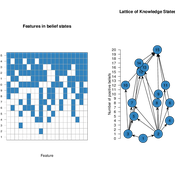
Shane Mueller | Published Thursday, September 28, 2017 | Last modified Thursday, September 20, 2018Knowledge Space model of Opinion Dynamics.
Displaying 10 of 1007 results for "Bert Van Meeuwen" clear search