Our mission is to help computational modelers develop, document, and share their computational models in accordance with community standards and good open science and software engineering practices. Model authors can publish their model source code in the Computational Model Library with narrative documentation as well as metadata that supports open science and emerging norms that facilitate software citation, computational reproducibility / frictionless reuse, and interoperability. Model authors can also request private peer review of their computational models. Models that pass peer review receive a DOI once published.
All users of models published in the library must cite model authors when they use and benefit from their code.
Please check out our model publishing tutorial and feel free to contact us if you have any questions or concerns about publishing your model(s) in the Computational Model Library.
Displaying 10 of 104 results for "Victor Ncube" clear search
NearshoreABM: production network formation under infrastructure constraints and financial frictions
Alejandro Platas López | Published Thursday, August 20, 2026NearshoreABM simulates whether a region captures the production linkages that nearshoring makes available, or fails to capture them because physical infrastructure and credit supply bind first.
The model runs over the 32 Mexican states at quarterly frequency. Multinational anchor firms decide whether to enter and where to locate, following Melitz selection on heterogeneous productivity under trade-policy uncertainty. Domestic supplier firms decide whether to formalise and whether to invest in quality, and may or may not obtain a contract with an anchor. A banking sector allocates a finite regional credit supply according to observed default risk, serving anchor firms before suppliers.
Electricity and water capacity enter production as non-linear congestion penalties with an engineering-based threshold, so the response of output to demand growth is discontinuous rather than proportional: below the threshold there is no penalty at all, between threshold and capacity the penalty grows quadratically, and above capacity it decays exponentially. Congestion is rivalrous within the quarter, which makes the order of production economically meaningful rather than incidental.
…
Structural Luck: An Agent-Based Model of Workplace Career Dynamics
Yang Ou | Published Sunday, August 23, 2026Why do career outcomes in organizations follow highly skewed distributions when the individual traits presumed to drive success — competence, effort, and social skill — are approximately normally distributed in the population? This agent-based model investigates the relative contributions of individual attributes versus random events (“luck”) to career outcomes in hierarchically structured organizations.
The model places 500 agents in a five-level pyramid-shaped organization over 80 six-month evaluation periods (40 simulated years). Each agent is characterized by four attributes drawn from normal distributions at initialization: competence, effort, social skill, and adaptability. In each period, agents may encounter stochastic career events (good or bad projects, supportive or poor managers, market booms or busts), which modify their performance and visibility scores. Promotion decisions are made competitively when vacancies arise at higher levels, using a weighted combination of recent performance, accumulated visibility, network position, and tenure. Social connections form and decay through a proximity-based model influenced by agents’ social skills.
The model extends the talent-versus-luck framework of Pluchino et al. (2018) in four substantive directions: (1) it embeds agents in a hierarchical organization with finite positions at each level, making promotion a zero-sum competition rather than an abstract encounter with random events; (2) it represents individual differences along four independent attribute dimensions rather than a single talent score; (3) it incorporates dynamic social network formation that mediates access to career-relevant opportunities; and (4) it implements the Peter Principle mechanism through which promoted agents must acquire competence appropriate to their new role.
…
Rebel Group Protection Rackets
Gerd Wagner Luis Gustavo Nardin Kamil C. Klosek Frances Duffy | Published Wednesday, December 04, 2019System Narrative
How do rebel groups control territory and engage with the local economy during civil war? Charles Tilly’s seminal War and State Making as Organized Crime (1985) posits that the process of waging war and providing governance resembles that of a protection racket, in which aspiring governing groups will extort local populations in order to gain power, and civilians or businesses will pay in order to ensure their own protection. As civil war research increasingly probes the mechanisms that fuel local disputes and the origination of violence, we develop an agent-based simulation model to explore the economic relationship of rebel groups with local populations, using extortion racket interactions to explain the dynamics of rebel fighting, their impact on the economy, and the importance of their economic base of support. This analysis provides insights for understanding the causes and byproducts of rebel competition in present-day conflicts, such as the cases of South Sudan, Afghanistan, and Somalia.
Model Description
The model defines two object types: RebelGroup and Enterprise. A RebelGroup is a group that competes for power in a system of anarchy, in which there is effectively no government control. An Enterprise is a local civilian-level actor that conducts business in this environment, whose objective is to make a profit. In this system, a RebelGroup may choose to extort money from Enterprises in order to support its fighting efforts. It can extract payments from an Enterprise, which fears for its safety if it does not pay. This adds some amount of money to the RebelGroup’s resources, and they can return to extort the same Enterprise again. The RebelGroup can also choose to loot the Enterprise instead. This results in gaining all of the Enterprise wealth, but prompts the individual Enterprise to flee, or leave the model. This reduces the available pool of Enterprises available to the RebelGroup for extortion. Following these interactions the RebelGroup can choose to AllocateWealth, or pay its rebel fighters. Depending on the value of its available resources, it can add more rebels or expel some of those which it already has, changing its size. It can also choose to expand over new territory, or effectively increase its number of potential extorting Enterprises. As a response to these dynamics, an Enterprise can choose to Report expansion to another RebelGroup, which results in fighting between the two groups. This system shows how, faced with economic choices, RebelGroups and Enterprises make decisions in war that impact conflict and violence outcomes.

SERDUX-MARCIM: agent-based simulation of cyberattack propagation in maritime critical infrastructure
Diego Edison Cabuya Padilla Carlos A Castaneda-Marroquin Daniel Díaz-López | Published Thursday, August 20, 2026 | Last modified Tuesday, October 20, 2026SERDUX-MARCIM simulates the propagation of a cyberattack over the computational network of an organization in the maritime sector, at the strategic level of decision-making. It is the instantiation of ABM-MARCIM, the agent-based model of the MARCIM framework for the modeling and simulation of maritime cyberdefense.
Every computational asset of the target organization – servers, endpoints, routers, gateways, vessel systems, radars – is an agent that occupies one of six states at each time step: Susceptible, Exposed, Resistant, Degraded, Unavailable or Destroyed, the initials of which give the model its name. The states Degraded, Unavailable and Destroyed are associated with the D5 cyberattack effects (disrupt, degrade, deny, destroy, deceive) as a function of the degree and the duration of the attack. Thirteen transitions between states are admissible.
Unlike a conventional agent-based model, the local update function is not an individual behavioral rule. It is a system of six ordinary differential equations with eight time-dependent transition rates – propagation, cyberattack (degraded), cyberattack (unavailable), cyberattack (destroyed), recovery, sanitation, loss of resistance, and unavailability by other causes. The values of those rates derive from the capabilities of the target organization, the capabilities of the attacker, and the degree and duration of the cyberattack, computed through a cyber risk approach aligned with the OWASP Risk Rating Methodology, the ISACA categorization of security controls and the IMO Guidelines on Maritime Cyber Risk Management.
…
Peer reviewed Organizational behavior in the hierarchy model
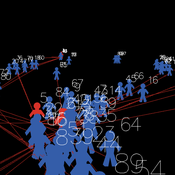
Smarzhevskiy Ivan | Published Tuesday, June 18, 2019 | Last modified Wednesday, July 31, 2019In a two-level hierarchical structure (consisting of the positions of managers and operators), persons holding these positions have a certain performance and the value of their own (personal perception in this, simplified, version of the model) perception of each other. The value of the perception of each other by agents is defined as a random variable that has a normal distribution (distribution parameters are set by the control elements of the interface).
In the world of the model, which is the space of perceptions, agents implement two strategies: rapprochement with agents that perceive positively and distance from agents that perceive negatively (both can be implemented, one of these strategies, or neither, the other strategy, which makes the agent stationary). Strategies are implemented in relation to those agents that are in the radius of perception (PerRadius).
The manager (Head) forms a team of agents. The performance of the group (the sum of the individual productivities of subordinates, weighted by the distance from the leader) varies depending on the position of the agents in space and the values of their individual productivities. Individual productivities, in the current version of the model, are set as a random variable distributed evenly on a numerical segment from 0 to 100. The manager forms the team 1) from agents that are in (organizational) radius (Op_Radius), 2) among agents that the manager perceives positively and / or negatively (both can be implemented, one of the specified rules, or neither, which means the refusal of the command formation).
Agents can (with a certain probability, given by the variable PrbltyOfDecisn%), in case of a negative perception of the manager, leave his group permanently.
It is possible in the model to change on the fly radii values, update the perception value across the entire population and the perception of an individual agent by its neighbors within the perception radius, and the probability values for a subordinate to make a decision about leaving the group.
You can also change the set of strategies for moving agents and strategies for recruiting a team manager. It is possible to add a randomness factor to the movement of agents (Stoch_Motion_Speed, the default is set to 0, that is, there are no random movements).
…
NarrABS
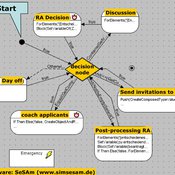
Tilman Schenk | Published Thursday, September 20, 2012 | Last modified Saturday, April 27, 2013An agent based simulation of a political process based on stakeholder narratives
The Internal Organizational Plasticity Model (IOP 2.1.2)
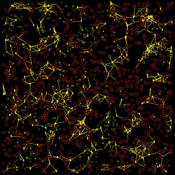
Davide Secchi | Published Tuesday, June 02, 2020IOP 2.1.2 is an agent-based simulation model designed to explore the relations between (1) employees, (2) tasks and (3) resources in an organizational setting. By comparing alternative cognitive strategies in the use of resources, employees face increasingly demanding waves of tasks that derive by challenges the organization face to adapt to a turbulent environment. The assumption tested by this model is that a successful organizational adaptation, called plastic, is necessarily tied to how employees handle pressure coming from existing and new tasks. By comparing alternative cognitive strategies, connected to ‘docility’ (Simon, 1993; Secchi, 2011) and ‘extended’ cognition (Clark, 2003, Secchi & Cowley, 2018), IOP 2.1.2 is an attempt to indicate which strategy is most suitable and under which scenario.
Agent-Based Model for Multiple Team Membership (ABMMTM)
Andrew Collins | Published Thursday, April 03, 2025The Agent-Based Model for Multiple Team Membership (ABMMTM) simulates design teams searching for viable design solutions, for a large design project that requires multiple design teams that are working simultaneously, under different organizational structures; specifically, the impact of multiple team membership (MTM). The key mechanism under study is how individual agent-level decision-making impacts macro-level project performance, specifically, wage cost. Each agent follows a stochastic learning approach, akin to simulated annealing or reinforcement learning, where they iteratively explore potential design solutions. The agent evaluates new solutions based on a random-walk exploration, accepting improvements while rejecting inferior designs. This iterative process simulates real-world problem-solving dynamics where designers refine solutions based on feedback.
As a proof-of-concept demonstration of assessing the macro-level effects of MTM in organizational design, we developed this agent-based simulation model which was used in a simulation experiment. The scenario is a system design project involving multiple interdependent teams of engineering designers. In this scenario, the required system design is split into three separate but interdependent systems, e.g., the design of a satellite could (trivially) be split into three components: power source, control system, and communication systems; each of three design team is in charge of a design of one of these components. A design team is responsible for ensuring its proposed component’s design meets the design requirement; they are not responsible for the design requirements of the other components. If the design of a given component does not affect the design requirements of the other components, we call this the uncoupled scenario; otherwise, it is a coupled scenario.
Exploring the aftermath of transition failures: An agent-based model
Gangmin Park Junmin Lee Jisoo Lee Keungoui Kim | Published Friday, March 06, 2026This computational model is an agent-based model (ABM) developed to investigate how repeated failures of emerging niches accumulate and influence the trajectory of socio-technical transitions. Built in AnyLogic 8.7.11, the model simulates the dynamic interactions between a dominant regime and sequential niche entrants within a two-dimensional practice space. It models alignment, movement, and competition based on technological maturity and market penetration. The model utilizes a reinforcing feedback structure linking consumer support, output, resource accumulation, and capacity development (Physical and Institutional Capacity). A complete model specification following the ODD+D (Overview, Design concepts, Details, and Decision) protocol is included in the documentation.
Peer reviewed Dynamic Value-based Cognitive Architectures
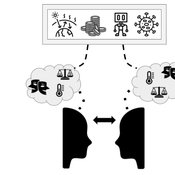
Bart de Bruin | Published Tuesday, November 30, 2021The intention of this model is to create an universal basis on how to model change in value prioritizations within social simulation. This model illustrates the designing of heterogeneous populations within agent-based social simulations by equipping agents with Dynamic Value-based Cognitive Architectures (DVCA-model). The DVCA-model uses the psychological theories on values by Schwartz (2012) and character traits by McCrae and Costa (2008) to create an unique trait- and value prioritization system for each individual. Furthermore, the DVCA-model simulates the impact of both social persuasion and life-events (e.g. information, experience) on the value systems of individuals by introducing the innovative concept of perception thermometers. Perception thermometers, controlled by the character traits, operate as buffers between the internal value prioritizations of agents and their external interactions. By introducing the concept of perception thermometers, the DVCA-model allows to study the dynamics of individual value prioritizations under a variety of internal and external perturbations over extensive time periods. Possible applications are the use of the DVCA-model within artificial sociality, opinion dynamics, social learning modelling, behavior selection algorithms and social-economic modelling.
Displaying 10 of 104 results for "Victor Ncube" clear search