Our mission is to help computational modelers develop, document, and share their computational models in accordance with community standards and good open science and software engineering practices. Model authors can publish their model source code in the Computational Model Library with narrative documentation as well as metadata that supports open science and emerging norms that facilitate software citation, computational reproducibility / frictionless reuse, and interoperability. Model authors can also request private peer review of their computational models. Models that pass peer review receive a DOI once published.
All users of models published in the library must cite model authors when they use and benefit from their code.
Please check out our model publishing tutorial and feel free to contact us if you have any questions or concerns about publishing your model(s) in the Computational Model Library.
Displaying 10 of 131 results Python clear search

SERDUX-MARCIM: agent-based simulation of cyberattack propagation in maritime critical infrastructure
Diego Edison Cabuya Padilla Carlos A Castaneda-Marroquin Daniel Díaz-López | Published Thursday, August 20, 2026SERDUX-MARCIM simulates the propagation of a cyberattack over the computational network of an organization in the maritime sector, at the strategic level of decision-making. It is the instantiation of ABM-MARCIM, the agent-based model of the MARCIM framework for the modeling and simulation of maritime cyberdefense.
Every computational asset of the target organization – servers, endpoints, routers, gateways, vessel systems, radars – is an agent that occupies one of six states at each time step: Susceptible, Exposed, Resistant, Degraded, Unavailable or Destroyed, the initials of which give the model its name. The states Degraded, Unavailable and Destroyed are associated with the D5 cyberattack effects (disrupt, degrade, deny, destroy, deceive) as a function of the degree and the duration of the attack. Thirteen transitions between states are admissible.
Unlike a conventional agent-based model, the local update function is not an individual behavioral rule. It is a system of six ordinary differential equations with eight time-dependent transition rates – propagation, cyberattack (degraded), cyberattack (unavailable), cyberattack (destroyed), recovery, sanitation, loss of resistance, and unavailability by other causes. The values of those rates derive from the capabilities of the target organization, the capabilities of the attacker, and the degree and duration of the cyberattack, computed through a cyber risk approach aligned with the OWASP Risk Rating Methodology, the ISACA categorization of security controls and the IMO Guidelines on Maritime Cyber Risk Management.
…
Activation and Foreclosure: An Agent-Based Model of Enforcement and Exit in Codified Moral Communities
Kiran Boggavarapu | Published Wednesday, August 19, 2026An agent-based model of rule-governed (religious) communities in which networked agents observe one another’s conduct, sanction deviation,
and decide whether to remain. The model separates two structural conditions for durable capture. First, whether an enforcement apparatus
activates: agents punish deviation only where conduct is observable (the code-geometry parameter sigma) and where sanctioning is
institutionally rewarded (pi), a joint threshold in which neither condition alone suffices. Second, whether members’ exit is foreclosed: an
outside-option degradation (delta) that can be imposed exogenously or allowed to drift with enforcement activity. Punishment concentrates in
a small, endogenously recomputed enforcer cadre, but that concentration is produced by an institutional privilege bundle (a punishment
…
Peer reviewed LSCs-CF: An agent-based model of public space conditions and the collective formation of local sports communities
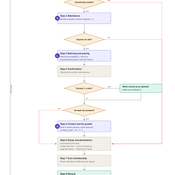
Yijia JIANG | Published Thursday, August 13, 2026 | Last modified Thursday, August 20, 2026An agent-based model of how public space conditions shape the collective formation of local sports communities in high-mobility cities. A small gathering is already exercising in an abstract, systematically configurable public space; the model asks how strangers join them and whether the loose gathering consolidates into a stable community. Three conditions are manipulated, each acting through exactly one channel: spatial legibility governs whether a passer-by notices the activity, routine compatibility governs whether a member attends in a given week, and social anchor availability governs how much one episode of co-presence builds a tie. Ties carry a continuous strength with two thresholds, so that relationships of differing strength cross their thresholds at different condition levels. Because the model does not represent the origin of an activity, dissolution is irreversible and survival is a clean binary outcome. Across 32,790 runs in eight experiments the model yields two well separated thresholds along routine compatibility — one for survival, one for consolidation — with a wide band between them in which a space is used continuously but no community forms. The tie submodel is adapted from Jin, Girvan and Newman (2001) and verified against it by docking. Robustness is established against the seeded gathering, the pre-existing social network, a joint ±20 per cent perturbation of the behavioural parameters, and the parameters of the tie machinery.
Peer reviewed Collective Problem-Solving Capacity, Trust, and O-Ring Team Productivity
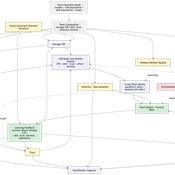
Taseer Salahuddin Hasan Vergil Muhammad Abdullah Yasser | Published Saturday, August 08, 2026This is a NetLogo 7.0.1 agent-based model of interdependent team productivity under O-ring production logic. The model asks when collective problem-solving capacity (CPS) improves team output and when its effect is constrained by trust, burnout, specialization diversity, weak-link quality, and team-formation rules. Agents are heterogeneous in skill, CPS, trust, burnout, effort, learning rate, openness, specialization, adaptability, and aspiration. Each tick forms temporary teams, computes individual contribution quality, combines contributions through a geometric O-ring production function with an explicit weakest-link term, records output and success, and updates agents through feedback, learning, trust change, burnout, recovery, and turnover. The paper follows the ODD protocol, reports exact implementation equations, and analyzes six BehaviorSpace experiments with 50 stochastic repetitions per condition. Scenario results show that CPS is beneficial but not sufficient: productivity is highest when CPS is combined with trust, low burnout, effective coordination, and a reliable weakest-link floor. Diversity yields only modest gains at low CPS but larger gains when CPS is high. Formation-mode results are especially informative because mixed CPS-skill formation maximizes total output, whereas random formation has the highest binary success rate, showing that output magnitude and threshold success can diverge. The study contributes a transparent computational mechanism linking collective intelligence with O-ring production and identifies boundary conditions under which high-CPS teams can still be limited by weak links and interdependence.
One Signal, Many Feeds: An Empirical-Response Agent-Based Model of Coordination Failure in Algorithmic Creator Discovery
Haocheng Wang | Published Thursday, August 06, 2026An empirical-response agent-based model of how many personalized feeds execute a shared low-exposure creator-discovery objective. Built from the KuaiRec dataset: the big interaction matrix initializes a transparent rank-8 matrix-factorization platform learner and the activity schedule, while the near-complete small matrix returns observed viewing responses only after a user-video pair is exposed. Four exploration policies (synchronous low-exposure targeting, uniform exploration, per-user random tie-breaking, capacity-balanced coordination) are compared over 28 rounds at a nominal 10% exploration budget, across 30 paired seeds (core) and 10 paired seeds (bias-only probe), with slot-level redundancy, cross-user collision, and coverage diagnostics.
This release accompanies an anonymised manuscript under review at the Journal of Artificial Societies and Social Simulation.
The model represents 1,411 users, 3,327 videos, 2,031 authors, and an adaptive platform over 28 discrete rounds derived from the KuaiRec big-matrix activity calendar. Exploration policies differ only in how a fixed 10% slot budget is allocated; all policies share the opportunity schedule, response oracle, initial checkpoints, and online update rule.
Archive contents: analysis pipeline scripts (01-16), frozen machine-readable protocols with input hashes, initial model checkpoints, aggregate result tables, the complete ODD protocol record, and publication figures. Raw KuaiRec files are not redistributed; obtain them from the official dataset repository and verify against the input hashes in data_contract/. Row-level oracle tables are excluded by design.
…
Asymmetric Demographic Hysteresis in a Spatial Agent-Based Urban System
Chen Shen | Published Friday, July 24, 2026This paper develops a spatial agent-based model to examine how fertility regime shifts reshape population concentration and wealth distribution in an abstract urban system. Migration decisions combine population preference, cultural homophily, expected net income, and resource endowment through a standardised softmax utility. The design is deliberately stylised: it is not calibrated to a particular country or city system, but is intended to isolate the feedbacks linking migration, fertility, urban scaling, and accumulated wealth.
The simulations reveal robust directional asymmetry. When fertility shifts from low to high, population concentration responds rapidly; when fertility shifts from high to low, concentration declines only after a detectable delay and may temporarily continue in the previous direction. Wealth adds a second layer of hysteresis: cell total-wealth concentration follows population concentration with delay, cell mean-wealth inequality and system-level wealth indicators are slower still, and phase-space trajectories form loops rather than collapsing onto a single population–wealth curve. Robustness experiments indicate that longer fertility cycles, wider mobility neighbourhoods, and smoother resource landscapes change the magnitude of delay and overshoot, but do not remove the qualitative asymmetry. The paper argues that demographic decline should be understood not as the mirror image of demographic expansion, but as a path-dependent transition mediated by fast migration-income feedbacks and slower fertility, cohort, culture, and wealth mechanisms.
AAAPS: AI-Augmented Academic Performance Simulation
Tuul Triyason | Published Wednesday, July 22, 2026Agent-based model simulating 60 undergraduate CS students over 8 semesters to investigate how differential AI tool access affects academic inequality, performance distributions, and dependency formation. Implements a three-phase AI dependency mechanism (effort reduction, metacognitive miscalibration, capability erosion) under five policy scenarios with a 4,050-run parameter sensitivity sweep.
Fragile, Resilient, Asymmetric: An Agent-Based Stress Test of European Cooperation under Geopolitical Shocks (2024-2040)
Alessandro Brugnoletti | Published Thursday, July 16, 2026An empirically calibrated agent-based model of cooperation among 14 EU member states. Adaptive state-agents update their cooperation propensity through behavioural inertia, influence along the observed intra-EU trade network (IMF bilateral flows), and repeated-game payoff indicators built from verified Eurostat, Eurobarometer and IMF data (2021-2024). An anchored logistic mapping makes the observed configuration stationary in the absence of shocks, so outcomes read as deviations from the empirical baseline. The model stress-tests European cooperation to 2040 under five scenarios of increasing severity, from a baseline to a Taiwan Strait crisis counterfactual, with 1,000 Monte Carlo replications and a full sensitivity suite (one-factor-at-a-time, joint parameter sampling, breaking-point analysis, alternative functional form). Documented with the ODD protocol; self-testing and fully reproducible under fixed seeds.
An Agent-Based Model of Saving under Quasi-Hyperbolic Discounting on a Social Network.
Jose Alejandro Velazquez Monzon | Published Wednesday, June 24, 2026An agent-based model of saving and dissaving behaviour under quasi-hyperbolic (β–δ) discounting. Building on the individual decision problem of Cao and Werning (2018), the model embeds present-biased agents in a Watts–Strogatz small-world network and adds three configurable mechanisms of social influence — information diffusion, peer comparison, and social-norm conformity — across five heterogeneous behavioural profiles (Planners, Moderates, Procrastinators, Inverse Procrastinators, and Impulsive agents).
Each profile’s saving policy is approximated by value-function iteration over a discretised wealth grid; the solved policies are cached and applied as agents interact over their network neighbourhoods. The model tests whether each social mechanism can alter the saving and wealth trajectories that present-biased agents would otherwise follow in isolation, and characterises the direction and size of each effect on median wealth, wealth inequality (Gini), and the incidence of severely depleted agents.
The deposit includes the core model (Model.py), an analysis and visualisation pipeline (analyze_results.py), a standalone ODD description (ODD.md), and pinned dependencies.
MASTOC-LLM (Multi-Agent System Tragedy of the Commons - Large Language Models)
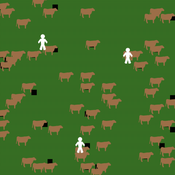
Thomas Tuoti | Published Monday, May 18, 2026 | Last modified Tuesday, May 19, 2026MASTOC-LLM extends the classic Multi-Agent System Tragedy of the Commons (MASTOC) model by replacing hard-coded behavioral rules with autonomous decision-making powered by large language models (LLMs). Three heterogeneous agents manage herds of cows on a shared grassland commons. Each tick, an agent receives a structured prompt describing current resource levels, its own herd size, peer behavior, and — optionally — a rolling memory of recent rounds and messages from neighboring agents. The LLM returns a stocking decision (add, remove, or hold cows) together with a natural-language rationale and, when communication is enabled, a short message to broadcast to peers.
The model is designed to test whether LLM agents spontaneously develop Ostrom-style common-pool resource governance (mutual monitoring, graduated sanctions, graduated rule revision) or instead fall into identifiable failure modes. Preliminary experiments with Claude Haiku 4.5, GPT-5.4-mini, and DeepSeek R1:32b have revealed four recurring collapse patterns — Cooperative Paralysis, Defection Cascade, Overshoot-Panic, and Hybrid Architecture Failure — whose onset timing is sensitive to memory length, inter-agent communication, and the post-training alignment approach of the underlying model.
MASTOC-LLM is intended as a laboratory for generative agent-based modelling (GABM) methodology: it provides a clean, well-understood commons baseline against which LLM behavioral hypotheses can be systematically tested and compared across models, parameter sweeps, and alignment regimes.
Displaying 10 of 131 results Python clear search