Our mission is to help computational modelers develop, document, and share their computational models in accordance with community standards and good open science and software engineering practices. Model authors can publish their model source code in the Computational Model Library with narrative documentation as well as metadata that supports open science and emerging norms that facilitate software citation, computational reproducibility / frictionless reuse, and interoperability. Model authors can also request private peer review of their computational models. Models that pass peer review receive a DOI once published.
All users of models published in the library must cite model authors when they use and benefit from their code.
Please check out our model publishing tutorial and feel free to contact us if you have any questions or concerns about publishing your model(s) in the Computational Model Library.
Displaying 10 of 1258 results for "Ian M Hamilton" clear search
Peer reviewed An agent-based simulation model of pedestrian evacuation based on Bayesian Nash Equilibrium
Jiaqi Ge Yiyu Wang Alexis Comber | Published Wednesday, July 06, 2022This ABM aims to introduce a new individual decision-making model, BNE into the ABM of pedestrian evacuation to properly model individual behaviours and motions in emergency situations. Three types of behavioural models has been developed, which are Shortest Route (SR) model, Random Follow (RF) model, and BNE model, to better reproduce evacuation dynamics in a tunnel space. A series of simulation experiments were conducted to evaluate the simulating performance of the proposed ABM.
The role of argument strength and informational biases in polarization and bipolarization effects
Davide Chiarella Carlo Proietti | Published Thursday, March 30, 2023The model explores the informational causes of polarization and bi-polarization of opinions in groups. To this end it expands the model of the Argument Communication Theory of Bi-polarization. The latter is an argument-based multi-agent model of opinion dynamics inspired by Persuasive Argument Theory. The original model can account for polarization as an outcome of pure informational influence, and reproduces bi-polarization effects by postulating an additional mechanism of homophilous selection of communication partners. The expanded model adds two dimensions: argument strength and more sophisticated protocols of informational influence (argument communication and opinion update).
Simulation Experiments of "The dynamics of corruption under an optional external supervision service"
Xin Zhou | Published Wednesday, June 21, 2023The simulation experiment is for studying the influence of external supervision services on combating corruption.
Algorithm: evolutionary game theory
ABM Code: Locating Cultural Holes Brokers in Diffusion Dynamics across Bright Symbolic Boundaries
Diego Leal | Published Thursday, January 23, 2025The code and data in this repository are associated with the article titled:
Leal, Diego F. 2025. “Locating Cultural Holes Brokers in Diffusion Dynamics across Bright Symbolic Boundaries.” Sociological Methods & Research OnlineFirst https://doi.org/10.1177/00491241251322517
The NetLogo code (version 6.4.0) is designed to be a standalone piece of code although it uses the ‘nw’ and ‘matrix’ extensions that come integrated with NetLogo 6.4.0. The code was ran on a Windows 10 x 64 machine.
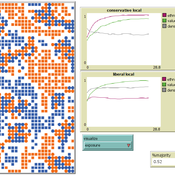
Peer reviewed Beyond Ethnicity: Intersectionality, Preferences, and the Emergence of Hybrid Segregation in Schelling model
Rocco Paolillo Andreas Flache | Published Tuesday, August 18, 2026Diversity has become a defining feature of most Western societies, where boundaries of membership extend beyond ethnicity to encompass multiple intersecting categories, increasing the complexity of social integration. The aim of this model is to adapt the classical Schelling model of spatial segregation to this context and to identify mechanisms that may generate the hybrid segregation patterns where individuals are segregated from out-groups along one dimension while remaining integrated along others.
We extend the Schelling model using a discrete choice framework that incorporates dominant and secondary preferences among agents from two ethnic groups. Liberal agents prioritize cross-ethnic shared values over ethnicity, whereas conservative agents prioritize ethnic membership over shared values, although both retain some preference for the secondary dimension. The model is designed to explore how heterogeneous preferences and intersecting group memberships interact under different group compositions and initial distributions.
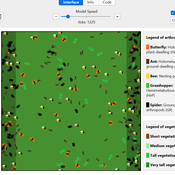
Modelling the effects of mowing regimes on arthropod abundance in grasslands of Lüneburg
Johanna Augustin Joanna-173 | Published Tuesday, August 25, 2026This NetLogo model simulates the impact of mowing frequency, mower type and the percentage of refuge strips on the abundance of arthropods in managed grasslands. It represents five functional arthropod groups: holometabolous plant-dwelling arthropods (HoP, represented by butterflies); holometabolous ground-dwelling arthropods (HoG, represented by ants); nesting pollinators (NP, represented by bees); hemimetabolous plant-dwelling arthropods (HeP, represented by grasshoppers); and ground-resident arthropods (GR, represented by spiders). Three mowing frequencies are simulated: intensive (four mowings per year), intermediate (two mowings per year) and extensive (one mowing per year). Bar and disc mowers differ in their effects on arthropod mortality and vegetation height. Refuge strip coverage can be set to 0%, 10% or 20%. Arthropod abundance changes over time through movement, reproduction, natural mortality, mower-related mortality and vegetation regrowth.
An agent-based model to study the effects of urban sprawl on bird distribution
Yun Ouyang | Published Tuesday, December 16, 2008 | Last modified Saturday, April 27, 2013This model was programmed for a class project, which studied the effects of urban sprawl on bird distribution. For the urban sprawl part of the model, we started from the model in (udhira, H. S., 200
An agent based simulation and data mining framework for scenario analysis of technology products
Moeed Haghnevis | Published Monday, December 13, 2010 | Last modified Saturday, April 27, 2013The objective of this study is to create a framework to simulate and analyze the effect of multiple business scenarios on the adoption behavior of a group of technology products.
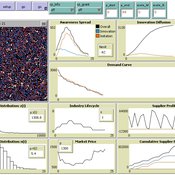
(Policy induced) Diffusion of Innovations - An integrated demand-supply Model based on Cournot Competition
Martin Rixin | Published Monday, August 29, 2011 | Last modified Saturday, April 27, 2013Objective is to simulate policy interventions in an integrated demand-supply model. The underlying demand function links both sides. Diffusion proceeds if interactions distribute awareness (Epidemic effect) and rivalry reduces the market price (Probit effect). Endogeneity is given due to the fact that consumer awareness as well as their willingness-to-pay drives supply-side rivalry. Firm´s entry and exit decisions as well as quantity and price settings are driven by Cournot competition.
Enhancing recycling of construction materials; an agent based model with empirically based decision parameters
Igor Nikolic Claudia Binder Christof Knoeri Hans-Joerg Althaus | Published Sunday, October 21, 2012 | Last modified Monday, June 09, 2014This model allows for analyzing the most efficient levers for enhancing the use of recycled construction materials, and the role of empirically based decision parameters.
Displaying 10 of 1258 results for "Ian M Hamilton" clear search