Our mission is to help computational modelers develop, document, and share their computational models in accordance with community standards and good open science and software engineering practices. Model authors can publish their model source code in the Computational Model Library with narrative documentation as well as metadata that supports open science and emerging norms that facilitate software citation, computational reproducibility / frictionless reuse, and interoperability. Model authors can also request private peer review of their computational models. Models that pass peer review receive a DOI once published.
All users of models published in the library must cite model authors when they use and benefit from their code.
Please check out our model publishing tutorial and feel free to contact us if you have any questions or concerns about publishing your model(s) in the Computational Model Library.
Displaying 10 of 138 results for "Francesco Scalone" clear search
Chiefdoms and Structural Resilience to Stress
Wendy Cegielski | Published Monday, December 13, 2010 | Last modified Saturday, April 27, 2013Original model of chiefdom modeled in terms of a hierarchical, scale-free network

A-KinGDom: A Kinship, Grooming and Dominance Model for Primate Societies
Ruth Dolado Francesc S Beltran Vicenc Quera | Published Thursday, July 11, 2013 | Last modified Wednesday, July 17, 2013A-KinGDom simulates the emergence of the social structure in a group of non-human primates. The model includes dominance and affiliative interactions which allow us to define four different attack and affiliative strategies.
Mikania micrantha control in western Chitwan community forests
Jie Dai | Published Thursday, August 20, 2020This model simulates the household participation in large-scale M. micrantha intervention campaigns and the response of M. micrantha to the intervention.
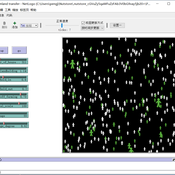
An Agent-based Model of Farmland Transfer (Version 1.0.0)
Peng Jiang Hang Xiong | Published Wednesday, August 11, 2021This is model that explores how a few farmers in a Chinese village, where all farmers are smallholders originally, reach optimal farming scale by transferring in farmland from other farmers in the context of urbanization and aging.
Peer reviewed Egalitarian sharing
Marcos Pinheiro | Published Friday, January 27, 2023The model explores food distribution patterns that emerge in a small-scale non-agricultural group when individuals follow a set of spatially explicit sharing interaction rules derived from a theory on the evolution of the egalitarian social instinct.
Sensitivity of the Deffuant model to measurement error
Dino Carpentras | Published Monday, June 07, 2021This code can be used to analyze the sensitivity of the Deffuant model to different measurement errors. Specifically to:
- Intrinsic stochastic error
- Binning of the measurement scale
- Random measurement noise
- Psychometric distortions
…

cluster analysis
Lars Spång | Published Tuesday, November 07, 2017This model demonstrates how to illustrate a cluster pattern by counting turtles within i moving circle with a specified radius. The procedure is common in archaeological spatial analysis.
Bicycle model
Dana Kaziyeva Gudrun Wallentin Martin Loidl | Published Thursday, January 10, 2019 | Last modified Monday, February 22, 2021The purpose of the model is to generate the spatio-temporal distribution of bicycle traffic flows at a regional scale level. Disaggregated results are computed for each network segment with the minute time step. The human decision-making is governed by probabilistic rules derived from the mobility survey.
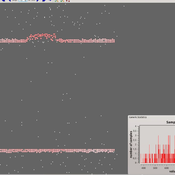
Gunpowder battle tactics
Xavier Rubio-Campillo Jose María Cela Francesc Xavier Hernàndez | Published Wednesday, November 20, 2013 | Last modified Tuesday, November 26, 2013This model simulates the dynamics of eighteenth-century infantry battle tactics. The goal is to explore the effect of different tactics and individual traits in the dynamics of the combat.
Scientific Collaboration and Knowledge Production
sciknowledgeprod | Published Wednesday, November 04, 2026A holistic, agent-based model of scientific knowledge production to simulate large-scale collaborative research processes. The model represents the scientific process as a stochastic, cooperative task-completion game where agents repeatedly collaborate on projects that can yield publications.
The model is implemented in Python as an environment in the popular Gymnasium reinforcement learning library.
Displaying 10 of 138 results for "Francesco Scalone" clear search