Our mission is to help computational modelers develop, document, and share their computational models in accordance with community standards and good open science and software engineering practices. Model authors can publish their model source code in the Computational Model Library with narrative documentation as well as metadata that supports open science and emerging norms that facilitate software citation, computational reproducibility / frictionless reuse, and interoperability. Model authors can also request private peer review of their computational models. Models that pass peer review receive a DOI once published.
All users of models published in the library must cite model authors when they use and benefit from their code.
Please check out our model publishing tutorial and feel free to contact us if you have any questions or concerns about publishing your model(s) in the Computational Model Library.
Displaying 10 of 461 results for "Therese Lindahl" clear search
MixFarm ABM Model
Leigh Anderson | Published Thursday, March 03, 2016MixFarmABM Model examines the competitiveness of second-generation biofuel crops with existing crops and beef cows at the farm level and their impact on the farm structure.
Genetic Algorithm and Food Choice
Diego Martín Díaz Córdova | Published Monday, August 10, 2026This models simulate how people choose their food buyings based on a limited budget and a food quality index. In order to make the choice the agents call a genetic algorithm who optimizes the buying. The agents are distributed randomly and there are 5 store options where agents can buy meat, fruits and vegetables, bread, ultraprocessed and medications. Agents need all of them, each of one has a different price and a different quality index. The genetic algorithm perform an optimization procedure in order to clasiffy what food set is the best for each agent. The agents are coloured based on their budget if the’ve got less than 100, then they are pink otherwise they are white.
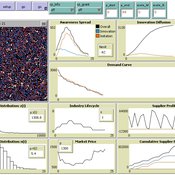
(Policy induced) Diffusion of Innovations - An integrated demand-supply Model based on Cournot Competition
Martin Rixin | Published Monday, August 29, 2011 | Last modified Saturday, April 27, 2013Objective is to simulate policy interventions in an integrated demand-supply model. The underlying demand function links both sides. Diffusion proceeds if interactions distribute awareness (Epidemic effect) and rivalry reduces the market price (Probit effect). Endogeneity is given due to the fact that consumer awareness as well as their willingness-to-pay drives supply-side rivalry. Firm´s entry and exit decisions as well as quantity and price settings are driven by Cournot competition.
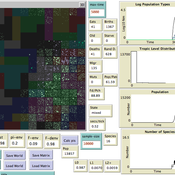
A test-bed ecological model
Bruce Edmonds | Published Sunday, May 04, 2014 | Last modified Wednesday, May 15, 2019This is a multi-patch meta-population ecological model. It intended as a test-bed in which to test the impact of humans with different kinds of social structure.
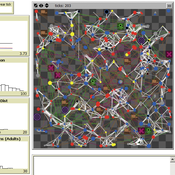
A Complex Model of Voter Turnout
Bruce Edmonds Laurence Lessard-Phillips Ed Fieldhouse | Published Monday, October 13, 2014 | Last modified Tuesday, August 18, 2015This is a complex “Data Integration Model”, following a “KIDS” rather than a “KISS” methodology - guided by the available evidence. It looks at the complex mix of social processes that may determine why people vote or not.

How to not get stuck – an ant model showing how negative feedback due to crowding maintains flexibility in ant foraging
Tomer Czaczkes | Published Thursday, December 17, 2015Positive feedback can lead to “trapping” in local optima. Adding a simple negative feedback effect, based on ant behaviour, prevents this trapping
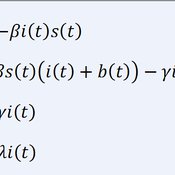
Product Diffusion Model in an Advance Selling Strategy
Peng Shao | Published Tuesday, March 15, 2016 | Last modified Tuesday, March 15, 2016the model can be used to describe the product diffusion in an Advance Selling Strategy. this model takes into account the consumers product adoption, and describe consumer’s online behavior based on four states.
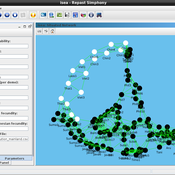
Modeling Asian-Papuan Admixture during the Neolithic Expansion across Island Southeast Asia
Murray Cox François Vallée | Published Friday, December 09, 2016This Repast Simphony model simulates genomic admixture during the farming expansion of human groups from mainland Asia into the Papuan dominated islands of Southeast Asia during the Neolithic period.
Peer reviewed Evolution of Sex
Kristin Crouse | Published Sunday, June 05, 2016 | Last modified Wednesday, February 18, 2026Evolution of Sex is a NetLogo model that illustrates the advantages and disadvantages of sexual and asexual reproductive strategies. It seeks to demonstrate the answer to the question “Why do we have sex?”
Contract farming in the Mekong Delta's rice supply chain
Hung Nguyen | Published Tuesday, February 05, 2019We study three obstacles of the expansion of contract rice farming in the Mekong Delta (MKD) region. The failure of buyers in building trust-based relationship with small-holder farmers, unattractive offered prices from the contract farming scheme, and limited rice processing capacity have constrained contractors from participating in the large-scale paddy field program. We present an agent-based model to examine the viability of contract farming in the region from the contractor perspective.
The model focuses on financial incentives and trust, which affect the decision of relevant parties on whether to participate and honor a contract. The model is also designed in the context of the MKD’s rice supply chain with two contractors engaging in the contract rice farming scheme alongside an open market, in which both parties can renege on the agreement. We then evaluate the contractors’ performances with different combinations of scenarios related to the three obstacles.
Our results firstly show that a fully-equipped contractor who opportunistically exploits a relatively small proportion (less than 10%) of the contracted farmers in most instances can outperform spot market-based contractors in terms of average profit achieved for each crop. Secondly, a committed contractor who offers lower purchasing prices than the most typical rate can obtain better earnings per ton of rice as well as higher profit per crop. However, those contractors in both cases could not enlarge their contract farming scheme, since either farmers’ trust toward them decreases gradually or their offers are unable to compete with the benefits from a competitor or the spot market. Thirdly, the results are also in agreement with the existing literature that the contract farming scheme is not a cost-effective method for buyers with limited rice processing capacity, which is a common situation among the contractors in the MKD region.
Displaying 10 of 461 results for "Therese Lindahl" clear search