Our mission is to help computational modelers develop, document, and share their computational models in accordance with community standards and good open science and software engineering practices. Model authors can publish their model source code in the Computational Model Library with narrative documentation as well as metadata that supports open science and emerging norms that facilitate software citation, computational reproducibility / frictionless reuse, and interoperability. Model authors can also request private peer review of their computational models. Models that pass peer review receive a DOI once published.
All users of models published in the library must cite model authors when they use and benefit from their code.
Please check out our model publishing tutorial and feel free to contact us if you have any questions or concerns about publishing your model(s) in the Computational Model Library.
Displaying 10 of 50 results for "Francisco Jose Vazquez" clear search
A preliminary extension of the Hemelrijk 1996 model of reciprocal behavior to include feeding
Sean Barton | Published Monday, December 13, 2010 | Last modified Saturday, April 27, 2013A more complete description of the model can be found in Appendix I as an ODD protocol. This model is an expansion of the Hemelrijk (1996) that was expanded to include a simple food seeking behavior.
PFS - Preference Falsification Simulation (PreFalSim)
Francisco J Miguel Francisco J. León-Medina Jordi Tena-Sanchez | Published Monday, July 01, 2019A model for simulating the evolution of individual’s preferences, incliding adaptive agents “falsifying” -as public opinions- their own preferences. It was builded to describe, explore, experiment and understand how simple heuristics can modulate global opinion dynamics. So far two mechanisms are implemented: a version of Festiguer’s reduction of cognitive disonance, and a version of Goffman’s impression management. In certain social contexts -minority, social rank presure- some models agents can “fake” its public opinion while keeping internally the oposite preference, but after a number of rounds following this falsifying behaviour pattern, a coherence principle can change the real or internal preferences close to that expressed in public.
PR-M: The Peer Review Model
Mario Paolucci Francisco Grimaldo | Published Sunday, November 10, 2013 | Last modified Wednesday, July 01, 2015This is an agent-based model of peer review built on the following three entities: papers, scientists and conferences. The model has been implemented on a BDI platform (Jason) that allows to perform both parameter and mechanism exploration.
Endogenous changes in public opinion dynamics
Francisco J. León-Medina | Published Tuesday, June 05, 2018The model formalizes a situation where agents embedded in different types of networks (random, small world and scale free networks) interact with their neighbors and express an opinion that is the result of different mechanisms: a coherence mechanism, in which agents try to stick to their previously expressed opinions; an assessment mechanism, in which agents consider available external information on the topic; and a social influence mechanism, in which agents tend to approach their neighbor’s opinions.
PSMED - Patagonia Simple Model of Ethnic Differentiation
Xavier Vilà Joan A Barceló J A Cuesta Florencia Del Castillo Ricardo Del Olmo José M Galán Laura Mameli Francisco J Miguel David Poza José I Santos | Published Tuesday, December 10, 2013Patagonia PSMED is an agent-based model designed to study a simple case of Evolution of Ethnic Differentiation. It replicates how can hunter-gatherer societies evolve and built cultural identities as a consequence of the way they interacted.
Livestock drought insurance model
Birgit Müller Felix John Jürgen Groeneveld Karin Frank Russell Toth | Published Tuesday, December 19, 2017 | Last modified Saturday, April 14, 2018The model analyzes the economic and ecological effects of a provision of livestock drought insurance for dryland pastoralists. More precisely, it yields qualitative insights into how long-term herd and pasture dynamics change through insurance.
A Simple Agent Based Modeling Tool for Plastic and Debris Tracking in Oceans
Subu Kandaswamy Koushik Sura Bhaskar Sai Amulya Murukutla Sai Pranay Raju Chinthala Abhishek Bobbillapati | Published Monday, October 04, 2021Plastics and the pollution caused by their waste have always been a menace to both nature and humans. With the continual increase in plastic waste, the contamination due to plastic has stretched to the oceans. Many plastics are being drained into the oceans and rose to accumulate in the oceans. These plastics have seemed to form large patches of debris that keep floating in the oceans over the years. Identification of the plastic debris in the ocean is challenging and it is essential to clean plastic debris from the ocean. We propose a simple tool built using the agent-based modeling framework NetLogo. The tool uses ocean currents data and plastic data both being loaded using GIS (Geographic Information System) to simulate and visualize the movement of floatable plastic and debris in the oceans. The tool can be used to identify the plastic debris that has been piled up in the oceans. The tool can also be used as a teaching aid in classrooms to bring awareness about the impact of plastic pollution. This tool could additionally assist people to realize how a small plastic chunk discarded can end up as large debris drifting in the oceans. The same tool might help us narrow down the search area while looking out for missing cargo and wreckage parts of ships or flights. Though the tool does not pinpoint the location, it might help in reducing the search area and might be a rudimentary alternative for more computationally expensive models.
epiworldR Type: Fast Agent-Based Epi Models
George G. Vega Yon Derek Meyer | Published Monday, August 26, 2024A flexible framework for Agent-Based Models (ABM), the ‘epiworldR’ package provides methods for prototyping disease outbreaks and transmission models using a ‘C++’ backend, making it very fast. It supports multiple epidemiological models, including the Susceptible-Infected-Susceptible (SIS), Susceptible-Infected-Removed (SIR), Susceptible-Exposed-Infected-Removed (SEIR), and others, involving arbitrary mitigation policies and multiple-disease models. Users can specify infectiousness/susceptibility rates as a function of agents’ features, providing great complexity for the model dynamics. Furthermore, ‘epiworldR’ is ideal for simulation studies featuring large populations.
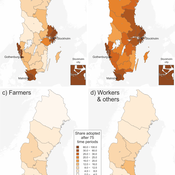
Communication and social change in space and time
Sebastian Kluesener Francesco Scalone Martin Dribe | Published Tuesday, May 17, 2016 | Last modified Friday, October 13, 2017This agent-based model simulates the diffusion of a social change process stratified by social class in space and time which is solely driven social and spatial variation in communication links.
Peer reviewed STiMUS-HAI: A Stigmergic–Mutualistic Agent-Based Model of Human-AI Collaboration on Shared Digital Artefacts
Yevgeny Patarakin | Published Monday, July 13, 2026 | Last modified Thursday, August 20, 2026STiMUS-HAI (Stigmergic–Mutualistic IMOI Model, Human-AI extension) is an agent-based model of teamwork in socio-technical systems where human and AI contributors collaborate through shared digital artefacts — wiki pages, code files, issue tickets, project cards, Scratch projects — represented as patches in a NetLogo world. It extends the human-only base model STiMUS v2.2, which established that two coordination mechanisms — stigmergy (indirect coordination through traces left in the environment) and mutualism (mutual benefit between contributors and the artefacts they tend) — can be decoupled: stigmergy decides where a contributor works, mutualism decides with what effort. STiMUS-HAI preserves this decoupling unchanged and adds two further theoretical questions: whether mixing AI agents into a human team distorts human coordination in ways that aggregate indicators hide, and whether AI’s cost to team outcomes depends on the type of work AI performs, not only on how much of it is present.
Two breeds of turtle — humans and ai-agents — follow identical target-selection, pheromone, and mutualism rules, so that any behavioural difference is attributable to team composition rather than a built-in advantage. The one designed asymmetry: AI agents never accumulate shared-mental-model and their motivation is fixed rather than adaptive. On top of this v3.0 baseline, v3.1 adds a task-type dimension to artefacts (“prediction” versus “judgment”, set via a judgment-share slider) that scales down AI edit-power specifically on judgment-requiring artefacts, and an ai-trust mechanic: humans build or lose trust in AI contributions based on the population-relative percentile rank of observed AI work quality (bottom-quartile work counts as an observed “error”), and that trust gates how much mutualistic benefit a human derives from continuing an AI’s work. Trust erodes quickly on a single error and recovers only after a streak of confirmed successes — an intentional asymmetry.
Displaying 10 of 50 results for "Francisco Jose Vazquez" clear search