Our mission is to help computational modelers develop, document, and share their computational models in accordance with community standards and good open science and software engineering practices. Model authors can publish their model source code in the Computational Model Library with narrative documentation as well as metadata that supports open science and emerging norms that facilitate software citation, computational reproducibility / frictionless reuse, and interoperability. Model authors can also request private peer review of their computational models. Models that pass peer review receive a DOI once published.
All users of models published in the library must cite model authors when they use and benefit from their code.
Please check out our model publishing tutorial and feel free to contact us if you have any questions or concerns about publishing your model(s) in the Computational Model Library.
Displaying 10 of 140 results for "Edward L Boone" clear search
Activation Regimes in Opinion Dynamics
Meysam Alizadeh Claudio Cioffi-Revilla | Published Tuesday, September 01, 2015We compare the effect of four activation regimes by measuring the appropriate opinion clustering statistics and also the number of emergent extremists.
Simulating the evolution of the human family
Paul Smaldino | Published Wednesday, November 29, 2017The (cultural) evolution of cooperative breeding in harsh environments.
Resisting hostility
Sylvie Huet | Published Thursday, December 20, 2018We propose an agent-based model leading to a decrease or an increase of hostility between agents after a major cultural threat such as a terrorist attack. The model is inspired from the Terror Management Theory and the Social Judgement Theory. An agent has a cultural identity defined through its acceptance segments about each of three different cultural worldviews (i.e., Atheist, Muslim, Christian) of the considered society. An agent’s acceptance segment is composed from its acceptable positions toward a cultural worldview, including its most acceptable position. An agent forms an attitude about another agent depending on the similarity between their cultural identities. When a terrorist attack is perpetrated in the name of an extreme cultural identity, the negatively perceived agents from this extreme cultural identity point of view tend to decrease the width of their acceptance segments in order to differentiate themselves more from the threatening cultural identity
Exploring Transitions towards Sustainable Construction
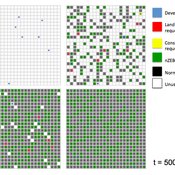
César García-Díaz Jesus Rosales-Carreon | Published Wednesday, October 30, 2013 | Last modified Saturday, January 31, 2015This model illustrates actor interaction in the construction sector, according to information gathered in NL. It offers a simple frame to represent diverse interests, interdependencies and effects on the number of built sustainable houses.
Inquisitiveness in ad hoc teams
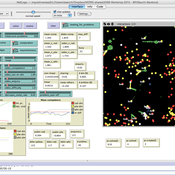
Davide Secchi | Published Sunday, October 18, 2015 | Last modified Thursday, June 11, 2020This model builds on inquisitiveness as a key individual disposition to expand the bounds of their rationality. It represents a system where teams are formed around problems and inquisitive agents integrate competencies to find ‘emergent’ solutions.
An agent-based model of cultural change for a low-carbon transition
Daniel Torren-Peraire | Published Friday, November 10, 2023An ABM of changes in individuals’ lifestyles which considers their
evolving behavioural choices. Individuals have a set of environmental behavioural traits that spread through a fixed Watts–Strogatz graph via social interactions with their neighbours. These exchanges are mediated by transmission biases informing from whom an individual learns and
how much attention is paid. The influence of individuals on each other is a function of their similarity in environmental identity, where we represent environmental identity computationally by aggregating past agent attitudes towards multiple environmentally related behaviours. To perform a behaviour, agents must both have
a sufficiently positive attitude toward a behaviour and overcome a corresponding threshold. This threshold
structure, where the desire to perform a behaviour does not equal its enactment, allows for a lack of coherence
between attitudes and actual emissions. This leads to a disconnect between what people believe and what
…
When Contact Backfires, and When It Does Not: A Computational Model of the Opinion Dynamics of Intergroup Attitudes
Yade Rotte Andreas Flache Alla Loseva | Published Wednesday, October 14, 2026This model represents individuals from two different groups interacting and sharing attitudes toward both groups. Through these interactions, individuals adjust their attitudes, which can lead to different outcomes in opinion dynamics. The model can study both intra-group and inter-group opinion dynamics. Under certain conditions, agents with initially moderate attitudes might enter a negative spiral, leading to increasingly extreme intergroup attitudes. Alternatively, these moderate attitudes can foster consensus between groups, resulting in agreement on intergroup attitudes. This model serves as a tool for exploring opinion polarization, particularly in contexts where attitudes evolve through interaction rather than remaining static.
By adjusting different parameters, one can examine the effects of variations in attitude distributions; group size and relative group size; contributions of xenophobia, opinion distance, and individual attitudes towards the outgroup; as well as ratio between xenophobia and attitudinal bias to the overall intergroup bias.
The model accompanies the paper When contact backfires, and when it does not: A computational model of the opinion dynamics of intergroup attitudes.
Parental choices, children's skills, and skill inequality: An agent-based model implemented in Python
Andrés Cardona | Published Thursday, October 30, 2014The model explores the emergence of inequality in cognitive and socio-emotional skills at the societal level within and across generations that results from differences in parental investment behavior during childhood and adolescence.
Transitions between homophilic and heterophilic modes of cooperation
Genki Ichinose | Published Sunday, June 14, 2015 | Last modified Sunday, November 14, 2021In our model, individual agents are distributed over a two-dimensional square lattice. The agents play the prisoner’s dilemma game with their neighbors, imitate the highest strategy, and then migrate to empty sites based on their tag preference.
Peer reviewed Lethal Geometry
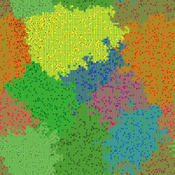
Kristin Crouse | Published Friday, February 21, 2020 | Last modified Wednesday, December 15, 2021LethalGeometry was developed to examine whether territory size influences the mortality risk for individuals within that territory. For animals who live in territoral groups and are lethally aggressive, we can expect that most aggression occurs along the periphery (or border) between two adjacent territories. For territories that are relatively large, the periphery makes up a proportionately small amount of the of the total territory size, suggesting that individuals in these territories might be less likely to die from these territorial skirmishes. LethalGeometry examines this geometric relationship between territory size and mortality risk under realistic assumptions of variable territory size and shape, variable border width, and stochastic interactions and movement.
The individuals (agents) are programmed to walk randomly about their environment, search for and eat food to obtain energy, reproduce if they can, and act aggressively toward individuals of other groups. During each simulation step, individuals analyze their environment and internal state to determine which actions to take. The actions available to individuals include moving, fighting, and giving birth.
Displaying 10 of 140 results for "Edward L Boone" clear search