Our mission is to help computational modelers develop, document, and share their computational models in accordance with community standards and good open science and software engineering practices. Model authors can publish their model source code in the Computational Model Library with narrative documentation as well as metadata that supports open science and emerging norms that facilitate software citation, computational reproducibility / frictionless reuse, and interoperability. Model authors can also request private peer review of their computational models. Models that pass peer review receive a DOI once published.
All users of models published in the library must cite model authors when they use and benefit from their code.
Please check out our model publishing tutorial and feel free to contact us if you have any questions or concerns about publishing your model(s) in the Computational Model Library.
Displaying 10 of 104 results for "Caroline Schill" clear search
LaMEStModel
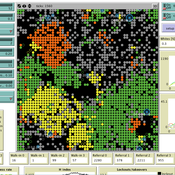
Ruth Meyer | Published Friday, October 12, 2018The Labour Markets and Ethnic Segmentation (LaMESt) Model is a model of a simplified labour market, where only jobs of the lowest skill level are considered. Immigrants of two different ethnicities (“Latino”, “Asian”) compete with a majority (“White”) and minority (“Black”) native population for these jobs. The model’s purpose is to investigate the effect of ethnically homogeneous social networks on the emergence of ethnic segmentation in such a labour market. It is inspired by Waldinger & Lichter’s study of immigration and the social organisation of labour in 1990’s Los Angeles.
Peninsula_Iberica 1.0
Carolina Cucart-Mora Sergi Lozano Javier Fernández-López De Pablo | Published Friday, November 04, 2016 | Last modified Monday, November 27, 2017This model was build to explore the bio-cultural interaction between AMH and Neanderthals during the Middle to Upper Paleolithic Transition in the Iberian Peninsula
Incentives for data sharing
Flaminio Squazzoni Federico Bianchi Thomas Klebel Tony Ross-Hellauer | Published Thursday, October 02, 2025Although beneficial to scientific development, data sharing is still uncommon in many research areas. Various organisations, including funding agencies that endorse open science, aim to increase its uptake. However, estimating the large-scale implications of different policy interventions on data sharing by funding agencies, especially in the context of intense competition among academics, is difficult empirically. Here, we built an agent-based model to simulate the effect of different funding schemes (i.e., highly competitive large grants vs. distributive small grants), and varying intensity of incentives for data sharing on the uptake of data sharing by academic teams strategically adapting to the context.
St Anthony flu
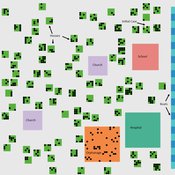
Lisa Sattenspiel | Published Monday, April 15, 2019The St Anthony flu model is an epidemiological model designed to test hypotheses related to the spread of the 1918 influenza pandemic among residents of a small fishing community in Newfoundland and Labrador. The 1921 census data from Newfoundland and Labrador are used to ensure a realistic model population; the community of St. Anthony, NL, located on the tip of the Northern Peninsula of the island of Newfoundland is the specific population modeled. Model agents are placed on a map-like grid that consists of houses, two churches, a school, an orphanage, a hospital, and several boats. They engage in daily activities that reflect known ethnographic patterns of behavior in St. Anthony and other similar communities. A pathogen is introduced into the community and then it spreads throughout the population as a consequence of individual agent movements and interactions.
A Simulation of Arab Spring Protests Informed by Qualitative Evidence
Bruce Edmonds Stephanie Dornschneider | Published Monday, April 29, 2019 | Last modified Friday, May 24, 2019The purpose of the simulation was to explore and better understand the process of bridging between an analysis of qualitative data and the specification of a simulation. This may be developed for more serious processes later but at the moment it is merely an illustration.
This exercise was done by Stephanie Dornschneider (School of Politics and International Relations, University College Dublin) and Bruce Edmonds to inform the discussion at the Lorentz workshop on “Integrating Qualitative and Quantitative Data using Social Simulation” at Leiden in April 2019. The qualitative data was collected and analysed by SD. The model specification was developed as the result of discussion by BE & SD. The model was programmed by BE. This is described in a paper submitted to Social Simulation 2019 and (to some extent) in the slides presented at the workshop.
Structural Luck: An Agent-Based Model of Workplace Career Dynamics
Yang Ou | Published Sunday, August 23, 2026Why do career outcomes in organizations follow highly skewed distributions when the individual traits presumed to drive success — competence, effort, and social skill — are approximately normally distributed in the population? This agent-based model investigates the relative contributions of individual attributes versus random events (“luck”) to career outcomes in hierarchically structured organizations.
The model places 500 agents in a five-level pyramid-shaped organization over 80 six-month evaluation periods (40 simulated years). Each agent is characterized by four attributes drawn from normal distributions at initialization: competence, effort, social skill, and adaptability. In each period, agents may encounter stochastic career events (good or bad projects, supportive or poor managers, market booms or busts), which modify their performance and visibility scores. Promotion decisions are made competitively when vacancies arise at higher levels, using a weighted combination of recent performance, accumulated visibility, network position, and tenure. Social connections form and decay through a proximity-based model influenced by agents’ social skills.
The model extends the talent-versus-luck framework of Pluchino et al. (2018) in four substantive directions: (1) it embeds agents in a hierarchical organization with finite positions at each level, making promotion a zero-sum competition rather than an abstract encounter with random events; (2) it represents individual differences along four independent attribute dimensions rather than a single talent score; (3) it incorporates dynamic social network formation that mediates access to career-relevant opportunities; and (4) it implements the Peter Principle mechanism through which promoted agents must acquire competence appropriate to their new role.
…
Modeling Arabian Upraise, a System Dynamics Approach: Egypt case study
Morteza Nazari | Published Wednesday, October 05, 2011 | Last modified Saturday, April 27, 2013A System Dynamics Model to anticipate insurgent movements and policy design to handle them .
MarPEM: An Agent Based Model to Explore the Effects of Policy Instruments on the Transition of the Maritime Fuel System
G Bas I Nikolic K De Boo Am Vaes - Van De Hulsbeek | Published Thursday, June 15, 2017MarPEM is an agent-based model that can be used to study the effects of policy instruments on the transition away from HFO.
Effective population size and cultural evolution
Luke Premo | Published Tuesday, May 17, 2016This model illustrates how the effective population size and the rate of change in mean skill level of a cultural trait are affected by the presence of natural selection and/or the cultural transmission mechanism by which it is passed.
Agent modeling (ABM) as a tool to improve the mobility of “avoidant” birds in an ecological corridor in the localities of Chapinero, Teusaquillo, Barrios Unidos and Engativá of Bogotá city [Scenario 2]
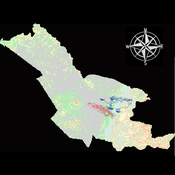
Paula Alejandra Meza | Published Thursday, June 25, 2026Considering that two of the three avoider species could not reach the target area in the inittial scenario, five alternative corridor scenarios were created. In all cases, we generated a greater amount of cover area under ‘Urban forest’, including elements such as scattered trees, woody plants, wooded areas, and rows of trees. This covered type was selected since all three species use it as a regular habitat. That is the second sceneario where those ecological parks and other areas inside the capital city were boostered into “urban forest patches” or buffer points, with the idea of improving the survive of the three bird species and their movement. However one of the most restrictive specie was still having movement and survival issues.
Displaying 10 of 104 results for "Caroline Schill" clear search