Our mission is to help computational modelers develop, document, and share their computational models in accordance with community standards and good open science and software engineering practices. Model authors can publish their model source code in the Computational Model Library with narrative documentation as well as metadata that supports open science and emerging norms that facilitate software citation, computational reproducibility / frictionless reuse, and interoperability. Model authors can also request private peer review of their computational models. Models that pass peer review receive a DOI once published.
All users of models published in the library must cite model authors when they use and benefit from their code.
Please check out our model publishing tutorial and feel free to contact us if you have any questions or concerns about publishing your model(s) in the Computational Model Library.
Displaying 10 of 97 results for "Arun Agrawal" clear search
MixFarm ABM Model
Leigh Anderson | Published Thursday, March 03, 2016MixFarmABM Model examines the competitiveness of second-generation biofuel crops with existing crops and beef cows at the farm level and their impact on the farm structure.
Agent-based model of risk behavior in adolescence
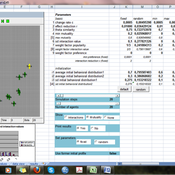
N Schuhmacher P Van Geert L Ballato | Published Monday, June 24, 2013 | Last modified Monday, April 08, 2019The computer model simulates the development of a social network (i.e. formation of friendships and cliques), the (dyadic) interactions between pupils and the development of similarities and differences in their behavioral profiles.
Metaphoria 2019 eternal mutation
Timothy Gooding | Published Sunday, February 24, 2019This model is a modification of Metaphoria 2019, where the monetary system can be run with agents that do not die, but their characteristics are mutated as they are in the mortal population.
Indirect Reciprocity with Contagious Reputation in Large-Scale Small-World Networks
Markus Neumann | Published Sunday, July 26, 2020This repository contains the replication materials for the JASSS submission: ‘Indirect Reciprocity with Contagious Reputation in Large-Scale Small-World Networks’. Further detail on how to run the models is provided in README.txt.
Observer Zero: an instrumented artificial world for studying scientific belief revision in autonomous LLM agents
Nick Lamb | Published Thursday, August 13, 2026Meridian is a deterministic artificial world in which autonomous LLM scientist agents run
experiments on instruments, exchange letters, and maintain explicit probabilistic beliefs, while
a physical constant changes covertly mid-run. The true state is known only to the simulator, so
whether anyone notices becomes a measurement rather than an interpretation.
The platform separates three things that are usually confounded: what could have been known from
…
Investigating dynamics of covid-19 spread and containment with agent-based modeling
Amirarsalan Rajabi | Published Thursday, January 21, 2021This repository includes an epidemic agent-based model that simulates the spread of Covid-19 epidemic. Normal.nlogo is the main file, while Exploring-zoning.nlogo and Exploring-Testing-With-Tracking.nlogo are modefied models to test the two strategies and run experiments.
Alternative Fuel Design/Consumer Choice Model
Rosanna Garcia | Published Wednesday, September 22, 2010 | Last modified Saturday, April 27, 2013This is a model of the diffusion of alternative fuel vehicles based on manufacturer designs and consumer choices of those designs. It is written in Netlogo 4.0.3. Because it requires data to upload
AAAPS: AI-Augmented Academic Performance Simulation
Tuul Triyason | Published Wednesday, July 22, 2026Agent-based model simulating 60 undergraduate CS students over 8 semesters to investigate how differential AI tool access affects academic inequality, performance distributions, and dependency formation. Implements a three-phase AI dependency mechanism (effort reduction, metacognitive miscalibration, capability erosion) under five policy scenarios with a 4,050-run parameter sensitivity sweep.
Evolutionary Dynamics of the Warring States Period: Initial Unification in Ancient China (475 BC to 221 BC)
zhuo zhang | Published Sunday, August 07, 2022If you have any questions about the model run, please send me an email and I will respond as soon as possible.
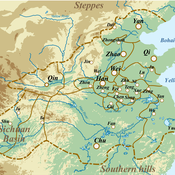
Under complex system perspectives, we build the multi-agent system to back-calculate this unification process of the Warring State period, from 32 states in 475 BC to 1 state (Qin) in 221 BC.
Peer reviewed An extended replication of Abelson's and Bernstein's community referendum simulation
Klaus G. Troitzsch | Published Friday, October 25, 2019 | Last modified Friday, August 25, 2023This is an extended replication of Abelson’s and Bernstein’s early computer simulation model of community referendum controversies which was originally published in 1963 and often cited, but seldom analysed in detail. This replication is in NetLogo 6.3.0, accompanied with an ODD+D protocol and class and sequence diagrams.
This replication replaces the original scales for attitude position and interest in the referendum issue which were distributed between 0 and 1 with values that are initialised according to a normal distribution with mean 0 and variance 1 to make simulation results easier compatible with scales derived from empirical data collected in surveys such as the European Value Study which often are derived via factor analysis or principal component analysis from the answers to sets of questions.
Another difference is that this model is not only run for Abelson’s and Bernstein’s ten week referendum campaign but for an arbitrary time in order that one can find out whether the distributions of attitude position and interest in the (still one-dimensional) issue stabilise in the long run.
Displaying 10 of 97 results for "Arun Agrawal" clear search