Our mission is to help computational modelers develop, document, and share their computational models in accordance with community standards and good open science and software engineering practices. Model authors can publish their model source code in the Computational Model Library with narrative documentation as well as metadata that supports open science and emerging norms that facilitate software citation, computational reproducibility / frictionless reuse, and interoperability. Model authors can also request private peer review of their computational models. Models that pass peer review receive a DOI once published.
All users of models published in the library must cite model authors when they use and benefit from their code.
Please check out our model publishing tutorial and feel free to contact us if you have any questions or concerns about publishing your model(s) in the Computational Model Library.
Displaying 10 of 865 results for "Blanca Gonzalez-Mon" clear search
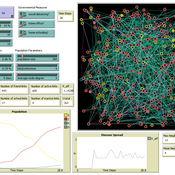
The Effect of Different Governmental Pandemic Control Measures on the Spread of a Virus Disease
Chiara Letter | Published Wednesday, January 26, 2022In this model, the spread of a virus disease in a network consisting of school pupils, employed, and umemployed people is simulated. The special feature in this model is the distinction between different types of links: family-, friends-, school-, or work-links. In this way, different governmental measures can be implemented in order to decelerate or stop the transmission.
Designing Fulfilling and Productive Workdays: Effects of Task Meaningfulness Sequences on Daily Engagement and Performance
S.R. Aurora (a.k.a. Mai P. Trinh) | Published Sunday, October 11, 2026Given the importance of experiencing fulfilling and productive workdays, scholars have focused on ways to boost employees’ daily engagement and performance, suggesting this may be accomplished by increasing meaningfulness of their work tasks. However, an alternative approach may be needed in multifaceted work contexts where employees need to complete sets of varied tasks each day, including tasks that lack meaningfulness. To address this issue, we integrate the workday design perspective with research on residual engagement to examine implications of strategically sequencing tasks in terms of their meaningfulness. We theorize that because of a process we refer to as engagement cascade, performing the day’s most highly meaningful tasks earlier and in a concentrated manner will tend to produce higher levels of daily engagement relative to sequences in which the most highly meaningful tasks occur later or are disbursed. We use agent-based modeling to formalize the engagement cascade process and generate specific predictions regarding how daily engagement is impacted by different task meaningfulness sequences. Findings from an intensive longitudinal design study with NASA and ROSCOSMOS crew members (Study 1), an experience sampling field experiment with full-time employees (Study 2), and two controlled laboratory experiments with undergraduates (Study 3 and Supplement to Study 3) provide support for our hypotheses. Specifically, the decreasing task meaningfulness sequence engendered higher levels of daily engagement, and in turn, daily performance, relative to increasing, inverted U-shaped, and U-shaped sequences.
Will it spread or not? The effects of social influences and network topology on innovation diffusion
Sebastiano Delre | Published Monday, October 24, 2011 | Last modified Saturday, April 27, 2013This models simulates innovation diffusion curves and it tests the effects of the degree and the direction of social influences. This model replicates, extends and departs from classical percolation models.
In-group favoritism due to friend selection strategies based on fixed tag and within-group reputation
Yutaka Nakai | Published Friday, March 28, 2014 | Last modified Friday, March 28, 2014An agent-based model simulates emergence of in-group favoritism. Agents adopt friend selection strategies using an invariable tag and reputations meaning how cooperative others are to a group. The reputation can be seen as a kind of public opinion.
The impact of scientific networks, affinity bias and scientific uncertainty on the public uptake of science
Sacha Ferrari | Published Thursday, January 23, 2025Ferrari, S., Lammers, W., Wenmackers, S. (forthcoming) How the structure of scientific communities could impact the public uptake of uncertain science. Philosophy of Science.
Peer reviewed STiMUS-HAI: A Stigmergic–Mutualistic Agent-Based Model of Human-AI Collaboration on Shared Digital Artefacts
Yevgeny Patarakin | Published Monday, July 13, 2026 | Last modified Thursday, August 20, 2026STiMUS-HAI (Stigmergic–Mutualistic IMOI Model, Human-AI extension) is an agent-based model of teamwork in socio-technical systems where human and AI contributors collaborate through shared digital artefacts — wiki pages, code files, issue tickets, project cards, Scratch projects — represented as patches in a NetLogo world. It extends the human-only base model STiMUS v2.2, which established that two coordination mechanisms — stigmergy (indirect coordination through traces left in the environment) and mutualism (mutual benefit between contributors and the artefacts they tend) — can be decoupled: stigmergy decides where a contributor works, mutualism decides with what effort. STiMUS-HAI preserves this decoupling unchanged and adds two further theoretical questions: whether mixing AI agents into a human team distorts human coordination in ways that aggregate indicators hide, and whether AI’s cost to team outcomes depends on the type of work AI performs, not only on how much of it is present.
Two breeds of turtle — humans and ai-agents — follow identical target-selection, pheromone, and mutualism rules, so that any behavioural difference is attributable to team composition rather than a built-in advantage. The one designed asymmetry: AI agents never accumulate shared-mental-model and their motivation is fixed rather than adaptive. On top of this v3.0 baseline, v3.1 adds a task-type dimension to artefacts (“prediction” versus “judgment”, set via a judgment-share slider) that scales down AI edit-power specifically on judgment-requiring artefacts, and an ai-trust mechanic: humans build or lose trust in AI contributions based on the population-relative percentile rank of observed AI work quality (bottom-quartile work counts as an observed “error”), and that trust gates how much mutualistic benefit a human derives from continuing an AI’s work. Trust erodes quickly on a single error and recovers only after a streak of confirmed successes — an intentional asymmetry.

REHAB: A Role Playing Game to Explore the Influence of Knowledge and Communication on Natural Resources Management
Christophe Le Page Anne Dray Pascal Perez Claude Garcia | Published Monday, July 13, 2015 | Last modified Monday, July 13, 2015REHAB has been designed as an ice-breaker in courses dealing with ecosystem management and participatory modelling. It helps introducing the two main tools used by the Companion Modelling approach, namely role-playing games and agent-based models.
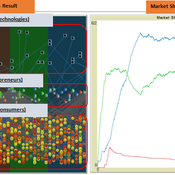
The simulation on the study of the optimal business strategy with the interaction between technologies and consumers.
sej-yoo | Published Monday, June 27, 2022 | Last modified Monday, July 04, 2022HOW IT WORKS
This model consists of three agents, and each agent type operates per business theories as below.
a. New technologies(Tech): It evolves per sustaining or disruptive technology trajectory with the constraint of project management triangle (Scope, Time, Quality, and Cost).
b. Entrepreneurs(Entre): It builds up the solution by combining Tech components per its own strategy (Exploration, Exploitation, or Ambidex).
c. Consumer(Consumer): It selects the solution per its own preference due to Diffusion of innovation theory (Innovators, Early Adopters, Early Majority, Late Majority, Laggards)
…
A model of opinion dynamics based on formal argumentation: application to the diffusion of the vegetarian diet
Patrick Taillandier Nicolas Salliou Rallou Thomopoulos | Published Monday, March 15, 2021 | Last modified Wednesday, January 07, 2026This generic agent-based model simulates the evolution of agent’s opinions through their exchange of arguments.
The idea behind this model is to explicitly represent the process of mental deliberation of agents from arguments to an opinion, through the use of Dung’s argumentation framework complemented by a structured description of arguments. An application of the model on the diffusion of vegetarian diets is proposed.
Peer reviewed AgModel
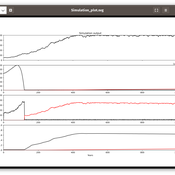
Isaac Ullah | Published Friday, December 06, 2024AgModel is an agent-based model of the forager-farmer transition. The model consists of a single software agent that, conceptually, can be thought of as a single hunter-gather community (i.e., a co-residential group that shares in subsistence activities and decision making). The agent has several characteristics, including a population of human foragers, intrinsic birth and death rates, an annual total energy need, and an available amount of foraging labor. The model assumes a central-place foraging strategy in a fixed territory for a two-resource economy: cereal grains and prey animals. The territory has a fixed number of patches, and a starting number of prey. While the model is not spatially explicit, it does assume some spatiality of resources by including search times.
Demographic and environmental components of the simulation occur and are updated at an annual temporal resolution, but foraging decisions are “event” based so that many such decisions will be made in each year. Thus, each new year, the foraging agent must undertake a series of optimal foraging decisions based on its current knowledge of the availability of cereals and prey animals. Other resources are not accounted for in the model directly, but can be assumed for by adjusting the total number of required annual energy intake that the foraging agent uses to calculate its cereal and prey animal foraging decisions. The agent proceeds to balance the net benefits of the chance of finding, processing, and consuming a prey animal, versus that of finding a cereal patch, and processing and consuming that cereal. These decisions continue until the annual kcal target is reached (balanced on the current human population). If the agent consumes all available resources in a given year, it may “starve”. Starvation will affect birth and death rates, as will foraging success, and so the population will increase or decrease according to a probabilistic function (perturbed by some stochasticity) and the agent’s foraging success or failure. The agent is also constrained by labor caps, set by the modeler at model initialization. If the agent expends its yearly budget of person-hours for hunting or foraging, then the agent can no longer do those activities that year, and it may starve.
Foragers choose to either expend their annual labor budget either hunting prey animals or harvesting cereal patches. If the agent chooses to harvest prey animals, they will expend energy searching for and processing prey animals. prey animals search times are density dependent, and the number of prey animals per encounter and handling times can be altered in the model parameterization (e.g. to increase the payoff per encounter). Prey animal populations are also subject to intrinsic birth and death rates with the addition of additional deaths caused by human predation. A small amount of prey animals may “migrate” into the territory each year. This prevents prey animals populations from complete decimation, but also may be used to model increased distances of logistic mobility (or, perhaps, even residential mobility within a larger territory).
…
Displaying 10 of 865 results for "Blanca Gonzalez-Mon" clear search