STiMUS-HAI: A Stigmergic–Mutualistic Agent-Based Model of Human-AI Collaboration on Shared Digital Artefacts 1.1.0
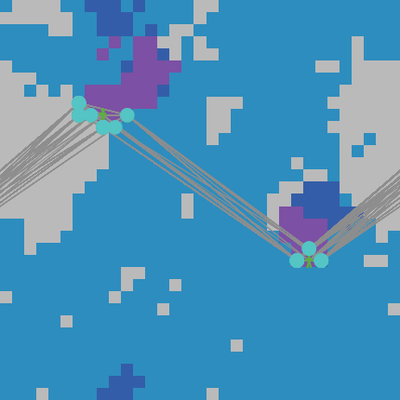
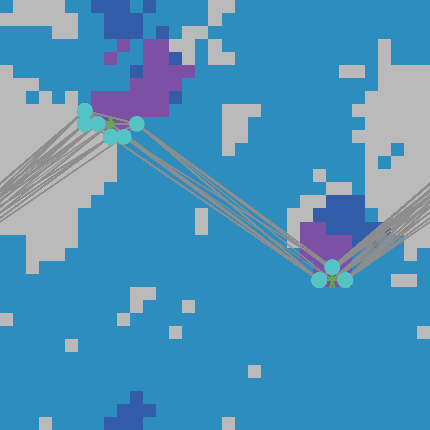
STiMUS-HAI (Stigmergic–Mutualistic IMOI Model, Human-AI extension) is an agent-based model of teamwork in socio-technical systems where human and AI contributors collaborate through shared digital artefacts — wiki pages, code files, issue tickets, project cards, Scratch projects — represented as patches in a NetLogo world. It extends the human-only base model STiMUS v2.2, which established that two coordination mechanisms — stigmergy (indirect coordination through traces left in the environment) and mutualism (mutual benefit between contributors and the artefacts they tend) — can be decoupled: stigmergy decides where a contributor works, mutualism decides with what effort. STiMUS-HAI preserves this decoupling unchanged and adds two further theoretical questions: whether mixing AI agents into a human team distorts human coordination in ways that aggregate indicators hide, and whether AI’s cost to team outcomes depends on the type of work AI performs, not only on how much of it is present.
Two breeds of turtle — humans and ai-agents — follow identical target-selection, pheromone, and mutualism rules, so that any behavioural difference is attributable to team composition rather than a built-in advantage. The one designed asymmetry: AI agents never accumulate shared-mental-model and their motivation is fixed rather than adaptive. On top of this v3.0 baseline, v3.1 adds a task-type dimension to artefacts (“prediction” versus “judgment”, set via a judgment-share slider) that scales down AI edit-power specifically on judgment-requiring artefacts, and an ai-trust mechanic: humans build or lose trust in AI contributions based on the population-relative percentile rank of observed AI work quality (bottom-quartile work counts as an observed “error”), and that trust gates how much mutualistic benefit a human derives from continuing an AI’s work. Trust erodes quickly on a single error and recovers only after a streak of confirmed successes — an intentional asymmetry.
Release Notes
Inputs (13 interface sliders). The 11 base sliders (num-contributors, num-tasks, topic-count, vision-radius, evaporation-rate, diffusion-rate, edit-increment, p-explicit, lambda-smm, mutualism-gain-factor, activity-probability) plus two new sliders: ai-share (v3.0, fraction of the team that is AI) and judgment-share (v3.1, fraction of artefacts requiring human judgment).
Outputs. Base v2.1 metrics plus v3.0/v3.1 additions: ESR-all, ESR-HH, ai-pheromone-share, human-edit-share, ai-edit-share, mean-ai-trust, judgment-edit-share, prediction-edit-share, human-smm-judgment, human-smm-prediction, mean-ai-error-observations. Optional bipartite edit log via save-edge-log (CSV).