Our mission is to help computational modelers develop, document, and share their computational models in accordance with community standards and good open science and software engineering practices. Model authors can publish their model source code in the Computational Model Library with narrative documentation as well as metadata that supports open science and emerging norms that facilitate software citation, computational reproducibility / frictionless reuse, and interoperability. Model authors can also request private peer review of their computational models. Models that pass peer review receive a DOI once published.
All users of models published in the library must cite model authors when they use and benefit from their code.
Please check out our model publishing tutorial and feel free to contact us if you have any questions or concerns about publishing your model(s) in the Computational Model Library.
Displaying 10 of 1037 results for "Rolf Anker Ims" clear search
Telephone Game
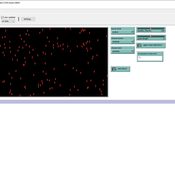
Julia Kasmire | Published Friday, January 10, 2020This is a model of a game of Telephone (also known as Chinese Whishpers in the UK), with agents representing people that can be asked, to play. The first player selects a word from their internal vocabulary and “whispers” it to the next player, who may mishear it depending on the current noise level, who whispers that word to the next player, and so on.
When the game ends, the word chosen by the first player is compared to the word heard by the last player. If they match exactly, all players earn large prize. If the words do not match exactly, a small prize is awarded to all players for each part of the words that do match. Players change color to reflect their current prize-count. A histogram shows the distribution of colors over all the players.
The user can decide on factors like
* how many players there are,
…
Stylized agricultural land-use model for resilience exploration
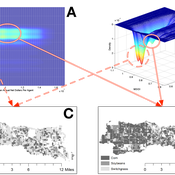
Patrick Bitterman | Published Tuesday, June 14, 2016 | Last modified Monday, April 08, 2019This model is a highly stylized land use model in the Clear Creek Watershed in Eastern Iowa, designed to illustrate the construction of stability landscapes within resilience theory.
Ageing and Spending
Tony Lawson | Published Tuesday, October 06, 2015How natural population ageing affects UK household spending patterns.

We construct a new type of agent-based model (ABM) that can simultaneously simulate land-use changes at multiple distant places (namely TeleABM, telecoupled agent-based model). We use soybean trade between Brazil and China as an example, where Brazil is the sending system and China is the receiving system because they are the world’s largest soybean exporter and importer respectively. We select one representative county in each country to calibrate and validate the model with spatio-temporal analysis of historical land-use changes and the empirical analysis of household survey data. The whole model is programmed on RePast Simphony. The most unique features of TeleABM are that it can simulate a telecoupled system and the flows between sending and receiving systems in this telecoupled system.
Pollution-development Tradeoffs in Nigeria--an Agent-based Model
Christopher Thron | Published Thursday, June 03, 2021Like many developing countries, Nigeria is faced with a number of tradeoffs that pit rapid economic development against environmental preservation. Environmentally sustainable, “green” economic development is slower, more costly, and more difficult than unrestricted, unregulated economic growth. The mathematical model that we develop in this code suggests that widespread public awareness of environmental issues is insufficient to prevent the tendency towards sacrificing the environment for the sake of growth. Even if people have an understanding of negative impacts and always choose to act in their own self-interest, they may still act collectively in such a way as to bring down the quality of life for the entire society. We conclude that additional actions must be taken besides raising public awareness of the environmental problem.
The Social Neighbourhood Model
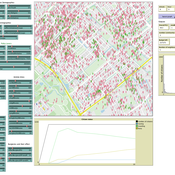
Igor Nikolic Geertje Slingerland | Published Wednesday, February 01, 2023An agent-based model that simulates urban neighbourhoods. The model has been designed to simulate perceived livability and safety (PLS) of citizens. The score attached to perceived livability and safety, PLS, is the main output of the model and is the average of each individual’s PLS. These PLS scores, in turn, are specific to each citizen and highly dependent on their individual experiences. PLS is impacted by several different social factors: interactions with fellow citizens, police officers, and community workers; visiting or starting a neighbourhood initiative; experiencing a burglary; seeing a youth gang; or hearing from friends (of friends) about these events. On top of this, the model allows to set various types of social networks which also influence the PLS.
Emergency Warning Dissemination in a Multiplex Social Network
Charles Koll | Published Tuesday, January 31, 2023This is an interdisciplinary agent-based model with Monte Carlo simulations to assess the relative effects of broadcast and contagion processes in a multiplex social network. This multiplex approach models multiple channels of informal communication - phone, word-of-mouth, and social media - that vary in their attribute values. Each agent is an individual in a threatened community who, once warned, has a probability of warning others in their social network using one of these channels. The probability of an individual warning others is based on their warning source and the time remaining until disaster impact, among other variables. Default parameter values were chosen from empirical studies of disaster warnings along with the spatial aspects of Coos Bay, OR, USA and Seaside, OR, USA communities.
Peer reviewed Theoretical Model of Oak Persistence Under Competition and Herbivory
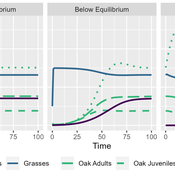
MV Eitzel Solera | Published Tuesday, October 25, 2022This model is intended to support oak tree management by representing the dynamics of oaks in multiple life stages and their competitors and consumers. This is implemented using a differential equation-based theoretical model representing three life stages of oaks: seedlings, juveniles, and adults. It includes the population dynamics of seedlings transitioning to juveniles, juveniles to adults, and adults producing new seedlings, as well as survival rates for each of the stages. It also includes a model of competition for light and water within seedlings and between seedlings and annual grasses. Finally, there is a predation term representing herbivores eating seedlings and grasses, using a Holling Type II (satiating) response with interference for predators and a death rate which depends on the resource extraction rate.
The code shared here accompanies the paper at https://doi.org/10.1371/journal.pone.0208451. It simulates the effects of various economic trade scenarios on the phenomenon of the ‘disappearing middle’ in the Scottish beef and dairy farming industries. The ‘disappearing middle’ is a situation in which there is a simultaneous observed decline in medium-sized enterprises and rise in the number of small and large-scale enterprises.
A model of opinion dynamics based on formal argumentation: application to the diffusion of the vegetarian diet
Patrick Taillandier Nicolas Salliou Rallou Thomopoulos | Published Monday, March 15, 2021 | Last modified Wednesday, January 07, 2026This generic agent-based model simulates the evolution of agent’s opinions through their exchange of arguments.
The idea behind this model is to explicitly represent the process of mental deliberation of agents from arguments to an opinion, through the use of Dung’s argumentation framework complemented by a structured description of arguments. An application of the model on the diffusion of vegetarian diets is proposed.
Displaying 10 of 1037 results for "Rolf Anker Ims" clear search