Our mission is to help computational modelers develop, document, and share their computational models in accordance with community standards and good open science and software engineering practices. Model authors can publish their model source code in the Computational Model Library with narrative documentation as well as metadata that supports open science and emerging norms that facilitate software citation, computational reproducibility / frictionless reuse, and interoperability. Model authors can also request private peer review of their computational models. Models that pass peer review receive a DOI once published.
All users of models published in the library must cite model authors when they use and benefit from their code.
Please check out our model publishing tutorial and feel free to contact us if you have any questions or concerns about publishing your model(s) in the Computational Model Library.
Displaying 10 of 346 results for "Michael D. Slater" clear search
Space colonization
allagonne | Published Wednesday, January 05, 2022Agent-Based-Modeling - space colonization
ask me for the .nlogo model
WHAT IS IT?
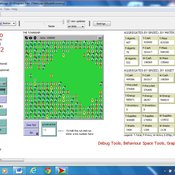
The goal of this project is to simulate with NetLogo (v6.2) a space colonization of humans, starting from Earth, into the Milky Way.
HOW IT WORKS
…
01b ModEco NLG V1.39 – Model Economies – The PMM
Garvin Boyle | Published Friday, April 14, 2017It is very difficult to model a sustainable intergenerational biophysical/financial economy. ModEco NLG is one of a series of models exploring the dynamics of sustainable economics – PSoup, ModEco, EiLab, OamLab, MppLab, TpLab, CmLab.
Viticulture development in emerging markets: Małopolska region
Marcin Czupryna Bogumił Kamiński Paweł Oleksy Piotr Przybek | Published Tuesday, November 28, 2017 | Last modified Saturday, June 16, 2018Model explains both the final state and the dynamics of the development process of the wine sector in the Małopolska region in Poland. Model admits heterogeneous agents (regular farms,large and small vineyards).
An Agent-Based Model of Corruption: Micro Approach
Valery Dzutsati | Published Friday, January 30, 2015 | Last modified Sunday, September 27, 2015Endogenous social transition from a high-corruption state to a low-corruption state, replication of Hammond 2009
Spatial rangeland model
Marco Janssen | Published Tuesday, January 22, 2019 | Last modified Friday, June 26, 2026Spatial explicit model of a rangeland system, based on Australian conditions, where grass, woody shrubs and fire compete fore resources. Overgrazing can cause the system to flip from a healthy state to an unproductive shrub state. With the model one can explore the consequences of different movement rules of the livestock on the resilience of the system.
The model is discussed in Introduction to Agent-Based Modeling by Marco Janssen. For more information see https://intro2abm.com/.
Anthill: A harvester ant colony built from the published science
Adrian Diez Cuadrado | Published Thursday, September 17, 2026 | Last modified Thursday, September 24, 2026An agent-based model of one colony of the Florida harvester ant, Pogonomyrmex badius, from the day a mated queen lands to the death of the colony. It runs in a web browser and, unchanged, headless in Node for replicate studies.
What the ants do: a claustral queen digs her own shaft and raises the first workers on her reserves; workers dig the nest under local rules, with no ant holding a plan; a one-way, age-based division of labour set by the season of birth, which no shortage reverses; trunk-trail foraging with site fidelity and recruitment; seed storage, opening and germination in the chambers, which is what feeds the larvae; daily weather from the climate normals of the study site, with drought years; nuptial flights after heavy rain; corpse removal; alarm at a disturbance on the foraging ground; and annual nest relocation, in which the store and then the brood are carried along the trail to a new nest the colony digs.
Every value in the model is tagged as measured in this species, borrowed from another ant, or invented, with its source, in a single parameter file. The model is deterministic: one seeded stream per system and a fixed one-minute timestep, so a seed reproduces a run bit for bit in the browser and in Node, which a test pins. A study writes a methods report listing the invented values the results rest on and the acceptance tests the model fails.
…
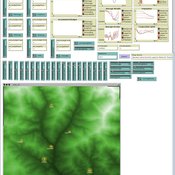
The model implements a model that reflects features of a rural hill village in Nepal. Key features of the model include water storage, social capital and migration of household members who then send remittances back to the village.
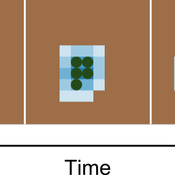
Feedback Loop Example: Vegetation Patch Growth
James Millington | Published Thursday, December 20, 2012 | Last modified Saturday, April 27, 2013This model illustrates a positive ‘growth’ feedback loop in which the areal extent of an entity increases through time.
Agent based model of COVID19 spread with digital contact tracing
Stefano Picascia Jonatan Almagor | Published Tuesday, September 28, 2021 | Last modified Wednesday, October 13, 2021Multi-layer network agent-based model of the progression of the COVID19 infection, digital contact tracing
Exploring social psychology theory for modelling farmer decision-making
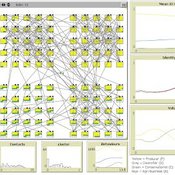
James Millington | Published Tuesday, September 18, 2012 | Last modified Saturday, April 27, 2013To investigate the potential of using Social Psychology Theory in ABMs of natural resource use and show proof of concept, we present an exemplary agent-based modelling framework that explicitly represents multiple and hierarchical agent self-concepts
Displaying 10 of 346 results for "Michael D. Slater" clear search