Our mission is to help computational modelers develop, document, and share their computational models in accordance with community standards and good open science and software engineering practices. Model authors can publish their model source code in the Computational Model Library with narrative documentation as well as metadata that supports open science and emerging norms that facilitate software citation, computational reproducibility / frictionless reuse, and interoperability. Model authors can also request private peer review of their computational models. Models that pass peer review receive a DOI once published.
All users of models published in the library must cite model authors when they use and benefit from their code.
Please check out our model publishing tutorial and feel free to contact us if you have any questions or concerns about publishing your model(s) in the Computational Model Library.
Displaying 10 of 373 results for "Miriam C. Kopels" clear search
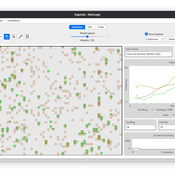
Logônia: Plant Growth Response Model in NetLogo
Daniel Vartanian Leandro Garcia Aline | Published Saturday, September 13, 2025 | Last modified Monday, July 13, 2026Logônia is a NetLogo model that simulates the growth response of a fictional plant, Logônia, under different climatic conditions. The model uses climate data from WorldClim 2.1 (Fick & Hijmans, 2017) and demonstrates how to integrate the LogoClim model through the LevelSpace extension.
The model was developed according to the FAIR principles for research software (Barker et al., 2022) and is openly available on the CoMSES Network and GitHub.
Leviathan group model and its approximation
Thibaut Roubin Guillaume Deffuant | Published Tuesday, July 26, 2022The model is based on the influence function of the Leviathan model (Deffuant, Carletti, Huet 2013 and Huet and Deffuant 2017) with the addition of group idenetity. We aim at better explaining some patterns generated by this model, using a derived mathematical approximation of the evolution of the opinions averaged.
We consider agents having an opinion/esteem about each other and about themselves. During dyadic meetings, agents change their respective opinion about each other, and possibly about other agents they gossip about, with a noisy perception of the opinions of their interlocutor. Highly valued agents are more influential in such encounters. Moreover, each agent belongs to a single group and the opinions within the group are attracted to their average.
We show that a group hierarchy can emerges from this model, and that the inequality of reputations among groups have a negative effect on the opinions about the groups of low status. The mathematical analysis of the opinion dynamic shows that the lower the status of the group, the more detrimental the interactions with the agents of other groups are for the opinions about this group, especially when gossip is activated. However, the interactions between agents of the same group tend to have a positive effect on the opinions about this group.
Incentives for data sharing
Flaminio Squazzoni Federico Bianchi Thomas Klebel Tony Ross-Hellauer | Published Thursday, October 02, 2025Although beneficial to scientific development, data sharing is still uncommon in many research areas. Various organisations, including funding agencies that endorse open science, aim to increase its uptake. However, estimating the large-scale implications of different policy interventions on data sharing by funding agencies, especially in the context of intense competition among academics, is difficult empirically. Here, we built an agent-based model to simulate the effect of different funding schemes (i.e., highly competitive large grants vs. distributive small grants), and varying intensity of incentives for data sharing on the uptake of data sharing by academic teams strategically adapting to the context.
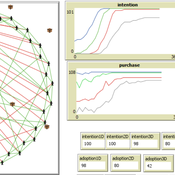
Diffusion of goods with multiple characteristics and price premiums
Pedro López Merino | Published Friday, February 18, 2022An agent-based model for the diffusion of innovations with multiple characteristics and price-premiums
BarterNet is a platform for modeling early barter networks with the aim of learning how supply and demand for a good determine if traders will learn to use that good as a form of money. Traders use a good as money when they offer to trade for it even if they can’t consume it, but believe that they can subsequently trade it for a good they can consume in the near future.
Peer reviewed Boyds (NetLogo): Boids That Fight
Oliver M. Haynold | Published Tuesday, January 20, 2026Boyds (Boids that Fight) is an agent-based model in NetLogo that extends the classic Flocking model with multi-faction competition, a local fight–flight heuristic, and a target locking/“taking” mechanism. The model separates perception (vision) from engagement range (lock distance) and uses per-faction steering bounds to explore how local numerical superiority, sensing, and bounded turning affect victory, losses, and emergent formations.
This model presents an autonomous, two-lane driving environment with a single lane-closure that can be toggled. The four driving scenarios - two baseline cases (based on the real-world) and two experimental setups - are as follows:
- Baseline-1 is where cars are not informed of the lane closure.
- Baseline-2 is where a Red Zone is marked wherein cars are informed of the lane closure ahead.
- Strategy-1 is where cars use a co-operative driving strategy - FAS. <sup>[1]</sup>
- Strategy-2 is a variant of Strategy-1 and uses comfortable deceleration values instead of the vehicle’s limit.
…
Fragile, Resilient, Asymmetric: An Agent-Based Stress Test of European Cooperation under Geopolitical Shocks (2024-2040)
Alessandro Brugnoletti | Published Thursday, July 16, 2026An empirically calibrated agent-based model of cooperation among 14 EU member states. Adaptive state-agents update their cooperation propensity through behavioural inertia, influence along the observed intra-EU trade network (IMF bilateral flows), and repeated-game payoff indicators built from verified Eurostat, Eurobarometer and IMF data (2021-2024). An anchored logistic mapping makes the observed configuration stationary in the absence of shocks, so outcomes read as deviations from the empirical baseline. The model stress-tests European cooperation to 2040 under five scenarios of increasing severity, from a baseline to a Taiwan Strait crisis counterfactual, with 1,000 Monte Carlo replications and a full sensitivity suite (one-factor-at-a-time, joint parameter sampling, breaking-point analysis, alternative functional form). Documented with the ODD protocol; self-testing and fully reproducible under fixed seeds.
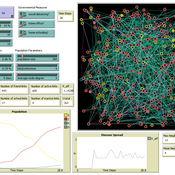
The Effect of Different Governmental Pandemic Control Measures on the Spread of a Virus Disease
Chiara Letter | Published Wednesday, January 26, 2022In this model, the spread of a virus disease in a network consisting of school pupils, employed, and umemployed people is simulated. The special feature in this model is the distinction between different types of links: family-, friends-, school-, or work-links. In this way, different governmental measures can be implemented in order to decelerate or stop the transmission.
An Agent-Based Model of Saving under Quasi-Hyperbolic Discounting on a Social Network.
Jose Alejandro Velazquez Monzon | Published Wednesday, June 24, 2026An agent-based model of saving and dissaving behaviour under quasi-hyperbolic (β–δ) discounting. Building on the individual decision problem of Cao and Werning (2018), the model embeds present-biased agents in a Watts–Strogatz small-world network and adds three configurable mechanisms of social influence — information diffusion, peer comparison, and social-norm conformity — across five heterogeneous behavioural profiles (Planners, Moderates, Procrastinators, Inverse Procrastinators, and Impulsive agents).
Each profile’s saving policy is approximated by value-function iteration over a discretised wealth grid; the solved policies are cached and applied as agents interact over their network neighbourhoods. The model tests whether each social mechanism can alter the saving and wealth trajectories that present-biased agents would otherwise follow in isolation, and characterises the direction and size of each effect on median wealth, wealth inequality (Gini), and the incidence of severely depleted agents.
The deposit includes the core model (Model.py), an analysis and visualisation pipeline (analyze_results.py), a standalone ODD description (ODD.md), and pinned dependencies.
Displaying 10 of 373 results for "Miriam C. Kopels" clear search