Our mission is to help computational modelers develop, document, and share their computational models in accordance with community standards and good open science and software engineering practices. Model authors can publish their model source code in the Computational Model Library with narrative documentation as well as metadata that supports open science and emerging norms that facilitate software citation, computational reproducibility / frictionless reuse, and interoperability. Model authors can also request private peer review of their computational models. Models that pass peer review receive a DOI once published.
All users of models published in the library must cite model authors when they use and benefit from their code.
Please check out our model publishing tutorial and feel free to contact us if you have any questions or concerns about publishing your model(s) in the Computational Model Library.
Displaying 10 of 269 results for "Marlies Bitter-Rijpkema" clear search
A Model of Making
Bruce Edmonds | Published Friday, January 29, 2016 | Last modified Wednesday, December 07, 2016This models provides the infrastructure to model the activity of making. Individuals use resources they find in their environment plus those they buy, to design, construct and deconstruct items. It represents plans and complex objects explicitly.
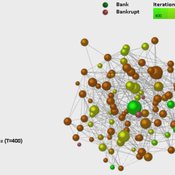
Dynamic Interbank Network Simulator
Valentina Guleva | Published Wednesday, November 23, 2016 | Last modified Monday, April 13, 2020The model provides instruments for the simulation of interbank network evolution. There are tools for dynamic network analysis, allowing to evaluate graph topological invariants, thermodynamic network features and combinational node-based features.
Peer reviewed SWIRS Spread of a woody invader in riparian systems
Moira Zellner Beatriz Sosa Carlos Andrés Chiale | Published Tuesday, May 09, 2023Riparian forests are one of the most vulnerable ecosystems to the development of biological invasions, therefore limiting their spread is one of the main challenges for conservation. The main factors that explain plant invasions in these ecosystems are the capacity for both short- and long-distance seed dispersion, and the occurrence of suitable habitats that facilitate the establishment of the invasive species. Large floods constitute an abiotic filter for invasion.
This model simulates the spatio-temporal spread of the woody invader Gleditsia. triacanthos in the riparian forest of the National Park Esteros de Farrapos e Islas del Río Uruguay, a riparian system in the coast of the Uruguay river (South America). In this model, we represent different environmental conditions for the development of G. triacanthos, long- and short-distance spread of its fruits, and large floods as the main factor of mortality for fruit and early stages.
Field results show that the distribution pattern of this invasive species is limited by establishment, i.e. it spreads locally through the expansion of small areas, and remotely through new invasion foci. This model recreates this dispersion pattern. We use this model to derive management implications to control the spread of G. triacanthos
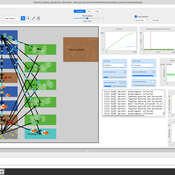
Netlogo Aquaponic Simulation
Derrick | Published Tuesday, October 06, 2026 | Last modified Wednesday, October 21, 2026This agent-based aquaponics simulation models the biological resilience and complex dynamics of a closed-loop agricultural system. Designed for educational use and agricultural research, the model helps aquaponic designers, farmers, and hobbyists understand systemic dynamics and stress-test species configurations prior to a physical build. The simulation dynamically models the nitrogen cycle by tracking aquatic bio-loads, bacterial filtration, and plant nutrient uptake. Utilizing real-world biological metrics from the Loyola Global Aquatic Excrement Dataset, the model calculates species-specific ammonia excretion rates (toxicity) for various aquatic life, including Trout, Tilapia, and Goldfish. Nitrifying bacteria agents convert this toxicity into usable nitrates, which are then absorbed by specific crop agents—such as Tomatoes, Swiss Chard, or Lettuce—at variable rates. Key features include dynamic stochastic harvesting, measurable agent health, vermaculture and crawdad integration, and reactive biological mitigators like emergency duckweed buffering. The system also introduces chaotic environmental variables, allowing users to test the agricultural setup’s resilience against random shocks like bio-filter pump failures and temperature crashes. This model is released under the GNU General Public License v3.0 (GPL-3.0) to encourage collaborative improvement within the academic and farming communities.
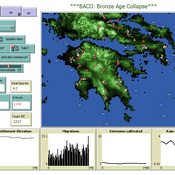
The Bronze Age Collapse model (BACO model)
Marco Vidal-Cordasco | Published Friday, October 09, 2020The Bronze Age Collapse model (BACO model) is written using free NetLogo software v.6.0.3. The purpose of using the BACO model is to develop a tool to identify and analyse the main factors that made the Late Bronze Age and Early Iron Age socio-ecological system resilient or vulnerable in the face of the environmental aridity recorded in the Aegean. The model explores the relationship between dependent and independent variables. Independent variables are: a) inter-annual rainfall variability for the Late Bronze Age and Early Iron Age in the eastern Mediterranean, b) intensity of raiding, c) percentage of marine, agricultural and other calorie sources included in the diet, d) soil erosion processes, e) farming assets, and d) storage capacity. Dependent variables are: a) human pressure for land, b) settlement patterns, c) number of commercial exchanges, d) demographic behaviour, and e) number of migrations.
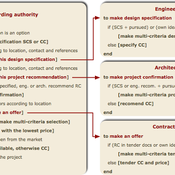
Enhancing recycling of construction materials; an agent based model with empirically based decision parameters
Igor Nikolic Claudia Binder Christof Knoeri Hans-Joerg Althaus | Published Sunday, October 21, 2012 | Last modified Monday, June 09, 2014This model allows for analyzing the most efficient levers for enhancing the use of recycled construction materials, and the role of empirically based decision parameters.
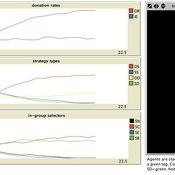
EthnoCultural Tag model (ECT)
Bruce Edmonds David Hales | Published Friday, October 16, 2015 | Last modified Wednesday, May 09, 2018Captures interplay between fixed ethnic markers and culturally evolved tags in the evolution of cooperation and ethnocentrism. Agents evolve cultural tags, behavioural game strategies and in-group definitions. Ethnic markers are fixed.
When Contact Backfires, and When It Does Not: A Computational Model of the Opinion Dynamics of Intergroup Attitudes
Andreas Flache Alla Loseva Yade Rotte | Published Wednesday, October 14, 2026This model represents individuals from two different groups interacting and sharing attitudes toward both groups. Through these interactions, individuals adjust their attitudes, which can lead to different outcomes in opinion dynamics. The model can study both intra-group and inter-group opinion dynamics. Under certain conditions, agents with initially moderate attitudes might enter a negative spiral, leading to increasingly extreme intergroup attitudes. Alternatively, these moderate attitudes can foster consensus between groups, resulting in agreement on intergroup attitudes. This model serves as a tool for exploring opinion polarization, particularly in contexts where attitudes evolve through interaction rather than remaining static.
By adjusting different parameters, one can examine the effects of variations in attitude distributions; group size and relative group size; contributions of xenophobia, opinion distance, and individual attitudes towards the outgroup; as well as ratio between xenophobia and attitudinal bias to the overall intergroup bias.
The model accompanies the paper When contact backfires, and when it does not: A computational model of the opinion dynamics of intergroup attitudes.
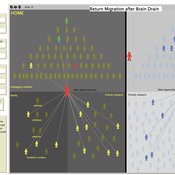
RETURN MIGRATION AFTER BRAIN DRAIN: A SIMULATION APPROACH
Alessandro Pluchino Alessio Emanuele Biondo Andrea Rapisarda | Published Friday, June 21, 2013This model, realized on the NetLogo platform, compares utility levels at home and abroad to simulate agents’ migration and their eventual return. Our model is based on two fundamental individual features, i.e. risk aversion and initial expectation, which characterize the dynamics of different agents according to the evolution of their social contacts.
07 EffLab_V5.07 NL
Garvin Boyle | Published Monday, October 07, 2019EffLab was built to support the study of the efficiency of agents in an evolving complex adaptive system. In particular:
- There is a definition of efficiency used in ecology, and an analogous definition widely used in business. In ecological studies it is called EROEI (energy returned on energy invested), or, more briefly, EROI (pronounced E-Roy). In business it is called ROI (dollars returned on dollars invested).
- In addition, there is the more well-known definition of efficiency first described by Sadi Carnot, and widely used by engineers. It is usually represented by the Greek letter ‘h’ (pronounced as ETA). These two measures of efficiency bear a peculiar relationship to each other: EROI = 1 / ( 1 - ETA )
In EffLab, blind seekers wander through a forest looking for energy-rich food. In this multi-generational world, they live and reproduce, or die, depending on whether they can find food more effectively than their contemporaries. Data is collected to measure their efficiency as they evolve more effective search patterns.
…
Displaying 10 of 269 results for "Marlies Bitter-Rijpkema" clear search