Our mission is to help computational modelers develop, document, and share their computational models in accordance with community standards and good open science and software engineering practices. Model authors can publish their model source code in the Computational Model Library with narrative documentation as well as metadata that supports open science and emerging norms that facilitate software citation, computational reproducibility / frictionless reuse, and interoperability. Model authors can also request private peer review of their computational models. Models that pass peer review receive a DOI once published.
All users of models published in the library must cite model authors when they use and benefit from their code.
Please check out our model publishing tutorial and feel free to contact us if you have any questions or concerns about publishing your model(s) in the Computational Model Library.
Displaying 10 of 1236 results for "Aad Kessler" clear search
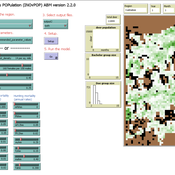
Peer reviewed INOvPOP
Aniruddha Belsare | Published Wednesday, June 01, 2022 | Last modified Wednesday, July 10, 2024INOvPOP is designed to simulate population dynamics (abundance, sex-age composition and distribution in the landscape) of white-tailed deer (Odocoileus virginianus) for selected Indiana counties. Updated for netLogo 6.4.0
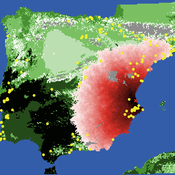
Neolithic Spread Model Version 1.0
Sean Bergin Salvador Pardo Gordo Joan Bernabeu Auban Michael Barton | Published Thursday, December 11, 2014 | Last modified Monday, December 31, 2018This model simulates different spread hypotheses proposed for the introduction of agriculture on the Iberian peninsula. We include three dispersal types: neighborhood, leapfrog, and ideal despotic distribution (IDD).
Ger Grouper
Stefani Crabtree | Published Tuesday, January 05, 2021A “Ger” is a yurt style house used by pastoralists in Mongolia. This model simulates seasonal movements, fission/fusion dynamics, social interaction between households and how these relate to climate impacts.
NetLogo-R-Example for the Inititialisation of Agents with Correlated Random Numbers
Danilo Saft | Published Friday, February 14, 2014 | Last modified Monday, April 08, 2019This is a short NetLogo example demonstrating how to initialize 500 agents with 4 correlated parameters each with random values by doing the necessary calculations in the program “R” and retrieving the results.
Evaluating Government's Policies on Promoting Smart Metering Diffusion in Retail Electricity Markets
Tao Zhang | Published Monday, December 07, 2009 | Last modified Saturday, April 27, 2013This model is a market game for evaluating the effectiveness of the UK government’s 2008-2010 policy on promoting smart metering in the UK retail electricity market. We break down the policy into four
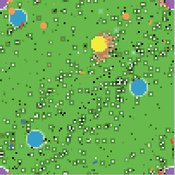
Peer reviewed Umwelten Ants
Kit Martin | Published Thursday, January 15, 2015 | Last modified Thursday, August 27, 2015Simulates impacts of ants killing colony mates when in conflict with another nest. The murder rate is adjustable, and the environmental change is variable. The colonies employ social learning so knowledge diffusion proceeds if interactions occur.
The Li-BIM model aims at simulating the behavior of occupants in a building. It is structured around the numerical modeling of the building (IFC format) and a BDI cognitive architecture. The model has been implemented under the GAMA platform.
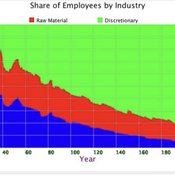
Peer reviewed A Macroeconomic Model of a Closed Economy
Ian Stuart | Published Saturday, May 08, 2021 | Last modified Wednesday, June 23, 2021This model/program presents a “three industry model” that may be particularly useful for macroeconomic simulations. The main purpose of this program is to demonstrate a mechanism in which the relative share of labor shifts between industries.
Care has been taken so that it is written in a self-documenting way so that it may be useful to anyone that might build from it or use it as an example.
This model is not intended to match a specific economy (and is not calibrated to do so) but its particular minimalist implementation may be useful for future research/development.
…
Competitive Arousal Agent Based Model
Zoé Chollet | Published Friday, May 13, 2022What is it?
This model demonstrates a very simple bidding market where buyers try to acquire a desired item at the best price in a competitive environment
…
Open Peer Review Model
Federico Bianchi | Published Monday, May 24, 2021This is an agent-based model of a population of scientists alternatively authoring or reviewing manuscripts submitted to a scholarly journal for peer review. Peer-review evaluation can be either ‘confidential’, i.e. the identity of authors and reviewers is not disclosed, or ‘open’, i.e. authors’ identity is disclosed to reviewers. The quality of the submitted manuscripts vary according to their authors’ resources, which vary according to the number of publications. Reviewers can assess the assigned manuscript’s quality either reliably of unreliably according to varying behavioural assumptions, i.e. direct/indirect reciprocation of past outcome as authors, or deference towards higher-status authors.
Displaying 10 of 1236 results for "Aad Kessler" clear search