Our mission is to help computational modelers develop, document, and share their computational models in accordance with community standards and good open science and software engineering practices. Model authors can publish their model source code in the Computational Model Library with narrative documentation as well as metadata that supports open science and emerging norms that facilitate software citation, computational reproducibility / frictionless reuse, and interoperability. Model authors can also request private peer review of their computational models. Models that pass peer review receive a DOI once published.
All users of models published in the library must cite model authors when they use and benefit from their code.
Please check out our model publishing tutorial and feel free to contact us if you have any questions or concerns about publishing your model(s) in the Computational Model Library.
Displaying 10 of 55 results for "Maria Antonia Serge" clear search

Peer reviewed HUMLAND2: HUMan impact on LANDscapes agent-based model
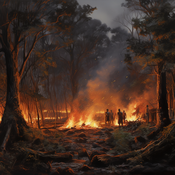
Fulco Scherjon Anastasia Nikulina Anhelina Zapolska Maria Antonia Serge Marco Davoli Dave van Wees Katharine MacDonald Elena A. Pearce | Published Friday, August 30, 2024The HUMan Impact on LANDscapes (HUMLAND) 2.0.0 is an enhanced version of HUMLAND 1.0.0, developed to track and quantify the intensity of various impacts on landscapes at a continental scale. The model is designed to identify the most influential factors in the transformation of interglacial vegetation, with a particular focus on the burning practices of hunter-gatherers. HUMLAND 2.0.0 incorporates a wide range of spatial datasets as both inputs and targets (expected modelling results) for simulations across Last Interglacial (~130,000–116,000 BP) and Early Holocene (~11,700–8,000 BP).
Peer reviewed HUMLAND: HUMan impact on LANDscapes agent-based model
Fulco Scherjon Anastasia Nikulina Anhelina Zapolska Maria Antonia Serge Marco Davoli Dave van Wees Katharine MacDonald | Published Monday, October 16, 2023The HUMan impact on LANDscapes (HUMLAND) model has been developed to track and quantify the intensity of different impacts on landscapes at the continental level. This agent-based model focuses on determining the most influential factors in the transformation of interglacial vegetation with a specific emphasis on burning organized by hunter-gatherers. HUMLAND integrates various spatial datasets as input and target for the agent-based model results. Additionally, the simulation incorporates recently obtained continental-scale estimations of fire return intervals and the speed of vegetation regrowth. The obtained results include maps of possible scenarios of modified landscapes in the past and quantification of the impact of each agent, including climate, humans, megafauna, and natural fires.
Peer reviewed ABM Overtourism Santa Marta
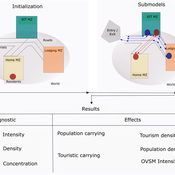
Janwar Moreno | Published Monday, October 23, 2023This model presents the simulation model of a city in the context of overtourism. The study area is the city of Santa Marta in Colombia. The purpose is to illustrate the spatial and temporal distribution of population and tourists in the city. The simulation analyzes emerging patterns that result from the interaction between critical components in the touristic urban system: residents, urban space, touristic sites, and tourists. The model is an Agent-Based Model (ABM) with the GAMA software. Also, it used public input data from statistical centers, geographical information systems, tourist websites, reports, and academic articles. The ABM includes assessing some measures used to address overtourism. This is a field of research with a low level of analysis for destinations with overtourism, but the ABM model allows it. The results indicate that the city has a high risk of overtourism, with spatial and temporal differences in the population distribution, and it illustrates the effects of two management measures of the phenomenon on different scales. Another interesting result is the proposed tourism intensity indicator (OVsm), taking into account that the tourism intensity indicators used by the literature on overtourism have an overestimation of tourism pressures.
AIforGoodSimulator - Modeling Covid-19 Spread and Potential Interventions in Refugee Camps
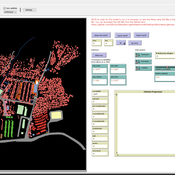
Shyaam Ramkumar Woi Sok Oh | Published Thursday, March 18, 2021The Netlogo model is a conceptualization of the Moria refugee camp, capturing the household demographics of refugees in the camp, a theoretical friendship network based on values, and an abstraction of their daily activities. The model then simulates how Covid-19 could spread through the camp if one refugee is exposed to the virus, utilizing transmission probabilities and the stages of disease progression of Covid-19 from susceptible to exposed to asymptomatic / symptomatic to mild / severe to recovered from literature. The model also incorporates various interventions - PPE, lockdown, isolation of symptomatic refugees - to analyze how they could mitigate the spread of the virus through the camp.
An Agent-Based Model of Indirect Minority Influence on Social Change
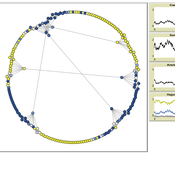
Jiin Jung | Published Wednesday, February 05, 2025This model demonstrates how different psychological mechanisms and network structures generate various patterns of cultural dynamics including cultural diversity, polarization, and majority dominance, as explored by Jung, Bramson, Crano, Page, and Miller (2021). It focuses particularly on the psychological mechanisms of indirect minority influence, a concept introduced by Serge Moscovici (1976, 1980)’s genetic model of social influence, and validates how such influence can lead to social change.
HousingABM_Japan: An Agent-Based Model of Price and Rent Amplification in the Tokyo Housing Market
Eiki Tamama | Published Sunday, September 06, 2026HousingABM_Japan is a NetLogo agent-based model of the residential market of Tokyo’s 23 wards. It evaluates whether a single parameter configuration can jointly reproduce key features of prices, rents, yields, and market turnover across distinct market regimes from 2001 to 2025, with particular attention to demand- and supply-side trend-following during the 2021–2025 price surge.
The model builds on the Bank of England housing-market lineage (Baptista et al. 2016; Carro et al. 2023) and introduces four extensions: (1) dynamic linkages between the sale and rental markets through vacancy, rents, and yields; (2) heterogeneous demand-side trend-following; (3) supply-side trend-following through construction-cost trend anchoring and a momentum-dependent dynamic premium; and (4) housing-equity borrowing that converts unrealized equity into additional borrowing capacity.
Twenty parameters are calibrated using 2001–2015 data and held fixed for post-calibration evaluation over 2016–2020 and 2021–2025, while annual exogenous inputs follow observed historical paths. The model reproduces the shift from moderate price growth to the 2021–2025 surge, as well as rent acceleration, surge-period yield compression, and persistently low market turnover, although it understates the intermediate acceleration of 2016–2020.
…
A simplified Arthur & Polak logic circuit model of combinatory technology build-out via incremental development. Only some inventions trigger radical effects, suggesting they depend on whole interdependent systems rather than specific innovations.
The Regional Security Game: An Agent-based, Evolutionary Model of Strategic Evolution and Stability
Anthony Skews | Published Saturday, June 09, 2018The Regional Security Game is a iterated public goods game with punishement based on based on life sciences work by Boyd et al. (2003 ) and Hintze & Adami (2015 ), with modifications appropriate for an international relations setting. The game models a closed regional system in which states compete over the distribution of common security benefits. Drawing on recent work applying cultural evolutionary paradigms in the social sciences, states learn through imitation of successful strategies rather than making instrumentally rational choices. The model includes the option to fit empirical data to the model, with two case studies included: Europe in 1933 on the verge of war and south-east Asia in 2013.
Social norms and the dominance of Low-doers
Antonio Franco | Published Wednesday, July 13, 2016 | Last modified Sunday, December 02, 2018The code for the paper “Social norms and the dominance of Low-doers”
Emergent Collapse and Resilience in Sequential Task Networks
Antonis Chatzipanagiotou | Published Monday, August 31, 2026Organizations operate under conditions of imperfect performance in which human error is inevitable, yet errors are rarely examined as the triggers for the managerial interactions that shape organizational culture over time. The present research introduces an agent-based simulation of a work team completing a fixed sequence of tasks under varying degrees of managerial oversight and response policy. The model isolates the mechanical loss of throughput caused by errors from the psychological and cultural consequences of managerial reactions, which are categorized into ignoring, correcting or punishing. Furthermore, the model incorporates an autonomous self-notice mechanism, allowing workers to correct themselves in the absence of managerial intervention. By tracking the accumulation of worker resentment and the transient enhancements in learning, the simulation acts as a dynamic laboratory for observing delayed consequences, nonlinear tipping points and systemic organizational collapse. The results reveal a central paradox of organizational control. Highly monitored punitive environments generate high short-term throughput, yet they simultaneously accumulate interactional injustice and resentment that engineer a rapid cascading turnover and the highest probability of systemic collapse. Conversely, corrective policies combined with active monitoring achieve equivalent throughput while sustaining workforce viability. A comprehensive sensitivity analysis establishes that error accumulation is primarily determined by structural factors, namely agent-level mistake propensity and task difficulty, while resignation dynamics, resentment accumulation and collapse timing remain predominantly governed by managerial policy, a hierarchy independently corroborated by a surrogate model and shown to be stable across independent seeds and across stakeholder weighting scenarios. The study bridges the operational mechanics of task completion and the social dynamics of workplace mistreatment, illustrating how short-term punitive success often masks long-term structural fragility.
Displaying 10 of 55 results for "Maria Antonia Serge" clear search