Our mission is to help computational modelers develop, document, and share their computational models in accordance with community standards and good open science and software engineering practices. Model authors can publish their model source code in the Computational Model Library with narrative documentation as well as metadata that supports open science and emerging norms that facilitate software citation, computational reproducibility / frictionless reuse, and interoperability. Model authors can also request private peer review of their computational models. Models that pass peer review receive a DOI once published.
All users of models published in the library must cite model authors when they use and benefit from their code.
Please check out our model publishing tutorial and feel free to contact us if you have any questions or concerns about publishing your model(s) in the Computational Model Library.
Displaying 10 of 10 results for "Carolina Rodríguez" clear search

FAKENEWS-ABM: News-Source Strategies for Disseminating False News
Paul Leger Agustín Olivares Oswaldo Terán Manuela López Francis Espinoza Carolina Rodríguez Dayana Jaque | Published Wednesday, November 25, 2026An agent-based model of how a source that repeatedly publishes false news can gain audience by imitating the presentation of established media without becoming more accurate. Five hundred users repeatedly choose which of the sources they know to share from; choices follow the evidence each user has accumulated about a source’s presentation (13 attributes such as credibility, information quality, proximity and sensationalism) and recommendations from contacts. User preferences, source profiles and initial reach are derived from a survey of 507 Chilean users of X. An experimental source can copy the engagement, proximity, informational or credibility attributes of traditional media while its probability of publishing false items is held fixed. The model compares imitation strategies, campaign timing, limits on reach, and warning labels on recommended or shared items, and separates two outcomes: the source’s share of sharing decisions and the share of shared items that are false. It includes robustness variants (memory, choice rule, network, survey coding, nine-outlet ecology) and an adaptive source that learns its presentation from audience feedback.
Peer reviewed Green Consumption Tipping Point
Mario | Published Thursday, February 26, 2026This model is a minimal agent-based model (ABM) of green consumption and market tipping dynamics in a stylised two-firm economy. It is designed as an existence proof to illustrate how weak individual preferences, when combined with habit formation, social influence, and firm price adaptation, can generate non-linear transitions (tipping points) in market outcomes.
The economy consists of:
1) Two firms, each supplying a differentiated consumption bundle that differs in its fixed green share (one relatively greener, one less green).
2) Many households, each consuming a unit mass per period and allocating consumption between the two firms.
…
v2.0.0 – Green Consumption ABM: Social Tipping and Policy Dynamics.
Mario | Published Thursday, November 05, 2026Green Consumption ABM – Version 2.0.0
This release presents an updated agent-based modelling (ABM) framework developed to investigate social tipping dynamics in green consumption markets.
The model integrates heterogeneous consumer preferences, social influence, firm-level economic decision-making, endogenous pricing, and environmental policy interventions to examine how individual behavioural responses can generate collective market transitions.
…
Mission San Diego Model
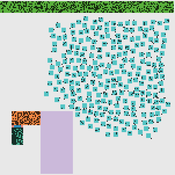
Carolyn Orbann | Published Monday, April 15, 2019The Mission San Diego model is an epidemiological model designed to test hypotheses related to the spread of the 1805-1806 measles epidemic among indigenous residents of Mission San Diego during the early mission period in Alta California. The model community is based on the population of the Mission San Diego community, as listed in the parish documents (baptismal, marriage, and death records). Model agents are placed on a map-like grid that consists of houses, the mission church, a women’s dormitory (monjeria) adjacent to the church, a communal kitchen, priest’s quarters, and agricultural fields. They engage in daily activities that reflect known ethnographic patterns of behavior at the mission. A pathogen is introduced into the community and then it spreads throughout the population as a consequence of individual agent movements and interactions.
Private forest owner management behavior using social interactions, information flow, and peer-to-peer n
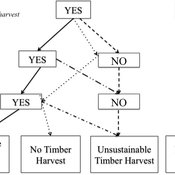
Emily Silver Huff Jessica Leahy Aaron R Weiskittel Caroline L Noblet David Hiebeler | Published Tuesday, October 13, 2015This theoretical model includes forested polygons and three types of agents: forest landowners, foresters, and peer leaders. Agent rules and characteristics were parameterized from existing literature and an empirical survey of forest landowners.
Peninsula_Iberica 1.0
Carolina Cucart-Mora Sergi Lozano Javier Fernández-López De Pablo | Published Friday, November 04, 2016 | Last modified Monday, November 27, 2017This model was build to explore the bio-cultural interaction between AMH and Neanderthals during the Middle to Upper Paleolithic Transition in the Iberian Peninsula

Peer reviewed AgentEx
Nanda Wijermans Caroline Schill Therese Lindahl Maja Schlüter | Published Sunday, November 13, 2016AgentEx aims to advance understanding of group processes for sustainable management of a common pool resource (CPR). By supporting the development and test explanations of cooperation and sustainable exploitation.
Modal Choice and the Right to the City: Simulation of Mobility Scenarios in Contexts of Territorial Vulnerability
Gamaliel Palomo | Published Tuesday, November 24, 2026This agent-based model (ABM), implemented in the GAMA Platform (v1.9), simulates daily commuting modal choice under structural socio-spatial constraints in the Guadalajara Metropolitan Area (GMA), Mexico.
Model Overview
- Agents & Heterogeneity: Simulates $N = 900$ synthetic citizen agents stratified across four socio-behavioral profiles (Peripheral Student, Worker with Car, Woman without Car, and Central Multimodal User) and three residential zones (Periphery, Intermediate, and Central), parameterized with empirical distributions from the 2023 Origin-Destination Survey (EOD-2023), PIMUS, and geospatial layers from IMEPLAN.
- Decision Mechanism: Combines structural choice-set filtering (gated by private vehicle ownership, physical distance thresholds, and shared-bicycle infrastructure availability) with a Multinomial Logit (MNL) random utility function evaluating door-to-door travel time, monetary cost, effective transit accessibility, and perceived safety.
- Policy Experiments: Evaluates five intervention scenarios across $R = 30$ stochastic Monte Carlo replications each ($150$ simulation runs; $135,000$ individual decisions):
…
School Enrollment Model
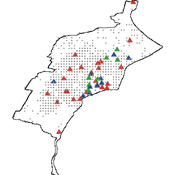
Catalina Canals Enrique Canessa Spiro Maroulis Alejandra Mizala Sergio Chaigneau | Published Monday, July 08, 2024The School Enrollment Model is a spatially-explicit computational model that depicts a city, with schools and students located within the space. The model represents the Chilean school system, a market-based educational system, where people are free to choose among public, private voucher, or private fee-paying schools. In the model, students become aware of some schools, apply to schools, switch schools, pass or fail grade levels, and eventually either graduate or dropout. Schools select students, update their tuition, test scores, and other characteristics.
The purpose of the model is to represent the Chilean school system and analyze the different mechanisms that affected the enrollment distribution between public, private voucher, and private fee-paying school sectors during the period 2004-2016.
Peer reviewed E³-MAN. An Institutionally-guided multi-agent. Model for fair and efficient negotiation.
José luis bustelo | Published Monday, September 01, 2025Negotiation plays a fundamental role in shaping human societies, underpinning conflict resolution, institutional design, and economic coordination. This article introduces E³-MAN, a novel multi-agent model for negotiation that integrates individual utility maximization with fairness and institutional legitimacy. Unlike classical approaches grounded solely in game theory, our model incorporates Bayesian opponent modeling, transfer learning from past negotiation domains, and fallback institutional rules to resolve deadlocks. Agents interact in dynamic environments characterized by strategic heterogeneity and asymmetric information, negotiating over multidimensional issues under time constraints. Through extensive simulation experiments, we compare E³-MAN against the Nash bargaining solution and equal-split baselines using key performance metrics: utilitarian efficiency, Nash social welfare, Jain fairness index, Gini coefficient, and institutional compliance. Results show that E³-MAN achieves near-optimal efficiency while significantly improving distributive equity and agreement stability. A legal application simulating multilateral labor arbitration demonstrates that institutional default rules foster more balanced outcomes and increase negotiation success rates from 58% to 98%. By combining computational intelligence with normative constraints, this work contributes to the growing field of socially aware autonomous agents. It offers a virtual laboratory for exploring how simple institutional interventions can enhance justice, cooperation, and robustness in complex socio-legal systems.