Our mission is to help computational modelers develop, document, and share their computational models in accordance with community standards and good open science and software engineering practices. Model authors can publish their model source code in the Computational Model Library with narrative documentation as well as metadata that supports open science and emerging norms that facilitate software citation, computational reproducibility / frictionless reuse, and interoperability. Model authors can also request private peer review of their computational models. Models that pass peer review receive a DOI once published.
All users of models published in the library must cite model authors when they use and benefit from their code.
Please check out our model publishing tutorial and feel free to contact us if you have any questions or concerns about publishing your model(s) in the Computational Model Library.
Displaying 10 of 88 results for "Wolfgang Nikolaus Probst" clear search
Bicycle encounter model
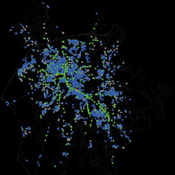
Gudrun Wallentin | Published Saturday, October 29, 2016 | Last modified Friday, March 29, 2019This Bicycle encounter model builds on the Salzburg Bicycle model (Wallentin & Loidl, 2015). It simulates cyclist flows and encounters, which are locations of potential accidents between cyclists.
HousingABM_Japan: An Agent-Based Model of Price and Rent Amplification in the Tokyo Housing Market
Eiki Tamama | Published Sunday, September 06, 2026HousingABM_Japan is a NetLogo agent-based model of the residential market of Tokyo’s 23 wards. It evaluates whether a single parameter configuration can jointly reproduce key features of prices, rents, yields, and market turnover across distinct market regimes from 2001 to 2025, with particular attention to demand- and supply-side trend-following during the 2021–2025 price surge.
The model builds on the Bank of England housing-market lineage (Baptista et al. 2016; Carro et al. 2023) and introduces four extensions: (1) dynamic linkages between the sale and rental markets through vacancy, rents, and yields; (2) heterogeneous demand-side trend-following; (3) supply-side trend-following through construction-cost trend anchoring and a momentum-dependent dynamic premium; and (4) housing-equity borrowing that converts unrealized equity into additional borrowing capacity.
Twenty parameters are calibrated using 2001–2015 data and held fixed for post-calibration evaluation over 2016–2020 and 2021–2025, while annual exogenous inputs follow observed historical paths. The model reproduces the shift from moderate price growth to the 2021–2025 surge, as well as rent acceleration, surge-period yield compression, and persistently low market turnover, although it understates the intermediate acceleration of 2016–2020.
…
Structural Luck: An Agent-Based Model of Workplace Career Dynamics
Yang Ou | Published Sunday, August 23, 2026Why do career outcomes in organizations follow highly skewed distributions when the individual traits presumed to drive success — competence, effort, and social skill — are approximately normally distributed in the population? This agent-based model investigates the relative contributions of individual attributes versus random events (“luck”) to career outcomes in hierarchically structured organizations.
The model places 500 agents in a five-level pyramid-shaped organization over 80 six-month evaluation periods (40 simulated years). Each agent is characterized by four attributes drawn from normal distributions at initialization: competence, effort, social skill, and adaptability. In each period, agents may encounter stochastic career events (good or bad projects, supportive or poor managers, market booms or busts), which modify their performance and visibility scores. Promotion decisions are made competitively when vacancies arise at higher levels, using a weighted combination of recent performance, accumulated visibility, network position, and tenure. Social connections form and decay through a proximity-based model influenced by agents’ social skills.
The model extends the talent-versus-luck framework of Pluchino et al. (2018) in four substantive directions: (1) it embeds agents in a hierarchical organization with finite positions at each level, making promotion a zero-sum competition rather than an abstract encounter with random events; (2) it represents individual differences along four independent attribute dimensions rather than a single talent score; (3) it incorporates dynamic social network formation that mediates access to career-relevant opportunities; and (4) it implements the Peter Principle mechanism through which promoted agents must acquire competence appropriate to their new role.
…
An ABM of historic British milk consumption
Matthew Gibson | Published Monday, December 20, 2021Substitution of food products will be key to realising widespread adoption of sustainable diets. We present an agent-based model of decision-making and influences on food choice, and apply it to historically observed trends of British whole and skimmed (including semi) milk consumption from 1974 to 2005. We aim to give a plausible representation of milk choice substitution, and test different mechanisms of choice consideration. Agents are consumers that perceive information regarding the two milk choices, and hold values that inform their position on the health and environmental impact of those choices. Habit, social influence and post-decision evaluation are modelled. Representative survey data on human values and long-running public concerns empirically inform the model. An experiment was run to compare two model variants by how they perform in reproducing these trends. This was measured by recording mean weekly milk consumption per person. The variants differed in how agents became disposed to consider alternative milk choices. One followed a threshold approach, the other was probability based. All other model aspects remained unchanged. An optimisation exercise via an evolutionary algorithm was used to calibrate the model variants independently to observed data. Following calibration, uncertainty and global variance-based temporal sensitivity analysis were conducted. Both model variants were able to reproduce the general pattern of historical milk consumption, however, the probability-based approach gave a closer fit to the observed data, but over a wider range of uncertainty. This responds to, and further highlights, the need for research that looks at, and compares, different models of human decision-making in agent-based and simulation models. This study is the first to present an agent-based modelling of food choice substitution in the context of British milk consumption. It can serve as a valuable pre-curser to the modelling of dietary shift and sustainable product substitution to plant-based alternatives in Britain.
Individual-based modelling as a tool for elephant poaching mitigation
Ernesto Carrella Richard Bailey Emily Neil Jens Koed Madsen Nicolas Payette | Published Tuesday, June 18, 2019 | Last modified Thursday, August 01, 2019We develop an IBM that predicts how interactions between elephants, poachers, and law enforcement affect poaching levels within a virtual protected area. The model is theoretical at this stage and is not meant to provide a realistic depiction of poaching, but instead to demonstrate how IBMs can expand upon the existing modelling work done in this field, and to provide a framework for future research. The model could be further developed into a useful management support tool to predict the outcomes of various poaching mitigation strategies at real-world locations. The model was implemented in NetLogo version 6.1.0.
We first compared a scenario in which poachers have prescribed, non-adaptive decision-making and move randomly across the landscape, to one in which poachers adaptively respond to their memories of elephant locations and where other poachers have been caught by law enforcement. We then compare a situation in which ranger effort is distributed unevenly across the protected area to one in which rangers patrol by adaptively following elephant matriarchal herds.
Toward Market Structure as a Complex System: A Web Based Simulation Assignment Implemented in Netlogo
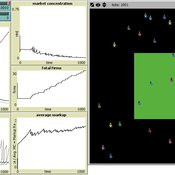
Timothy Kochanski | Published Monday, February 14, 2011 | Last modified Saturday, April 27, 2013This is the model for a paper that is based on a simulation model, programmed in Netlogo, that demonstrates changes in market structure that occur as marginal costs, demand, and barriers to entry change. Students predict and observe market structure changes in terms of number of firms, market concentration, market price and quantity, and average marginal costs, profits, and markups across the market as firms innovate. By adjusting the demand growth and barriers to entry, students can […]
Peer reviewed The Megafauna Hunting Pressure Model
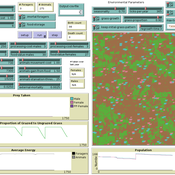
Isaac Ullah Miriam C. Kopels | Published Friday, February 16, 2024 | Last modified Friday, October 11, 2024The Megafaunal Hunting Pressure Model (MHPM) is an interactive, agent-based model designed to conduct experiments to test megaherbivore extinction hypotheses. The MHPM is a model of large-bodied ungulate population dynamics with human predation in a simplified, but dynamic grassland environment. The overall purpose of the model is to understand how environmental dynamics and human predation preferences interact with ungulate life history characteristics to affect ungulate population dynamics over time. The model considers patterns in environmental change, human hunting behavior, prey profitability, herd demography, herd movement, and animal life history as relevant to this main purpose. The model is constructed in the NetLogo modeling platform (Version 6.3.0; Wilensky, 1999).
Rangeland and evolution of management styles
Marco Janssen | Published Tuesday, January 14, 2020 | Last modified Friday, June 26, 2026Provided is a landscape of properties where pastoralists make decisions how much livestock they put on their property and how much to suppress fire from occuring. Rangelands can be grass dominated, or unproductive shrubb dominated. Overgrazing and fire suppresion lead to shrub dominated landscapes. What management strategies evolve, and how is this impacted by policies?
The model is discussed in Introduction to Agent-Based Modeling by Marco Janssen. For more information see https://intro2abm.com/.
Peer reviewed Green Consumption Tipping Point
Mario | Published Thursday, February 26, 2026This model is a minimal agent-based model (ABM) of green consumption and market tipping dynamics in a stylised two-firm economy. It is designed as an existence proof to illustrate how weak individual preferences, when combined with habit formation, social influence, and firm price adaptation, can generate non-linear transitions (tipping points) in market outcomes.
The economy consists of:
1) Two firms, each supplying a differentiated consumption bundle that differs in its fixed green share (one relatively greener, one less green).
2) Many households, each consuming a unit mass per period and allocating consumption between the two firms.
…
CINCH1 (Covid-19 INfection Control in Hospitals)
Nick Gotts | Published Sunday, August 29, 2021CINCH1 (Covid-19 INfection Control in Hospitals), is a prototype model of physical distancing for infection control among staff in University College London Hospital during the Covid-19 pandemic, developed at the University of Leeds, School of Geography. It models the movement of collections of agents in simple spaces under conflicting motivations of reaching their destination, maintaining physical distance from each other, and walking together with a companion. The model incorporates aspects of the Capability, Opportunity and Motivation of Behaviour (COM-B) Behaviour Change Framework developed at University College London Centre for Behaviour Change, and is aimed at informing decisions about behavioural interventions in hospital and other workplace settings during this and possible future outbreaks of highly contagious diseases. CINCH1 was developed as part of the SAFER (SARS-CoV-2 Acquisition in Frontline Health Care Workers – Evaluation to Inform Response) project
(https://www.ucl.ac.uk/behaviour-change/research/safer-sars-cov-2-acquisition-frontline-health-care-workers-evaluation-inform-response), funded by the UK Medical Research Council. It is written in Python 3.8, and built upon Mesa version 0.8.7 (copyright 2020 Project Mesa Team).
Displaying 10 of 88 results for "Wolfgang Nikolaus Probst" clear search