Our mission is to help computational modelers develop, document, and share their computational models in accordance with community standards and good open science and software engineering practices. Model authors can publish their model source code in the Computational Model Library with narrative documentation as well as metadata that supports open science and emerging norms that facilitate software citation, computational reproducibility / frictionless reuse, and interoperability. Model authors can also request private peer review of their computational models. Models that pass peer review receive a DOI once published.
All users of models published in the library must cite model authors when they use and benefit from their code.
Please check out our model publishing tutorial and feel free to contact us if you have any questions or concerns about publishing your model(s) in the Computational Model Library.
Displaying 10 of 268 results for "Piergiuseppe Morone" clear search
Ring Around the Kula: The Influence of Ceremonial Exchange on Network Formation
Andrea Tovinen | Published Tuesday, December 16, 2008 | Last modified Saturday, April 27, 2013The purpose of the model is to examine the strength of network connections in a ceremonial exchange network in a non-hierarchical society.
cultural group and persistent parochialism
Jae-Woo Kim | Published Monday, November 08, 2010 | Last modified Saturday, April 27, 2013Discriminators who have limited tolerance for helping dissimilar others are necessary for the evolution of costly cooperation in a one-shot Prisoner’s Dilemma. Existing research reports that trust in
SpeciesWorld
Tony Lawson | Published Friday, March 16, 2012 | Last modified Saturday, April 27, 2013How can species evolve a cooperative network to keep the environment suitable for life?
Leviathan model and its approximation
Thibaut Roubin Guillaume Deffuant | Published Thursday, September 17, 2020 | Last modified Monday, September 06, 2021The model is based on the influence function of the Leviathan model (Deffuant, Carletti, Huet 2013 and Huet and Deffuant 2017). We aim at better explaining some patterns generated by this model, using a derived mathematical approximation of the evolution of the opinions averaged.
We consider agents having an opinion/esteem about each other and about themselves. During dyadic meetings, agents change their respective opinion about each other, and possibly about other agents they gossip about, with a noisy perception of the opinions of their interlocutor. Highly valued agents are more influential in such encounters.
We show that the inequality of reputations among agents have a negative effect on the opinions about the agents of low status.The mathematical analysis of the opinion dynamic shows that the lower the status of the agent, the more detrimental the interactions are for the opinions about this agent, especially when gossip is activated, while the interactions always tend to increase the opinions about agents of high status.
The Bronze Age Collapse model (BACO model)
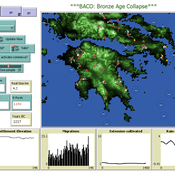
Marco Vidal-Cordasco | Published Friday, October 09, 2020The Bronze Age Collapse model (BACO model) is written using free NetLogo software v.6.0.3. The purpose of using the BACO model is to develop a tool to identify and analyse the main factors that made the Late Bronze Age and Early Iron Age socio-ecological system resilient or vulnerable in the face of the environmental aridity recorded in the Aegean. The model explores the relationship between dependent and independent variables. Independent variables are: a) inter-annual rainfall variability for the Late Bronze Age and Early Iron Age in the eastern Mediterranean, b) intensity of raiding, c) percentage of marine, agricultural and other calorie sources included in the diet, d) soil erosion processes, e) farming assets, and d) storage capacity. Dependent variables are: a) human pressure for land, b) settlement patterns, c) number of commercial exchanges, d) demographic behaviour, and e) number of migrations.
Peer reviewed Neighbor Influenced Energy Retrofit (NIER) agent-based model
Eric Boria | Published Friday, April 03, 2020The NIER model is intended to add qualitative variables of building owner types and peer group scales to existing energy efficiency retrofit adoption models. The model was developed through a combined methodology with qualitative research, which included interviews with key stakeholders in Cleveland, Ohio and Detroit and Grand Rapids, Michigan. The concepts that the NIER model adds to traditional economic feasibility studies of energy retrofit decision-making are differences in building owner types (reflecting strategies for managing buildings) and peer group scale (neighborhoods of various sizes and large-scale Districts). Insights from the NIER model include: large peer group comparisons can quickly raise the average energy efficiency values of Leader and Conformist building owner types, but leave Stigma-avoider owner types as unmotivated to retrofit; policy interventions such as upgrading buildings to energy-related codes at the point of sale can motivate retrofits among the lowest efficient buildings, which are predominantly represented by the Stigma-avoider type of owner; small neighborhood peer groups can successfully amplify normal retrofit incentives.
An Individual-Based Mechanistic Model of Mussel Bed Boundary Formation and Intensity
Matthew Schumm | Published Saturday, September 28, 2019Individually parameterized mussels (Mytilus californianus) recruit, grow, move and die in a 3D environment while facing predation (in the form of seastar agents), heat and desiccation with increased tide height, and storms. Parameterized with data collected by Wootton, Paine, Kandur, Donahue, Robles and others. See my 2019 CoMSES video presentation to learn more.
Patch choice model from Optimal Foraging Theory (Human Behavioral Ecology)
C Michael Barton | Published Saturday, November 22, 2008 | Last modified Saturday, April 27, 2013NetLogo model of patch choice model from optimal foraging theory (human behavioral ecology).
Consumats on a network
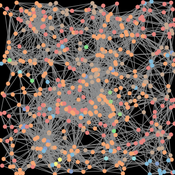
Marco Janssen | Published Tuesday, January 14, 2020 | Last modified Sunday, June 28, 2026Consumer agents make choices which products to choose using the consumat approach. In this approach agents will make choices using deliberation, repetition, imitation or social comparison dependent on the level of need satisfaction and uncertainty.
The model is discussed in Introduction to Agent-Based Modeling by Marco Janssen. For more information see https://intro2abm.com/
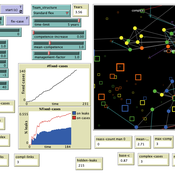
Team Structure and Task Performance
Davide Secchi Martin Neumann | Published Monday, August 05, 2024This model was designed to study resilience in organizations. Inspired by ethnographic work, it follows the simple goal to understand whether team structure affects the way in which tasks are performed. In so doing, it compares the ‘hybrid’ data-inspired structure with three more traditional structures (i.e. hierarchy, flexible/relaxed hierarchy, and anarchy/disorganization).
Displaying 10 of 268 results for "Piergiuseppe Morone" clear search