Our mission is to help computational modelers develop, document, and share their computational models in accordance with community standards and good open science and software engineering practices. Model authors can publish their model source code in the Computational Model Library with narrative documentation as well as metadata that supports open science and emerging norms that facilitate software citation, computational reproducibility / frictionless reuse, and interoperability. Model authors can also request private peer review of their computational models. Models that pass peer review receive a DOI once published.
All users of models published in the library must cite model authors when they use and benefit from their code.
Please check out our model publishing tutorial and feel free to contact us if you have any questions or concerns about publishing your model(s) in the Computational Model Library.
Displaying 10 of 104 results for "María Victoria de-la-Fuente-Aragon" clear search

Peer reviewed HUMLAND2: HUMan impact on LANDscapes agent-based model
Anastasia Nikulina Anhelina Zapolska Maria Antonia Serge Marco Davoli Dave van Wees Katharine MacDonald Elena A. Pearce Fulco Scherjon | Published Friday, August 30, 2024The HUMan Impact on LANDscapes (HUMLAND) 2.0.0 is an enhanced version of HUMLAND 1.0.0, developed to track and quantify the intensity of various impacts on landscapes at a continental scale. The model is designed to identify the most influential factors in the transformation of interglacial vegetation, with a particular focus on the burning practices of hunter-gatherers. HUMLAND 2.0.0 incorporates a wide range of spatial datasets as both inputs and targets (expected modelling results) for simulations across Last Interglacial (~130,000–116,000 BP) and Early Holocene (~11,700–8,000 BP).
Cooling in simulated annealing using Metropolis' algorithm (version a & b)
José Santos María Pereda Virginia Ahedo José Manuel Galán | Published Monday, March 15, 2021Netlogo model that shows how the cooling process determines the quality of a solution in simulated annealing using Metropolis algorithm.
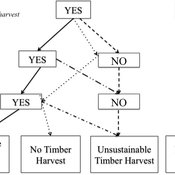
Private forest owner management behavior using social interactions, information flow, and peer-to-peer n
Emily Silver Huff Jessica Leahy Aaron R Weiskittel Caroline L Noblet David Hiebeler | Published Tuesday, October 13, 2015This theoretical model includes forested polygons and three types of agents: forest landowners, foresters, and peer leaders. Agent rules and characteristics were parameterized from existing literature and an empirical survey of forest landowners.
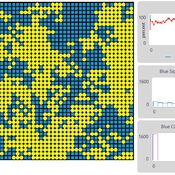
The current model is designed to examine whether—and under what conditions—minority influence can generate social change. Specifically, the model assesses whether empirically validated psychological mechanisms of indirect minority influence, operating in combination, can produce system-level social change, defined as the initial minority opinion becoming the majority position. Notably, this model formalizes Moscovici’s (1976) genetic model of social influence using agent-based modeling.
Wave When the Hale Wale (WWHW)
José Manuel Galán María Pereda Iván Briz I Godino Jorge Caro Débora Zurro Myriam Álvarez José Santos | Published Friday, October 10, 2014 | Last modified Wednesday, April 25, 2018WWHW is an agent-based model designed to allow the exploration of the emergence, resilience and evolution of cooperative behaviours in hunter-fisher-gatherer societies.
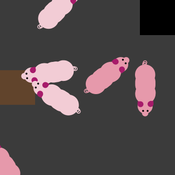
A model on feeding and social interaction behaviour of pigs
Iris J.M.M. Boumans | Published Thursday, May 04, 2017 | Last modified Tuesday, February 27, 2018The model simulates interaction between internal physiological factors (e.g. energy balance) and external social factors (e.g. competition level) underlying feeding and social interaction behaviour of commercially group-housed pigs.
Vertical Communication in Organizations
Victorien Barbet Juliette Rouchier Noé Guiraud vinz2711 | Published Friday, December 20, 2019We propose an ABM replicating the evolution of action oriented groups (like NPO) due to disagreement among members on the practices to implement. Looking at the stability and representativeness (ability of groups to federate) we introduce vertical communication: the possibility for group to communicate around their practices to their members. We test for three levels (to whom it is addressed) and four types (how it influences agents) of communication.
Alternative scenarios of green consumption in Italy: an empirically grounded model.
Giangiacomo Bravo Elena Vallino Alessandro K Cerutti Maria Beatrice Pairotti | Published Thursday, March 28, 2013 | Last modified Saturday, April 27, 2013We provide a full description of the model following the ODD protocol (Grimm et al. 2010) in the attached document. The model is developed in NetLogo 5.0 (Wilenski 1999).
Last Mile Commuter Behavior Model
Moira Zellner Dean Massey Yoram Shiftan Jonathan Levine Maria Arquero | Published Friday, November 07, 2014 | Last modified Friday, November 07, 2014We represent commuters and their preferences for transportation cost, time and safety. Agents assess their options via their preferences, their environment, and the modes available. The model has policy levers to test impact on last-mile problem.
World of Cows - Exploring land-use policies for a dairy-farm world (teaching modeling complex human-environment systems)
Maria Haensel Thomas Michael Schmitt Jakob Bogenreuther | Published Wednesday, January 11, 2023In the “World of Cows”, dairy farmers run their farms and interact with each other, the surrounding agricultural landscape, and the economic and political framework. The model serves as an exemplary case of an interdependent human-environment system.
With the model, users can analyze the influence of policies and markets on land use decisions of dairy farms. The land use decisions taken by farms determine the delivered ecosystem services on the landscape level. Users can choose a combination of five policy options and how strongly market prices fluctuate. Ideally, the choice of policy options fulfills the following three “political goals” 1) dairy farming stays economically viable, 2) the provision of ecosystem services is secured, and 3) government spending on subsidies is as low as possible.
The model has been designed for students to practice agent-based modeling and analyze the impacts of land use policies.
Displaying 10 of 104 results for "María Victoria de-la-Fuente-Aragon" clear search