Our mission is to help computational modelers develop, document, and share their computational models in accordance with community standards and good open science and software engineering practices. Model authors can publish their model source code in the Computational Model Library with narrative documentation as well as metadata that supports open science and emerging norms that facilitate software citation, computational reproducibility / frictionless reuse, and interoperability. Model authors can also request private peer review of their computational models. Models that pass peer review receive a DOI once published.
All users of models published in the library must cite model authors when they use and benefit from their code.
Please check out our model publishing tutorial and feel free to contact us if you have any questions or concerns about publishing your model(s) in the Computational Model Library.
Displaying 10 of 119 results for "Keungoui Kim" clear search
Wedding Doughnut
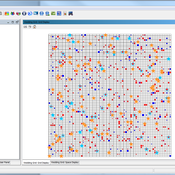
Eric Silverman Jason Hilton Jakub Bijak Viet Cao | Published Thursday, December 20, 2012 | Last modified Friday, September 20, 2013A reimplementation of the Wedding Ring model by Francesco Billari. We investigate partnership formation in an agent-based framework, and combine this with statistical demographic projections using real empirical data.
TransportVarese
Elena Vallino Elena Maggi | Published Tuesday, January 31, 2017 | Last modified Friday, August 04, 2017This ABM deals with commuting choices in the Italian city of Varese. Empirical data inform agents’ attitudes and modal choices costs and emissions. We evaluate ex ante the impact of policies for less polluting commuting choices.
Biodiversity and Adoption of Small-scale Agroforestry in Rwanda (BASAR)
Beatrice Nöldeke Etti Winter Elisée Bahati Ntawuhiganayo | Published Friday, July 15, 2022The BASAR model aims to investigate different approaches to describe small-scale farmers’ decision-making in the context of diversified agroforestry adoption in rural Rwanda. Thereby, it compares random behaviour with perfect rationality (non-discounted and discounted utility maximization), bounded rationality (satisficing and fast and frugal decision tree heuristics), Theory of Planned Behaviour, and a probabilistic regression-based approach. It is aimed at policy-makers, extension agents, and cooperatives to better understand how rural farmers decide about implementing innovative agricultural practices such as agroforestry and at modelers to support them in selecting an approach to represent human decision-making in ABMs of Social-Ecological Systems. The overall objective is to identify a suitable approach to describe human decision-making and therefore improve forecasts of adoption rates and support the development and implementation of interventions that aim to raise low adoption rates.
Peer reviewed Beyond Ethnicity: Intersectionality, Preferences, and the Emergence of Hybrid Segregation in Schelling model
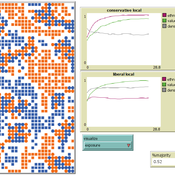
Rocco Paolillo Andreas Flache | Published Tuesday, August 18, 2026Diversity has become a defining feature of most Western societies, where boundaries of membership extend beyond ethnicity to encompass multiple intersecting categories, increasing the complexity of social integration. The aim of this model is to adapt the classical Schelling model of spatial segregation to this context and to identify mechanisms that may generate the hybrid segregation patterns where individuals are segregated from out-groups along one dimension while remaining integrated along others.
We extend the Schelling model using a discrete choice framework that incorporates dominant and secondary preferences among agents from two ethnic groups. Liberal agents prioritize cross-ethnic shared values over ethnicity, whereas conservative agents prioritize ethnic membership over shared values, although both retain some preference for the secondary dimension. The model is designed to explore how heterogeneous preferences and intersecting group memberships interact under different group compositions and initial distributions.

SERDUX-MARCIM: agent-based simulation of cyberattack propagation in maritime critical infrastructure
Diego Edison Cabuya Padilla Carlos A Castaneda-Marroquin Daniel Díaz-López | Published Thursday, August 20, 2026 | Last modified Tuesday, October 20, 2026SERDUX-MARCIM simulates the propagation of a cyberattack over the computational network of an organization in the maritime sector, at the strategic level of decision-making. It is the instantiation of ABM-MARCIM, the agent-based model of the MARCIM framework for the modeling and simulation of maritime cyberdefense.
Every computational asset of the target organization – servers, endpoints, routers, gateways, vessel systems, radars – is an agent that occupies one of six states at each time step: Susceptible, Exposed, Resistant, Degraded, Unavailable or Destroyed, the initials of which give the model its name. The states Degraded, Unavailable and Destroyed are associated with the D5 cyberattack effects (disrupt, degrade, deny, destroy, deceive) as a function of the degree and the duration of the attack. Thirteen transitions between states are admissible.
Unlike a conventional agent-based model, the local update function is not an individual behavioral rule. It is a system of six ordinary differential equations with eight time-dependent transition rates – propagation, cyberattack (degraded), cyberattack (unavailable), cyberattack (destroyed), recovery, sanitation, loss of resistance, and unavailability by other causes. The values of those rates derive from the capabilities of the target organization, the capabilities of the attacker, and the degree and duration of the cyberattack, computed through a cyber risk approach aligned with the OWASP Risk Rating Methodology, the ISACA categorization of security controls and the IMO Guidelines on Maritime Cyber Risk Management.
…
Variations on the Ethnocentrism Model of Hammond and Axelrod
Fredrik Jansson | Published Saturday, November 10, 2012 | Last modified Saturday, April 27, 2013Agents co-operate or defect towards other agents in a prisoner’s dilemma, with strategy choice depending on whether agents share tags or are kin in different social structures.
Model of a Socioterritorial complex system - The Southern Rural Territory of Sergipe
Marcos Aurélio Santos da Silva | Published Friday, May 18, 2018The model represents a set of social actors engaged into a collegiate (composed of representants of civil society and public sector) to manage the Southern Rural Territory of Sergipe (SRTS), created by two territorial public policies, the National Program for the Sustainable Development of Rural Territories (PRONAT) and the Program Territories of Citizenship (PTC) which aim at balancing power relations between social actors of Rural Territories. The main gola of these public policies is to empower the civil society engaged in the territory to enable them to negotiate with the traditional power (mainly majors). It was designed two models of the SRTS, one that represents the situation in 2012, and other that represents the social interdependencies in 2017. For each period it is possible to measure the capability and power of each modeled social actor and see whether it is observed the empowerment of the civil society or not.
MoPAgrIB: simulating savannah landscape mosaic under shifting cultivation
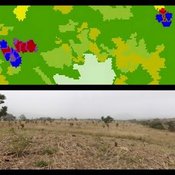
Nicolas Becu Marc Deconchat Eric Garine Kouami Kokou Christine Raimond | Published Monday, May 27, 2013 | Last modified Tuesday, January 21, 2014MoPAgrIB model simulates the movement of cultivated patches in a savannah vegetation mosaic ; how they move and relocate through the landscape, depending on farming practices, population growth, social rules and vegetation growth.
Peer reviewed Flibs’NFarol: Self-Organized Efficiency and Fairness Emergence in an Evolutive Game
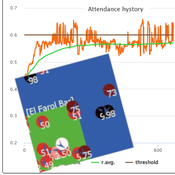
Cosimo Leuci | Published Thursday, October 12, 2023According to the philosopher of science K. Popper “All life is problem solving”. Genetic algorithms aim to leverage Darwinian selection, a fundamental mechanism of biological evolution, so as to tackle various engineering challenges.
Flibs’NFarol is an Agent Based Model that embodies a genetic algorithm applied to the inherently ill-defined “El Farol Bar” problem. Within this context, a group of agents operates under bounded rationality conditions, giving rise to processes of self-organization involving, in the first place, efficiency in the exploitation of available resources. Over time, the attention of scholars has shifted to equity in resource distribution, as well. Nowadays, the problem is recognized as paradigmatic within studies of complex evolutionary systems.
Flibs’NFarol provides a platform to explore and evaluate factors influencing self-organized efficiency and fairness. The model represents agents as finite automata, known as “flibs,” and offers flexibility in modifying the number of internal flibs states, which directly affects their behaviour patterns and, ultimately, the diversity within populations and the complexity of the system.
Leviathan model and its approximation
Thibaut Roubin Guillaume Deffuant | Published Thursday, September 17, 2020 | Last modified Monday, September 06, 2021The model is based on the influence function of the Leviathan model (Deffuant, Carletti, Huet 2013 and Huet and Deffuant 2017). We aim at better explaining some patterns generated by this model, using a derived mathematical approximation of the evolution of the opinions averaged.
We consider agents having an opinion/esteem about each other and about themselves. During dyadic meetings, agents change their respective opinion about each other, and possibly about other agents they gossip about, with a noisy perception of the opinions of their interlocutor. Highly valued agents are more influential in such encounters.
We show that the inequality of reputations among agents have a negative effect on the opinions about the agents of low status.The mathematical analysis of the opinion dynamic shows that the lower the status of the agent, the more detrimental the interactions are for the opinions about this agent, especially when gossip is activated, while the interactions always tend to increase the opinions about agents of high status.
Displaying 10 of 119 results for "Keungoui Kim" clear search