Our mission is to help computational modelers develop, document, and share their computational models in accordance with community standards and good open science and software engineering practices. Model authors can publish their model source code in the Computational Model Library with narrative documentation as well as metadata that supports open science and emerging norms that facilitate software citation, computational reproducibility / frictionless reuse, and interoperability. Model authors can also request private peer review of their computational models. Models that pass peer review receive a DOI once published.
All users of models published in the library must cite model authors when they use and benefit from their code.
Please check out our model publishing tutorial and feel free to contact us if you have any questions or concerns about publishing your model(s) in the Computational Model Library.
Displaying 10 of 99 results scale clear search
MARE: Marine Activity Reordering Evaluations
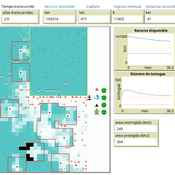
Luis García | Published Thursday, November 19, 2026MARE (Marine Activity Reordering Evaluations) is an exploratory agent-based model of interactions between small-scale fisheries, offshore oil production, and marine conservation in the Bank of Campeche, southern Gulf of Mexico. Adapted from POSEIDON, the model simulates ecological, economic, and spatial dynamics in a shared marine environment. Users can explore alternative management scenarios by varying fishing fleet size, oil platform numbers, and protected-area coverage. MARE illustrates cross-sectoral trade-offs and indirect consequences of management decisions for fish biomass, sea turtle populations, fishing income, and hydrocarbon production. Designed as an interactive tool for scenario exploration and participatory workshops, it supports the analysis of alternative marine spatial management strategies.
Peer reviewed Random Vs Expert movement simulation for different bird groups in Bogota, Colombia
Martin Otalora-Low | Published Thursday, November 05, 2026 | Last modified Thursday, November 12, 2026The model’s primary aim was not to be entirely realistic; instead, it was designed to point to new questions, test the usefulness of the tool, and lay the groundwork for new insights. As such, this model is targeted at ecologists, ornithologists, and urban planners who want to test and simulate how different birds face the challenge of a densely urbanized city that aims to enhance its natural connectivity and foster a wide range of biodiversity. We aimed to identify bird movement at the city-wide scale, encompassing representatives from the entire avian community, while examining differences in movement between totally random models and an informed model, defined by expert criteria.
Scientific Collaboration and Knowledge Production
sciknowledgeprod | Published Wednesday, November 04, 2026A holistic, agent-based model of scientific knowledge production to simulate large-scale collaborative research processes. The model represents the scientific process as a stochastic, cooperative task-completion game where agents repeatedly collaborate on projects that can yield publications.
The model is implemented in Python as an environment in the popular Gymnasium reinforcement learning library.
Essential Workers at Risk: An Agent-Based Model (SAFE-ABM) with Uncertainty Quantification
Elizabeth Amona Edward L Boone | Published Sunday, November 01, 2026This archive contains the SAFE-ABM computational model developed to evaluate targeted intervention strategies for protecting essential workers during epidemic conditions, accompanying the published article “Essential Workers at Risk: An Agent-Based Model (SAFE-ABM) with Uncertainty Quantification” in the Journal of Artificial Societies and Social Simulation, 29(4), Article 7 (2026). https://doi.org/10.18564/jasss.6276. SAFE-ABM is an agent-based model that simulates disease transmission through structured interactions across households, workplaces, and schools, while incorporating stochastic disease progression and uncertainty in transmission, recovery, and mortality parameters.
The model evaluates five intervention scenarios: Scenario 1, no restrictions; Scenario 2, school-from-home; Scenario 3, essential-workers-only movement; Scenario 4, rotational shifts among essential workers with quarantine of symptomatic active workers; and Scenario 5, rotational shifts among essential workers without quarantine. The archive includes scenario-specific simulation scripts, comparison-analysis scripts, saved derived outputs, README documentation, software requirements, and reproducibility notes.
The included comparison scripts reproduce the main numerical summaries and manuscript outputs, including median epidemic trajectories, predictive-uncertainty plots, cumulative recovery and death summaries, inflection-point summaries, Welch-test comparisons, and mutual-information sensitivity rankings. Saved derived outputs are included so that the main figures and tables can be reproduced without rerunning all large-scale simulations.
…
The emergence of new market logics in sustainable food
César García-Díaz | Published Friday, October 30, 2026The model represents a large, traditional firm competing with small, sustainable food producers. The large firm operates under conventional assumptions, pursuing monopoly profits maximized through standard economic principles. Its behavior is driven by economies of scale, which compel small firms to strategically differentiate themselves to deliver added value to consumers. Consequently, small firms focus on offering higher-quality products—a factor that matters significantly to consumers.
The gains achieved by small firms represent social profits that hinge upon establishing co-participation schemes with farmers and building trustworthy relationships with consumers. Cooperation with farmers directly shapes production processes and product quality. Because a firm trusted by one consumer becomes visible to neighbors, trust can diffuse and evolve into a collective identity. Ultimately, population-level legitimation occurs when the organizational form of the organic food producer gains widespread acceptance within the consumer community.
The model’s behavior depends on three key factors: a trust parameter, a legitimation intensity parameter, and an aspiration-level weight (for the large firm).
ZIP-Level Housing Supply Elasticity and Crash Dynamics: A GIS-Based Agent-Based Model of the Washington DC and Northern Virginia Metro Region
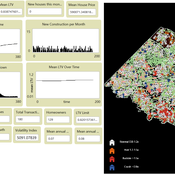
Mansoor Abdul Bari | Published Saturday, August 01, 2026 | Last modified Sunday, August 02, 2026This model tests whether local housing supply elasticity governs crash severity inside a single metropolitan housing market. Saiz (2010) established that across US metros, regions constrained by geography and regulation experience deeper boom-bust cycles than flexible ones. That finding is routinely applied downward to neighborhoods and ZIP codes as though the mechanism scaled without qualification.
The empirical record for the Washington DC and Northern Virginia region says it does not. Across 84 ZIP codes, measured supply elasticity ranges from 0.35 to 4.95 with a median of 1.21. The worst single-year price decline between 2007 and 2012 averaged 9.6 percent in constrained ZIP codes and 9.0 percent in flexible ones, a gap that cannot be distinguished from noise. Wide variation in the proposed cause, no meaningful separation in the proposed effect.
The model embeds households, houses and a metro-wide credit condition in the real ZIP geography of the region using three GIS layers and an empirical price panel. Local elasticity governs construction, exactly as theory predicts. Prices are driven by a shared macro drift schedule and, under the credit-amplified mode, by a leverage cycle with a financial accelerator and a deviation penalty. The design question is whether those shared forces are sufficient to override local supply differences at the sub-metropolitan scale.
…
Agent modeling (ABM) as a tool to improve the mobility of “avoidant” birds in an ecological corridor in the localities of Chapinero, Teusaquillo, Barrios Unidos and Engativá of Bogotá city
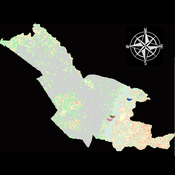
Paula Alejandra Meza Maria Angela Echeverry-Galvis Mauricio González Méndez | Published Wednesday, June 24, 2026The purpose of this model is to analyze different configurations and scenarios of ecological corridors to simulate the movement of three avoider bird species at a local scale: Chondrohierax uncinatus (Accipitridae), a large carnivorous bird; Ampelion rubrocristatus (Cotingidae), a species that seeks areas with substantial land cover for refuge and rest; and Coeligena bonapartei (Trochilidae), a large hummingbird that prefers areas with a rich and diverse food supply. The model focusses on juvenile bird individuals seeking refuge and food, taking into account the mobility parameters of each species and the existing land cover types within the study area.
Specifically, the model aims to:
• Simulate the movement of 45 avoiders birds which are considered umbrella species sensitive to urban changes (which were chosen based on their specific biological and ecological requirements and parameters relevant to urban conservation efforts), 15 avoiders birds per specie to cross a two-dimensional world predominant urban.
• To be able to select which corridor scenario would be the most beneficial, in order to help the mobility of other species affected by urban fragmentation.
• Contribute to urban ecology research and support decision-making processes by relevant stakeholders.
Peer reviewed Boundary crossings as a minimal mechanism for global connectivity in structured landscapes
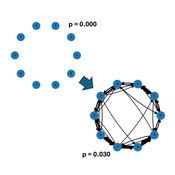
Fabio Nelli | Published Sunday, May 17, 2026 | Last modified Thursday, November 05, 2026This repository contains the Python implementation of an agent-based model investigating how heterogeneous mobility and boundary-crossing dynamics generate large-scale connectivity in structured multi-attractor landscapes. A small fraction of higher-mobility agents explores the environment while the remaining agents stay locally constrained. The model compares pure random-walk exploration, interface-sensitive dynamics, novelty-biased exploration, and a flat-landscape control. The release includes the complete simulation framework, the experimental pipeline used in the associated paper, multi-K and population-scaling robustness analyses, network-snapshot and transition-slope analyses, and reproducibility documentation. Transition networks are analysed using graph density, connected components, and giant weakly connected components. The implementation is compatible with Python 3.11 and is released under the MIT License.
Zensei Wago: A Wealth-Integrated Social Capital Model
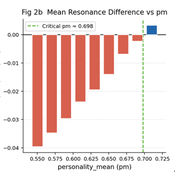
hiiki | Published Friday, May 15, 2026Interest-based compound economies generate monotonically increasing wealth inequality through multiplicative accumulation dynamics, yet the conditions under which gift-based reciprocal exchange outperforms such systems in collective well-being remain unquantified. We present Zensei Wago (全生和合), a seven-layer agent-based model comparing a Gift Resource Circulation (GRC) economy with a Compound Interest Circulation (CIC) economy under identical initial conditions. Across N = 5000 Monte Carlo replications (T = 700 ticks, N = 100 agents), GRC produced significantly higher collective resonance than CIC (p < 0.001, Cohen’s d = +0.171), above a critical prosocial threshold pm ≈ 0.698. Cohen’s d grows monotonically with duration — d = +1.943 at T = 1500 and d = +4.126 at T = 3000 — driven primarily by structural collapse of CIC resonance as inequality exceeds a critical Gini threshold (G > 0.333), while GRC resonance remains stable. The gift mechanism further decouples collective well-being from distributional outcomes, generating resonance through relational quality rather than material redistribution. Network topology analysis across seven configurations — combining a Watts-Strogatz rewiring sweep and a T = 1500 longitudinal replication — reveals that ring topology maximises GRC advantage (d = +1.17), that most topology-dependent reversals are transient (sparse and small-world both transition to significantly positive by T = 1500), and that a critical rewiring threshold of p ≈ 0.10–0.20 separates GRC-advantaged from GRC-disadvantaged network configurations. Scale-free networks remain persistently adverse (d = -7.24*), requiring structural redesign for gift-economy viability.
Simulating Climate Stress and Social Instability: An Agent-Based Model of Ecosystem Degradation and Violence in Coastal Communities
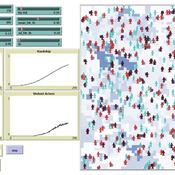
hurtado-valdivieso Jacopo A. Baggio | Published Sunday, April 12, 2026This model is an agent-based simulation designed to explore how climate-induced environmental degradation can contribute to the emergence of social violence in coastal communities that depend heavily on ecosystem services for their livelihoods. The model represents a coupled social–ecological system in which environmental shocks—such as sea level rise and marine ecosystem decline—affect local economic conditions, food security, and community stability.
Agents in the model represent individuals whose livelihoods depend on coastal ecosystems. Environmental degradation reduces ecosystem productivity and increases economic hardship, which can lead to the formation of grievances among agents. The model incorporates behavioral thresholds that determine how individuals respond to hardship and perceived injustice. Under certain conditions—particularly when institutional capacity and law enforcement effectiveness are limited—these grievances may escalate into violent behavior.
The simulation allows users to explore how different climate scenarios, levels of ecosystem degradation, livelihood dependence, and institutional responses influence the probability of social instability and violence. By modeling the interactions between environmental stress, socio-economic vulnerability, and governance capacity, the model provides a computational framework for examining potential pathways linking climate change and conflict in coastal social–ecological systems.
…
Displaying 10 of 99 results scale clear search