Our mission is to help computational modelers develop, document, and share their computational models in accordance with community standards and good open science and software engineering practices. Model authors can publish their model source code in the Computational Model Library with narrative documentation as well as metadata that supports open science and emerging norms that facilitate software citation, computational reproducibility / frictionless reuse, and interoperability. Model authors can also request private peer review of their computational models. Models that pass peer review receive a DOI once published.
All users of models published in the library must cite model authors when they use and benefit from their code.
Please check out our model publishing tutorial and feel free to contact us if you have any questions or concerns about publishing your model(s) in the Computational Model Library.
Displaying 10 of 734 results agent-based clear search
From Population Diversity to Contact Diversity: A Network-Based Generalization of the Greenberg Index
Marco Civico | Published Tuesday, October 13, 2026This repository contains a Python simulation script for studying network-based linguistic diversity. The model extends the classic Greenberg Diversity Index by introducing diversity measures defined over social ties rather than only over population shares. It also includes two extensions: a competence-conditioned version and a multilayer version.
Designing Fulfilling and Productive Workdays: Effects of Task Meaningfulness Sequences on Daily Engagement and Performance
S.R. Aurora (a.k.a. Mai P. Trinh) | Published Sunday, October 11, 2026Given the importance of experiencing fulfilling and productive workdays, scholars have focused on ways to boost employees’ daily engagement and performance, suggesting this may be accomplished by increasing meaningfulness of their work tasks. However, an alternative approach may be needed in multifaceted work contexts where employees need to complete sets of varied tasks each day, including tasks that lack meaningfulness. To address this issue, we integrate the workday design perspective with research on residual engagement to examine implications of strategically sequencing tasks in terms of their meaningfulness. We theorize that because of a process we refer to as engagement cascade, performing the day’s most highly meaningful tasks earlier and in a concentrated manner will tend to produce higher levels of daily engagement relative to sequences in which the most highly meaningful tasks occur later or are disbursed. We use agent-based modeling to formalize the engagement cascade process and generate specific predictions regarding how daily engagement is impacted by different task meaningfulness sequences. Findings from an intensive longitudinal design study with NASA and ROSCOSMOS crew members (Study 1), an experience sampling field experiment with full-time employees (Study 2), and two controlled laboratory experiments with undergraduates (Study 3 and Supplement to Study 3) provide support for our hypotheses. Specifically, the decreasing task meaningfulness sequence engendered higher levels of daily engagement, and in turn, daily performance, relative to increasing, inverted U-shaped, and U-shaped sequences.
HOSS(-5): Human Organizations Simulations Start
José Quintás Alonso | Published Friday, October 09, 2026HOSS(-5) is an exploratory agent-based prototype of a small artificial society, written in Python. Each agent is a “ph” (punto humano, “human point”) that is born, is educated, works, consumes and dies. Its yearly decisions depend on a psychological profile (archetype × character), its economic status and its intentionality. Agents interact indirectly through families, firms in 10 sectors, a labour market with about 200 job categories, and a State that provides public services, employment and a Universal Basic Income, adjusting taxes and UBI each year to seek fiscal balance.
The model simulates a few thousand agents over decades of virtual time and records yearly aggregates (population, GDP, income, Gini index, HDI). A separate analysis script explores the results and fits Gamma distributions to individual incomes, comparing the shape parameter with Gini and HDI.
HOSS does not aim to predict real societies or claim empirical validation. It is a sandbox for comparing scenarios and thinking about the organizational design of society from an engineering perspective. Known limitations: no direct social relations between agents, prices and production follow simple rules rather than supply-demand dynamics, and organizations are black boxes.
…
Viking Sailing: Simulation of Viking era small ship sailing
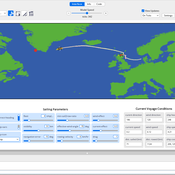
C Michael Barton | Published Wednesday, October 07, 2026Viking Sailing is a spatially explicit agent-based simulation for conditional exploration of how rasterized coastlines, wind, and
surface-current conditions interact with simplified ship movement, sailing, rowing, navigation, and land-avoidance rules. The
model compares simulated route trajectories and terminal outcomes for hypothetical Viking-era small-ship voyages. It includes an example dataset representing sea surface winds and currents from June 1000 CE. Additional data can are downloaded from Zenodo: https://zenodo.org/records/23213147.
Netlogo Aquaponic Simulation
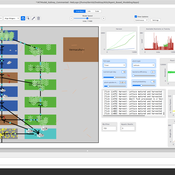
Derrick | Published Tuesday, October 06, 2026 | Last modified Wednesday, October 07, 2026This agent-based aquaponics simulation models the biological resilience and complex dynamics of a closed-loop agricultural system. Designed for educational use and agricultural research, the model helps aquaponic designers, farmers, and hobbyists understand systemic dynamics and stress-test species configurations prior to a physical build. The simulation dynamically models the nitrogen cycle by tracking aquatic bio-loads, bacterial filtration, and plant nutrient uptake. Utilizing real-world biological metrics from the Loyola Global Aquatic Excrement Dataset, the model calculates species-specific ammonia excretion rates (toxicity) for various aquatic life, including Trout, Tilapia, and Goldfish. Nitrifying bacteria agents convert this toxicity into usable nitrates, which are then absorbed by specific crop agents—such as Tomatoes, Swiss Chard, or Lettuce—at variable rates. Key features include dynamic stochastic harvesting, measurable agent health, vermaculture and crawdad integration, and reactive biological mitigators like emergency duckweed buffering. The system also introduces chaotic environmental variables, allowing users to test the agricultural setup’s resilience against random shocks like bio-filter pump failures and temperature crashes. This model is released under the GNU General Public License v3.0 (GPL-3.0) to encourage collaborative improvement within the academic and farming communities.

Artificial Anasazi: Baseline Fixes, Dynamic Soil and Plot Crowding
Thomas Tuoti | Published Sunday, October 04, 2026Artificial Anasazi is an agent-based model of farming households in the Long House Valley, Arizona, from 800 to 1350 CE. Each household chooses where to farm and settle based on expected harvest, water sources and stored maize, and simulated household counts are compared with the archaeological record.
This release adapts the NetLogo Models Library version (Stonedahl & Wilensky 2010) of Janssen’s (2009) NetLogo replication of the original Ascape model (Dean et al. 2000; Axtell et al. 2002). It contains four configurations in one NetLogo 7.0.4 file, selected with two switches:
- Both switches off: the baseline, which is the Models Library model with small fixes that make it work as intended (the arable-uplands zone name, the setup base yield, the initial household count, one-tick-lag capacity reporting, and seed control with observation-only instruments).
soil-on?: dynamic soil quality that depletes under cultivation and regrows, following Janssen (2010, eq. 4).
…
Anchored logistic agent-based model of cooperation among fourteen European Union member states, with structural diagnostics
Alessandro Brugnoletti | Published Friday, October 02, 2026An agent-based model in which fourteen European Union member states each carry a cooperation
propensity in [0,1], updated by a logistic link applied to a latent index that combines the unit’s
own previous state, a weighted average of the other units’ states, and four min-max normalised
exogenous indicators (cooperative benefit, opportunistic temptation, systemic exit cost,
intertemporal confidence). The logistic centres are anchored so that the observed 2024
configuration is an exact fixed point of the baseline map, the device that makes such models
…
BOUNDARYBOAR simulation tool
Christophe Le Page Céline Fromont Raphaël Mathevet | Published Wednesday, September 30, 2026An agent-based model to explore human–wild boar interactions in urban and suburban landscapes at the interface with agricultural land and natural habitats, by simulating wild boar population growth, mortality, and movements across the landscape
Aquaponics & Multitrophic System Simulation
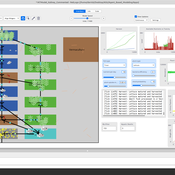
derrickatasu | Published Friday, September 25, 2026 | Last modified Thursday, October 08, 2026An agent-based model built in NetLogo that simulates a closed-loop recirculating aquaponics and integrated multitrophic aquaculture (IMTA) ecosystem, modeling the complex dynamics between aquatic species, vermaculture, and hydroponic plant beds. This model captures the operational mechanics of a complex, sustainable production network. It tracks nutrient flows, water recirculation pathways, biological growth stages, and environmental feedback penalties (such as nutrient toxicity or starvation) across multiple specialized tanks and grow beds. Model Architecture & HabitatsAquatic Subsystem: Duckweed Tank, Breeding Tank, Fry Tank, Fingerling Tank, Adult Tank, and a Holding Tank for harvested fish. Benthic & Waste Management: Crawdad Tank 1 & 2 for bottom-feeding and waste processing, alongside a Vermaculture node populated by composting worms. Hydroponic Subsystem: Five sequential Grow Beds and a recirculating loop feeding back into the system. Key Agent DynamicsWater Flow Visualization: Active links between tanks spawn animated droplet agents that visually simulate recirculating water dynamics across the network. Biological Growth & Aging: Fish and plants progress through age-based development thresholds governed by species-specific parameters. Feedback Loops:Toxicity Penalty: Excess nutrients (nutrient-per-day > 80) slow fish growth rates by 50%. Starvation Penalty: Insufficient nutrient levels (nutrient-per-day < 30) delay plant maturation by 50%. Interface Controlsfish-type Chooser: Selects the primary aquatic species (Tilapia, Channel Catfish, Trout, Goldfish), altering base growth thresholds. plant-type Chooser: Selects the cultivated crop (Lettuce, Basil, Tomatoes, Mint). nutrient-per-day Slider: Manages daily nutrient input to balance system load and avoid toxicity or starvation thresholds. Dashboard Plot: Real-time tracking of total-fish-harvested and total-plants-harvested.
Peer reviewed An agent-based implementation of the optimal foraging patch choice model for multiple individuals
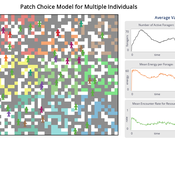
C Michael Barton | Published Sunday, September 20, 2026patch_choice_enhanced.nlogox is an agent-based model (ABM) implementing the patch choice model from optimal foraging theory (OFT) in a multi-agent simulation environment. It extends the classical single-forager, equation-based Marginal Value Theorem (MVT) formulation to support multiple competing foragers, demographic processes, bounded memory, and stochastic resource dynamics on a spatially heterogeneous landscape.
Displaying 10 of 734 results agent-based clear search