The Informational Assumptions of Schelling Segregation: An Agent-Based Decomposition of Cue Inference, Cultural Schemas, and Residential Sorting (1.0.0)
This computational model accompanies the article “The Informational Assumptions of Schelling Segregation: An Agent-Based Decomposition of Cue Inference, Cultural Schemas, and Residential Sorting.” It implements an agent-based model in which agents infer latent neighborhood-type classes from noisy non-demographic cues through schema-specific diagnostic mappings, update beliefs, and relocate when satisfaction on a preferred latent class falls below a threshold.
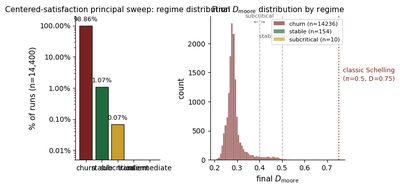
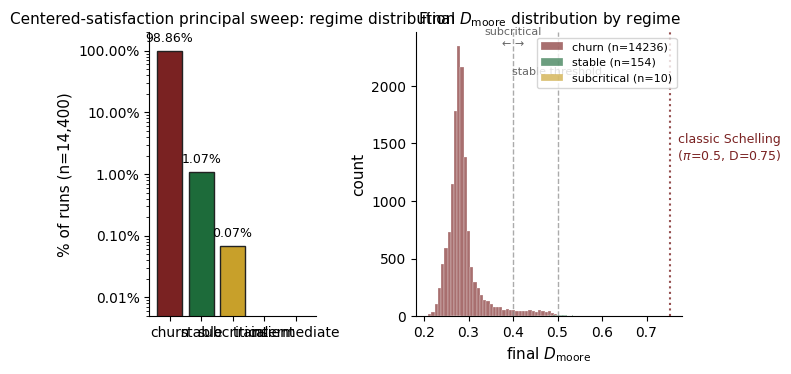
The model serves as a mechanism-isolation device for studying the informational architecture underlying Schelling-style residential sorting. It includes the principal sweep configuration (14,400 runs across a seven-parameter grid), a disagreement-metric sub-sweep with permutation-minimized Jensen-Shannon divergence recorded natively, controls (positive, negative, and frozen-belief), a paired-seed cue-channel perturbation experiment, and selected-cell sensitivity sweeps for cue persistence and home-biased mobility.
The full ODD protocol, parameter manifests, deterministic seed schedules, processed outputs, regenerable figure scripts, the verification test suite, and the satisfaction-mapping audit document are included. Every reported run is deterministic given a (config, seed) pair, and an included audit script verifies bit-for-bit replay on sampled runs.
Release Notes
Initial release accompanying the manuscript submission to JASSS. Includes the principal sweep (14,400 runs, 7-parameter grid, 20 replicates per cell), the disagreement-metric sub-sweep (4,800 runs with permutation-minimized Jensen-Shannon divergence recorded natively), the Stage 2.5 broader replication (900 runs), three control conditions (positive, negative, frozen-belief), the paired-seed cue-channel perturbation experiment, and cue-persistence and home-biased mobility sensitivity sweeps. The full ODD protocol, methods archive, parameter manifests, deterministic seed schedules, regenerable figure scripts, verification test suite, and satisfaction-mapping audit are included. Every reported run is deterministic given a (config, seed) pair, and the included audit script verifies bit-for-bit replay on sampled runs. Restricted-for-review access at submission; will be made public on acceptance.
Associated Publications
Gladstone, E. (under review). The Informational Assumptions of Schelling Segregation: An Agent-Based Decomposition of Cue Inference, Cultural Schemas, and Residential Sorting. Journal of Artificial Societies and Social Simulation.
The Informational Assumptions of Schelling Segregation: An Agent-Based Decomposition of Cue Inference, Cultural Schemas, and Residential Sorting 1.0.0
Submitted byEric GladstonePublished May 13, 2026
Last modified May 13, 2026
This computational model accompanies the article “The Informational Assumptions of Schelling Segregation: An Agent-Based Decomposition of Cue Inference, Cultural Schemas, and Residential Sorting.” It implements an agent-based model in which agents infer latent neighborhood-type classes from noisy non-demographic cues through schema-specific diagnostic mappings, update beliefs, and relocate when satisfaction on a preferred latent class falls below a threshold.
The model serves as a mechanism-isolation device for studying the informational architecture underlying Schelling-style residential sorting. It includes the principal sweep configuration (14,400 runs across a seven-parameter grid), a disagreement-metric sub-sweep with permutation-minimized Jensen-Shannon divergence recorded natively, controls (positive, negative, and frozen-belief), a paired-seed cue-channel perturbation experiment, and selected-cell sensitivity sweeps for cue persistence and home-biased mobility.
The full ODD protocol, parameter manifests, deterministic seed schedules, processed outputs, regenerable figure scripts, the verification test suite, and the satisfaction-mapping audit document are included. Every reported run is deterministic given a (config, seed) pair, and an included audit script verifies bit-for-bit replay on sampled runs.
Release Notes
Initial release accompanying the manuscript submission to JASSS. Includes the principal sweep (14,400 runs, 7-parameter grid, 20 replicates per cell), the disagreement-metric sub-sweep (4,800 runs with permutation-minimized Jensen-Shannon divergence recorded natively), the Stage 2.5 broader replication (900 runs), three control conditions (positive, negative, frozen-belief), the paired-seed cue-channel perturbation experiment, and cue-persistence and home-biased mobility sensitivity sweeps. The full ODD protocol, methods archive, parameter manifests, deterministic seed schedules, regenerable figure scripts, verification test suite, and satisfaction-mapping audit are included. Every reported run is deterministic given a (config, seed) pair, and the included audit script verifies bit-for-bit replay on sampled runs. Restricted-for-review access at submission; will be made public on acceptance.
Schelling, T. C. (1971). Dynamic models of segregation. Journal of Mathematical Sociology, 1(2), 143–186.
This model is not a direct replication but a theoretical extension of the Schelling tradition. A classic Schelling baseline is implemented for like-with-like comparison.
Associated Publication(s)
Gladstone, E. (under review). The Informational Assumptions of Schelling Segregation: An Agent-Based Decomposition of Cue Inference, Cultural Schemas, and Residential Sorting. Journal of Artificial Societies and Social Simulation.
References
Berg, N., Hoffrage, U., & Abramczuk, K. (2010). Fast acceptance by common experience: FACE-recognition in Schelling’s model of neighborhood segregation. Judgment and Decision Making, 5(5), 391–410.
Grimm, V., et al. (2020). The ODD protocol for describing agent-based and other simulation models: A second update to improve clarity, replication, and structural realism. Journal of Artificial Societies and Social Simulation, 23(2), 7.
Galán, J. M., et al. (2009). Errors and artefacts in agent-based modelling. Journal of Artificial Societies and Social Simulation, 12(1), 1.
Create an Open Code Badge that links to this model more info
This model has not been reviewed by CoMSES Net and should be independently reviewed to
meet the Open Code Badge guidelines.
You can use the following HTML or Markdown code to create an Open Code Badge that links to
version 1.0.0
of this computational model.
This website uses cookies and Google Analytics to help us track user engagement and improve our site. If
you'd like to know more information about what data we collect and why, please see
our data privacy policy. If you continue to use this site, you consent to
our use of cookies.