Our mission is to help computational modelers develop, document, and share their computational models in accordance with community standards and good open science and software engineering practices. Model authors can publish their model source code in the Computational Model Library with narrative documentation as well as metadata that supports open science and emerging norms that facilitate software citation, computational reproducibility / frictionless reuse, and interoperability. Model authors can also request private peer review of their computational models. Models that pass peer review receive a DOI once published.
All users of models published in the library must cite model authors when they use and benefit from their code.
Please check out our model publishing tutorial and feel free to contact us if you have any questions or concerns about publishing your model(s) in the Computational Model Library.
Displaying 7 of 7 results Leadership clear search
C/PA Model with Leaders (Dictator and Democrat stubborn and Democrat with feedback)
N. Leticia Abrica-Jacinto Evguenii Kurmyshev Fernando Flores Briceño | Published Tuesday, July 28, 2026This entry provides an Agent-Based Model (ABM) of opinion and tolerance dynamics in artificial societies, implemented in the frame of the Concord/Partial Antagonism (C/PA) model. This version is specifically designed to investigate the impact of asymmetric influence through two leadership archetypes—Dictator and Democrat—within networked societies.
The model is highly modular, allowing the user to simulate three distinct social scenarios:
Baseline C/PA: Self-organization of a society without external influence.
Stubborn Leadership: Introduction of a “solid conviction” leader (Dictator or Democrat) who exerts constant pressure without changing their own stance.
Feedback Leadership: A democratic leader receptive to social feedback, where the leader’s opinion evolves based on interactions with the population.
Theoretical Foundations:
…
An agent-based model of scapegoating
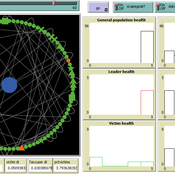
Carlos Paes | Published Thursday, August 28, 2025 | Last modified Thursday, August 28, 2025This agent-based model investigates scapegoating as a social mechanism of crisis management. Inspired by René Girard’s mimetic theory, it simulates how individual tension accumulates and spreads across a small-world network. When tension exceeds certain thresholds, leaders emerge and accuse marginalized agents, who may attempt to transfer blame to substitutes. If scapegoating occurs, collective tension decreases, but victims become isolated while leaders consolidate temporary authority. This simulation provides a conceptual and methodological framework for exploring how collective blame, crisis contagion, and leadership paradoxes emerge in complex networks. It can also be extended with empirical data, such as social media dynamics of online harassment and virtual lynching, offering potential applications for both theoretical research and practical crisis monitoring.
Status hierarchies and the emergence of cooperation in task groups
Hsuan-Wei Lee | Published Thursday, January 02, 2025This repository contains an agent-based simulation model exploring how status hierarchies influence the emergence and sustainability of cooperation in task-oriented groups. The model builds on evolutionary game theory to examine the dynamics of cooperation under single-leader and multi-leader hierarchies, investigating factors such as group size, assortativity, and hierarchical clarity. Key findings highlight the trade-offs between different leadership structures in fostering group cooperation and reveal the conditions under which cooperation is most stable.
The repository includes code for simulations, numerical analysis scripts, and visualization tools to replicate the results presented in the manuscript titled “Status hierarchies and the emergence of cooperation in task groups.”
Feel free to explore, reproduce the findings, or adapt the model for further research!
Formal Organization Hierarchy and Informal Networks - "The Company Behind the Org Chart"
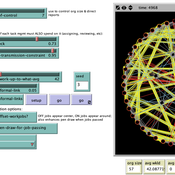
Tom Briggs | Published Sunday, April 18, 2021A generalized organizational agent- based model (ABM) containing both formal organizational hierarchy and informal social networks simulates organizational processes that occur over both formal network ties and informal networks.
PA/C model with affinity
N. Leticia Abrica-Jacinto Evguenii Kurmyshev Héctor Juárez | Published Thursday, October 27, 2016We expose RA agent-based model of the opinion and tolerance dynamics in artificial societies. The formal mathematical model is based on the ideas of Social Influence, Social Judgment, and Social Identity theories.
Nice Musical Chairs
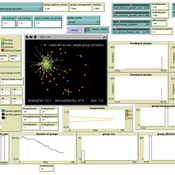
Andreas Angourakis | Published Friday, February 05, 2016 | Last modified Friday, November 17, 2017The Nice Musical Chairs (NMC) model represent the competition for space between groups of stakeholders of farming and herding activities in the arid Afro-Eurasia.
A simple emulation-based computational model
Carlos M Fernández-Márquez Francisco J Vázquez | Published Tuesday, May 21, 2013 | Last modified Tuesday, February 05, 2019Emulation is one of the simplest and most common mechanisms of social interaction. In this paper we introduce a descriptive computational model that attempts to capture the underlying dynamics of social processes led by emulation.