Computational Model Library

An agent-based model of scapegoating (1.0.1)

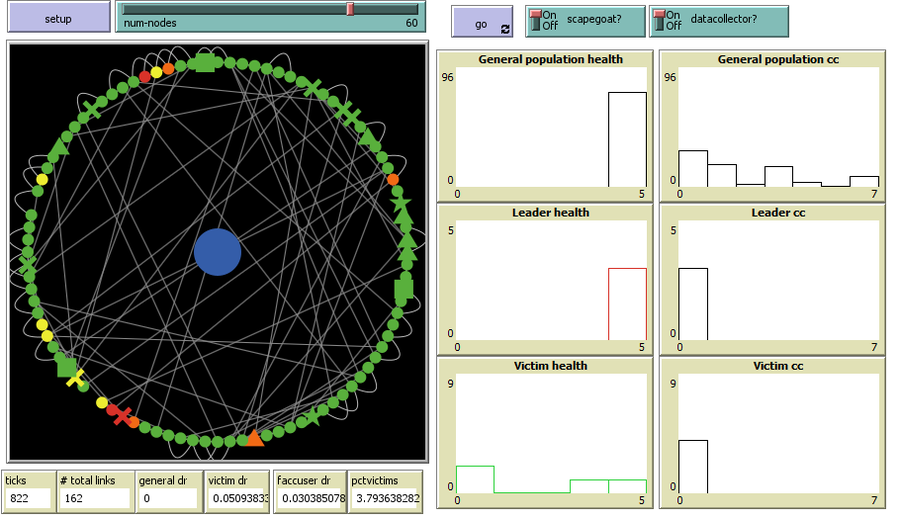
An agent-based model of the scapegoat mechanism of René Girard’s mimetic theory on a coevolving network. Agents accumulate tension from a shared stressor and from contagion; an agent whose whole neighbourhood is saturated accuses another; ties reorganise around accusers; once the marked exceed a tenth of the living, a threshold rule expels one of them and the group’s tension is discharged. The model asks when a stressed population reaches the collective act, what it costs and what it leaves behind: without the accusation rules tension saturates and most of the population dies; with them tension stays low and the cost falls on a few; closure (the reluctance to form new ties) decides whether expulsion occurs and skepticism decides when; the act’s lasting mark is a lower division into communities. A null model, the ablation of each rule, six initial networks and controls on the reach of the relief test the results. Release 1.1.0 is the package behind a manuscript submitted to JASSS (November 2026): six model versions, the per-tick output of every series, daily aggregates of eight anonymised episodes of online hostility and the scripts that regenerate every table and figure. Releases 1.0.x hold an earlier version of the model alone.
Captura de tela 2024-12-02 063013.png

Release Notes

An agent-based model of the scapegoat mechanism, after René Girard. Thirty to a hundred agents on a small-world ring (Watts–Strogatz, from the NetLogo Small Worlds model) accumulate tension and propagate it to their neighbours. A saturated agent surrounded by saturated agents transfers its tension onto a target, chosen first among isolated agents; the network either follows the transfer, making the transferrer an amplifying pole, or does not. Once more than a tenth of the agents are marked and a pole exists, one marked target is expelled, the rest adhere to the pole, and a new agent takes the empty place. Three parameters — population, closure and skepticism — vary the rate and the shape of the episode. This is the model behind the runs published at omecanismo.org/en/model.

Associated Publications

An agent-based model of scapegoating 1.0.1

An agent-based model of the scapegoat mechanism of René Girard’s mimetic theory on a coevolving network. Agents accumulate tension from a shared stressor and from contagion; an agent whose whole neighbourhood is saturated accuses another; ties reorganise around accusers; once the marked exceed a tenth of the living, a threshold rule expels one of them and the group’s tension is discharged. The model asks when a stressed population reaches the collective act, what it costs and what it leaves behind: without the accusation rules tension saturates and most of the population dies; with them tension stays low and the cost falls on a few; closure (the reluctance to form new ties) decides whether expulsion occurs and skepticism decides when; the act’s lasting mark is a lower division into communities. A null model, the ablation of each rule, six initial networks and controls on the reach of the relief test the results. Release 1.1.0 is the package behind a manuscript submitted to JASSS (November 2026): six model versions, the per-tick output of every series, daily aggregates of eight anonymised episodes of online hostility and the scripts that regenerate every table and figure. Releases 1.0.x hold an earlier version of the model alone.

Release Notes

An agent-based model of the scapegoat mechanism, after René Girard. Thirty to a hundred agents on a small-world ring (Watts–Strogatz, from the NetLogo Small Worlds model) accumulate tension and propagate it to their neighbours. A saturated agent surrounded by saturated agents transfers its tension onto a target, chosen first among isolated agents; the network either follows the transfer, making the transferrer an amplifying pole, or does not. Once more than a tenth of the agents are marked and a pole exists, one marked target is expelled, the rest adhere to the pole, and a new agent takes the empty place. Three parameters — population, closure and skepticism — vary the rate and the shape of the episode. This is the model behind the runs published at omecanismo.org/en/model.

Version Submitter First published Last modified Status
1.0.1 Carlos Paes Thu Aug 28 18:08:44 2025 Sun Nov 8 12:17:25 2026 Published
1.0.0 Carlos Paes Thu Aug 28 17:40:37 2025 Sun Nov 8 12:17:24 2026 Published

Discussion

This website uses cookies and Google Analytics to help us track user engagement and improve our site. If you'd like to know more information about what data we collect and why, please see our data privacy policy. If you continue to use this site, you consent to our use of cookies.
Accept