Our mission is to help computational modelers develop, document, and share their computational models in accordance with community standards and good open science and software engineering practices. Model authors can publish their model source code in the Computational Model Library with narrative documentation as well as metadata that supports open science and emerging norms that facilitate software citation, computational reproducibility / frictionless reuse, and interoperability. Model authors can also request private peer review of their computational models. Models that pass peer review receive a DOI once published.
All users of models published in the library must cite model authors when they use and benefit from their code.
Please check out our model publishing tutorial and feel free to contact us if you have any questions or concerns about publishing your model(s) in the Computational Model Library.
Displaying 10 of 21 results for "Miriam Crisman" clear search
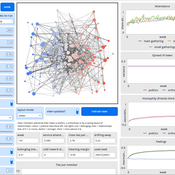
Trifold Community Model, version 1.0
Eric Fernandes de Mello Araujo Miriam Crisman Damaris Parsitau | Published Friday, November 13, 2026An agent-based model of one community whose members meet every week. Members decide whether to attend the community’s gatherings, meet partners there, reveal or withhold their views on two topics, and judge each partner as “like me” or as one of “those people”. Views move toward accepted voices and are held by each member’s starting view. Each conversation has a feeling, which updates the member’s warmth toward her own side and toward the other side and strengthens or weakens the tie between the two partners; ties decide belonging, and belonging decides attendance. Listening enters as one trait, conversational receptiveness. The release includes the BehaviorSpace setup file and the output of every run reported in the accompanying paper.
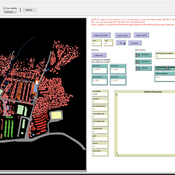
AIforGoodSimulator - Modeling Covid-19 Spread and Potential Interventions in Refugee Camps
Shyaam Ramkumar Woi Sok Oh | Published Thursday, March 18, 2021The Netlogo model is a conceptualization of the Moria refugee camp, capturing the household demographics of refugees in the camp, a theoretical friendship network based on values, and an abstraction of their daily activities. The model then simulates how Covid-19 could spread through the camp if one refugee is exposed to the virus, utilizing transmission probabilities and the stages of disease progression of Covid-19 from susceptible to exposed to asymptomatic / symptomatic to mild / severe to recovered from literature. The model also incorporates various interventions - PPE, lockdown, isolation of symptomatic refugees - to analyze how they could mitigate the spread of the virus through the camp.
Peer reviewed Gradient Descent Simulation
Ilyes Azouani | Published Wednesday, March 18, 2026 | Last modified Monday, May 25, 2026This model visualizes gradient descent optimization - the fundamental algorithm used to train neural networks and other machine learning models. Agents represent different optimization algorithms searching for the minimum of a loss landscape (the “error surface” that ML models try to minimize during training).
The model demonstrates how different optimizer types (SGD, Momentum with different parameters) behave on various loss landscapes, from simple bowls to the notoriously difficult Rosenbrock “banana valley” function. This helps build intuition about why certain optimization algorithms work better than others for different problem geometries.
HOW IT WORKS
…
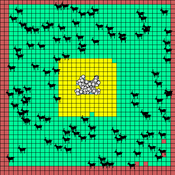
TERRoir level Organic matter Interactions and Recycling model
Myriam Grillot | Published Wednesday, April 19, 2017 | Last modified Wednesday, June 17, 2020The TERROIR agent-based model was built for the multi-level analysis of biomass and nutrient flows within agro-sylvo-pastoral villages in West Africa. It explicitly takes into account both human organization and spatial extension of such flows.
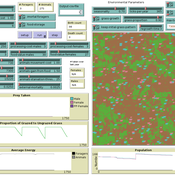
Peer reviewed The Megafauna Hunting Pressure Model
Isaac Ullah Miriam C. Kopels | Published Friday, February 16, 2024 | Last modified Friday, October 11, 2024The Megafaunal Hunting Pressure Model (MHPM) is an interactive, agent-based model designed to conduct experiments to test megaherbivore extinction hypotheses. The MHPM is a model of large-bodied ungulate population dynamics with human predation in a simplified, but dynamic grassland environment. The overall purpose of the model is to understand how environmental dynamics and human predation preferences interact with ungulate life history characteristics to affect ungulate population dynamics over time. The model considers patterns in environmental change, human hunting behavior, prey profitability, herd demography, herd movement, and animal life history as relevant to this main purpose. The model is constructed in the NetLogo modeling platform (Version 6.3.0; Wilensky, 1999).
Peer reviewed Modelling value change; An exploratory approach
Tristan de Wildt Ibo van de Poel | Published Tuesday, June 20, 2023 | Last modified Tuesday, December 12, 2023This model has been developed together with the publication ‘Modelling Value Change - An Exploratory Approach’
Value change and moral change have increasingly become topics of interest in the philosophical literature. Several theoretical accounts have been proposed. Such accounts are usually based on certain theoretical and conceptual assumptions and their strengths and weaknesses are often hard to determine and compare, also because they are based on limited empirical evidence.
We propose that a step forward can be made with the help of agent-based modelling (ABM). ABM can be used to investigate whether a simulation model based on a specific account of value change can reproduce relevant phenomena. To illustrate this approach, we built a model based on the pragmatist account of value change proposed in van de Poel and Kudina (2022). We show that this model can reproduce four relevant phenomena, namely 1) the inevitability and stability of values, 2) how different societies may react differently to external shocks, 3) moral revolutions, and 4) lock-in.
MIXTRUST - crop-livestock interactions at regional level
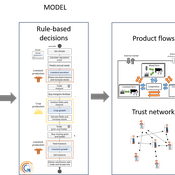
Myriam Grillot Aurélien Peter | Published Tuesday, February 25, 2025 | Last modified Monday, September 01, 2025The basic idea behind developing MIXTRUST was to represent a network of agricultural stakeholders composed of farmers and a cooperative in a mixed landscape to test its performances in response to risks. A mixed landscape here is a landscape where crop and livestock systems interact by the intermediary of material flows of agricultural products. It can be within mixed farms, or between farms, often specialized, (e.g. straw-manure).
Mitigating bioenergy-driven biodiversity decline: a modelling approach with the European brown hare
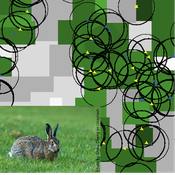
Volker Grimm Maria Langhammer | Published Wednesday, November 13, 2019 | Last modified Tuesday, November 24, 2020The model is designed to analyse the effects of mitigation measures on the European brown hare (Lepus europaeus), which is directly affected by ongoing land use change and has experienced widespread decline throughout Europe since the 1960s. As an input, we use two 4×4 km large model landscapes, which were generated by a landscape generator based on real field sizes and crop proportions and differed in average field size and crop composition. The crops grown annually are evaluated in terms of forage suitability, breeding suitability and crop richness for the hare. Six mitigation scenarios are implemented, defined by a 10 % increase in: (1) mixed silphie, (2) miscanthus, (3) grass-clover ley, (4) alfalfa, (5) set-aside, and (6) general crop richness. The model shows that that both landscape configuration and composition have a significant effect on hare population development, which responds particularly strongly to compositional changes.
Peer reviewed Agent-Based Model of Avian Movement and Functional Connectivity in Bogotá: Evaluating the 'Media Luna del Sur' Ecological Corridor (POT 2022–2035)
Maria Emilia Pelaez De Los Rios | Published Monday, September 14, 2026This NetLogo model simulates the movement and foraging behavior of 20 bird species (classified as urban avoiders or utilizers) across a 20×20m grid landscape representing southern Bogotá, Colombia. Agents follow an optimal foraging strategy (90% of the time) or move randomly (10%), gaining energy from land-cover-dependent food sources and dying if energy falls below their basal metabolic rate. The model compares two landscape scenarios — current land cover (2016) and a proposed scenario incorporating the ‘Media Luna del Sur’ ecological corridor from Bogotá’s 2022–2035 Land Use Plan (POT) — to evaluate whether the proposed green infrastructure improves functional connectivity for avian biodiversity across the urban matrix. Outputs include cumulative patch visitation counts, exported as raster files, used to generate connectivity heatmaps.
Vulnerability of Cooperation Due to Limited Vision
Marco Janssen | Published Thursday, December 02, 2010 | Last modified Saturday, April 27, 2013This model describes the consequences of limited vision of agents in harvesting a common resource. We show the vulnerability of cooperation due to reduced visibility of the resource and other agents.
Displaying 10 of 21 results for "Miriam Crisman" clear search