Our mission is to help computational modelers develop, document, and share their computational models in accordance with community standards and good open science and software engineering practices. Model authors can publish their model source code in the Computational Model Library with narrative documentation as well as metadata that supports open science and emerging norms that facilitate software citation, computational reproducibility / frictionless reuse, and interoperability. Model authors can also request private peer review of their computational models. Models that pass peer review receive a DOI once published.
All users of models published in the library must cite model authors when they use and benefit from their code.
Please check out our model publishing tutorial and feel free to contact us if you have any questions or concerns about publishing your model(s) in the Computational Model Library.
Displaying 10 of 287 results for "Eckhard Auch" clear search
WEEM (Woodlot Establishment and Expansion Model)
Vianny Ahimbisibwe Jürgen Groeneveld Melvin Lippe Susan Balaba Tumwebaze Eckhard Auch Uta Berger | Published Monday, September 27, 2021The agent-based model WEEM (Woodlot Establishment and Expansion Model) as described in the journal article, has been designed to make use of household socio-demographics (household status, birth, and death events of households), to better understand the temporal dynamics of woodlot in the buffer zones of Budongo protected forest reserve, Masindi district, Uganda. The results contribute to a mechanistic understanding of what determines the current gap between intention and actual behavior in forest land restoration at farm level.
Netlogo Aquaponic Simulation
Derrick | Published Tuesday, October 06, 2026 | Last modified Wednesday, October 21, 2026This agent-based aquaponics simulation models the biological resilience and complex dynamics of a closed-loop agricultural system. Designed for educational use and agricultural research, the model helps aquaponic designers, farmers, and hobbyists understand systemic dynamics and stress-test species configurations prior to a physical build. The simulation dynamically models the nitrogen cycle by tracking aquatic bio-loads, bacterial filtration, and plant nutrient uptake. Utilizing real-world biological metrics from the Loyola Global Aquatic Excrement Dataset, the model calculates species-specific ammonia excretion rates (toxicity) for various aquatic life, including Trout, Tilapia, and Goldfish. Nitrifying bacteria agents convert this toxicity into usable nitrates, which are then absorbed by specific crop agents—such as Tomatoes, Swiss Chard, or Lettuce—at variable rates. Key features include dynamic stochastic harvesting, measurable agent health, vermaculture and crawdad integration, and reactive biological mitigators like emergency duckweed buffering. The system also introduces chaotic environmental variables, allowing users to test the agricultural setup’s resilience against random shocks like bio-filter pump failures and temperature crashes. This model is released under the GNU General Public License v3.0 (GPL-3.0) to encourage collaborative improvement within the academic and farming communities.
Peter Diamond's Coconut Model (Heterogeneity and Learning)
Sven Banisch Eckehard Olbrich | Published Monday, May 30, 2016Agent-based version of the simple search and barter economy conceived by Peter Diamond in 1982. The model is also known as Coconut Model.
The Informational Dynamics of Regime Change
Dominik Klein Johannes Marx | Published Saturday, October 07, 2017 | Last modified Tuesday, January 14, 2020We model the epistemic dynamics preceding political uprising. Before deciding whether to start protests, agents need to estimate the amount of discontent with the regime. This model simulates the dynamics of group knowledge about general discontent.
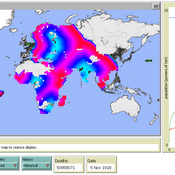
A Modelling4All/NetLogo model of the Spanish Flu Pandemic
Ken Kahn | Published Monday, August 05, 2013 | Last modified Monday, August 05, 2013A global model of the 1918-19 Influenza Pandemic. It can be run to match history or explore counterfactual questions about the influence of World War I on the dynamics of the epidemic. Explores two theories of the location of the initial infection.
An agent-based model of cultural change for a low-carbon transition
Daniel Torren-Peraire | Published Friday, November 10, 2023An ABM of changes in individuals’ lifestyles which considers their
evolving behavioural choices. Individuals have a set of environmental behavioural traits that spread through a fixed Watts–Strogatz graph via social interactions with their neighbours. These exchanges are mediated by transmission biases informing from whom an individual learns and
how much attention is paid. The influence of individuals on each other is a function of their similarity in environmental identity, where we represent environmental identity computationally by aggregating past agent attitudes towards multiple environmentally related behaviours. To perform a behaviour, agents must both have
a sufficiently positive attitude toward a behaviour and overcome a corresponding threshold. This threshold
structure, where the desire to perform a behaviour does not equal its enactment, allows for a lack of coherence
between attitudes and actual emissions. This leads to a disconnect between what people believe and what
…
00 PSoup V1.22 – Primordial Soup
Garvin Boyle | Published Thursday, April 13, 2017PSoup is an educational program in which evolution is demonstrated, on the desk-top, as you watch. Blind bugs evolve sophisticated heuristic search algorithms to be the best at finding food fast.
Interactions between organizations and social networks in common-pool resource governance
Phesi Project | Published Monday, October 29, 2012 | Last modified Saturday, April 27, 2013Explores how social networks affect implementation of institutional rules in a common pool resource.
Models associated with paper entitled "Polarization in Social Media: A Virtual Worlds-Based Approach"
Dennis Jacob Sven Banisch | Published Thursday, June 22, 2023This model contains MATLAB code describing the virtual worlds framework used in the paper entitled “Polarization in Social Media: A Virtual Worlds-Based Approach.” The parent directory contains driver code for replicating results from the paper. Additionally, the source code is structured by three directories:
- Data Structures: Contains classes and objects used in the code, such as the virtualWorlds.m
- Metrics: Contains code which computes metrics, such as congruentLinks.m
- Visualization: Contains code for generating pictures and plots, such as drawSystemState.m
…
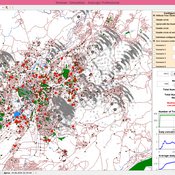
Hybrid individual- and particle-based simulation model and data on air pollutants and vertical greenery systems in the city of Yerevan, Armenia
Andranik Akopov | Published Friday, June 19, 2020Urban greenery such as vertical greenery systems (VGS) can effectively absorb air pollutants emitted by different agents, such as vehicles and manufacturing enterprises. The main challenge is how to protect socially important objects, such as kindergartens, from the influence if air pollution with the minimum of expenditure. There is proposed the hybrid individual- and particle-based model of interactions between vertical greenery systems and air pollutants to identify optimal locations of tree clusters and high-rise buildings where horizontal greenery systems and VGS should be implemented, respectively. The model is implemented in the AnyLogic simulation tool.
Displaying 10 of 287 results for "Eckhard Auch" clear search