Our mission is to help computational modelers develop, document, and share their computational models in accordance with community standards and good open science and software engineering practices. Model authors can publish their model source code in the Computational Model Library with narrative documentation as well as metadata that supports open science and emerging norms that facilitate software citation, computational reproducibility / frictionless reuse, and interoperability. Model authors can also request private peer review of their computational models. Models that pass peer review receive a DOI once published.
All users of models published in the library must cite model authors when they use and benefit from their code.
Please check out our model publishing tutorial and feel free to contact us if you have any questions or concerns about publishing your model(s) in the Computational Model Library.
Displaying 10 of 839 results NetLogo clear search
Mobility Sharing for Social Integration: A Reverse Schelling Model
Hongmou Zhang | Published Thursday, October 15, 2026This model extends Schelling’s segregation model with mobility sharing. Agents of two groups occupy cells of a 32 × 32 grid and repeatedly choose activity destinations subject to a preference threshold, the minimum share of ingroup neighbours they accept. Trips are matched into shared rides between members of different groups, using one of four matching algorithms on a shareability network (maximal cross-group matching, maximum weight matching on contact time, maximum cardinality matching, or random greedy matching) with a maximum detour constraint. After each trip, an agent’s preference threshold changes with the time spent in contact with outgroup members.
Starting from complete segregation, the model examines under which conditions contact during shared trips leads to integration. Besides the main scenario, in which contact always lowers the threshold, it includes two extensions. In the first, a share of adversarial agents becomes less tolerant with contact, and this share grows or shrinks with the current level of segregation, governed by a branching dissimilarity index and a conversion rate. In the second, each contact raises or lowers the threshold with a probability that depends on the agent’s current attitude relative to a compatibility threshold.
Segregation is measured with the index of dissimilarity and the Gini coefficient. The model file includes BehaviorSpace experiments for each analysis in the associated article. The matching step uses the NetworkX library through the Python extension of NetLogo (requires Python 3 with numpy and networkx 3.x).
When Contact Backfires, and When It Does Not: A Computational Model of the Opinion Dynamics of Intergroup Attitudes
Andreas Flache Alla Loseva Yade Rotte | Published Wednesday, October 14, 2026This model represents individuals from two different groups interacting and sharing attitudes toward both groups. Through these interactions, individuals adjust their attitudes, which can lead to different outcomes in opinion dynamics. The model can study both intra-group and inter-group opinion dynamics. Under certain conditions, agents with initially moderate attitudes might enter a negative spiral, leading to increasingly extreme intergroup attitudes. Alternatively, these moderate attitudes can foster consensus between groups, resulting in agreement on intergroup attitudes. This model serves as a tool for exploring opinion polarization, particularly in contexts where attitudes evolve through interaction rather than remaining static.
By adjusting different parameters, one can examine the effects of variations in attitude distributions; group size and relative group size; contributions of xenophobia, opinion distance, and individual attitudes towards the outgroup; as well as ratio between xenophobia and attitudinal bias to the overall intergroup bias.
The model accompanies the paper When contact backfires, and when it does not: A computational model of the opinion dynamics of intergroup attitudes.
Designing Fulfilling and Productive Workdays: Effects of Task Meaningfulness Sequences on Daily Engagement and Performance
S.R. Aurora (a.k.a. Mai P. Trinh) | Published Sunday, October 11, 2026Given the importance of experiencing fulfilling and productive workdays, scholars have focused on ways to boost employees’ daily engagement and performance, suggesting this may be accomplished by increasing meaningfulness of their work tasks. However, an alternative approach may be needed in multifaceted work contexts where employees need to complete sets of varied tasks each day, including tasks that lack meaningfulness. To address this issue, we integrate the workday design perspective with research on residual engagement to examine implications of strategically sequencing tasks in terms of their meaningfulness. We theorize that because of a process we refer to as engagement cascade, performing the day’s most highly meaningful tasks earlier and in a concentrated manner will tend to produce higher levels of daily engagement relative to sequences in which the most highly meaningful tasks occur later or are disbursed. We use agent-based modeling to formalize the engagement cascade process and generate specific predictions regarding how daily engagement is impacted by different task meaningfulness sequences. Findings from an intensive longitudinal design study with NASA and ROSCOSMOS crew members (Study 1), an experience sampling field experiment with full-time employees (Study 2), and two controlled laboratory experiments with undergraduates (Study 3 and Supplement to Study 3) provide support for our hypotheses. Specifically, the decreasing task meaningfulness sequence engendered higher levels of daily engagement, and in turn, daily performance, relative to increasing, inverted U-shaped, and U-shaped sequences.
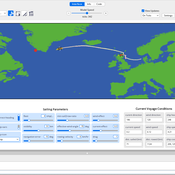
Viking Sailing: Simulation of Viking era small ship sailing
C Michael Barton | Published Wednesday, October 07, 2026Viking Sailing is a spatially explicit agent-based simulation for conditional exploration of how rasterized coastlines, wind, and
surface-current conditions interact with simplified ship movement, sailing, rowing, navigation, and land-avoidance rules. The
model compares simulated route trajectories and terminal outcomes for hypothetical Viking-era small-ship voyages. It includes an example dataset representing sea surface winds and currents from June 1000 CE. Additional data can are downloaded from Zenodo: https://zenodo.org/records/23213147.
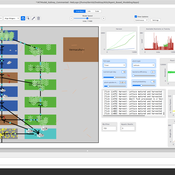
Netlogo Aquaponic Simulation
Derrick | Published Tuesday, October 06, 2026 | Last modified Wednesday, October 07, 2026This agent-based aquaponics simulation models the biological resilience and complex dynamics of a closed-loop agricultural system. Designed for educational use and agricultural research, the model helps aquaponic designers, farmers, and hobbyists understand systemic dynamics and stress-test species configurations prior to a physical build. The simulation dynamically models the nitrogen cycle by tracking aquatic bio-loads, bacterial filtration, and plant nutrient uptake. Utilizing real-world biological metrics from the Loyola Global Aquatic Excrement Dataset, the model calculates species-specific ammonia excretion rates (toxicity) for various aquatic life, including Trout, Tilapia, and Goldfish. Nitrifying bacteria agents convert this toxicity into usable nitrates, which are then absorbed by specific crop agents—such as Tomatoes, Swiss Chard, or Lettuce—at variable rates. Key features include dynamic stochastic harvesting, measurable agent health, vermaculture and crawdad integration, and reactive biological mitigators like emergency duckweed buffering. The system also introduces chaotic environmental variables, allowing users to test the agricultural setup’s resilience against random shocks like bio-filter pump failures and temperature crashes. This model is released under the GNU General Public License v3.0 (GPL-3.0) to encourage collaborative improvement within the academic and farming communities.

Artificial Anasazi: Baseline Fixes, Dynamic Soil and Plot Crowding
Thomas Tuoti | Published Sunday, October 04, 2026Artificial Anasazi is an agent-based model of farming households in the Long House Valley, Arizona, from 800 to 1350 CE. Each household chooses where to farm and settle based on expected harvest, water sources and stored maize, and simulated household counts are compared with the archaeological record.
This release adapts the NetLogo Models Library version (Stonedahl & Wilensky 2010) of Janssen’s (2009) NetLogo replication of the original Ascape model (Dean et al. 2000; Axtell et al. 2002). It contains four configurations in one NetLogo 7.0.4 file, selected with two switches:
- Both switches off: the baseline, which is the Models Library model with small fixes that make it work as intended (the arable-uplands zone name, the setup base yield, the initial household count, one-tick-lag capacity reporting, and seed control with observation-only instruments).
soil-on?: dynamic soil quality that depletes under cultivation and regrows, following Janssen (2010, eq. 4).
…
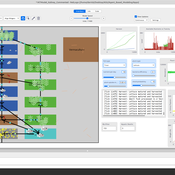
Aquaponics & Multitrophic System Simulation
derrickatasu | Published Friday, September 25, 2026 | Last modified Thursday, October 08, 2026An agent-based model built in NetLogo that simulates a closed-loop recirculating aquaponics and integrated multitrophic aquaculture (IMTA) ecosystem, modeling the complex dynamics between aquatic species, vermaculture, and hydroponic plant beds. This model captures the operational mechanics of a complex, sustainable production network. It tracks nutrient flows, water recirculation pathways, biological growth stages, and environmental feedback penalties (such as nutrient toxicity or starvation) across multiple specialized tanks and grow beds. Model Architecture & HabitatsAquatic Subsystem: Duckweed Tank, Breeding Tank, Fry Tank, Fingerling Tank, Adult Tank, and a Holding Tank for harvested fish. Benthic & Waste Management: Crawdad Tank 1 & 2 for bottom-feeding and waste processing, alongside a Vermaculture node populated by composting worms. Hydroponic Subsystem: Five sequential Grow Beds and a recirculating loop feeding back into the system. Key Agent DynamicsWater Flow Visualization: Active links between tanks spawn animated droplet agents that visually simulate recirculating water dynamics across the network. Biological Growth & Aging: Fish and plants progress through age-based development thresholds governed by species-specific parameters. Feedback Loops:Toxicity Penalty: Excess nutrients (nutrient-per-day > 80) slow fish growth rates by 50%. Starvation Penalty: Insufficient nutrient levels (nutrient-per-day < 30) delay plant maturation by 50%. Interface Controlsfish-type Chooser: Selects the primary aquatic species (Tilapia, Channel Catfish, Trout, Goldfish), altering base growth thresholds. plant-type Chooser: Selects the cultivated crop (Lettuce, Basil, Tomatoes, Mint). nutrient-per-day Slider: Manages daily nutrient input to balance system load and avoid toxicity or starvation thresholds. Dashboard Plot: Real-time tracking of total-fish-harvested and total-plants-harvested.
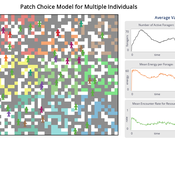
Peer reviewed An agent-based implementation of the optimal foraging patch choice model for multiple individuals
C Michael Barton | Published Sunday, September 20, 2026patch_choice_enhanced.nlogox is an agent-based model (ABM) implementing the patch choice model from optimal foraging theory (OFT) in a multi-agent simulation environment. It extends the classical single-forager, equation-based Marginal Value Theorem (MVT) formulation to support multiple competing foragers, demographic processes, bounded memory, and stochastic resource dynamics on a spatially heterogeneous landscape.
Norms@Risk ABM aim is to develop an explanation for the conditions under which people jointly take action to prevent disasters from happening, e.g. impacts from climate crisis, pandemic. The aim of the Norms@Risk work is to explore understudied dynamics between risk, social norms and cooperative behaviour and their role in overcoming collective threats. More specifically, Norms@Risk seeks to refine existing theory on cooperation by unpacking the role of collective risk interacting with social norms in ‘Collective Risk Social Dilemmas’*.
This simulation study takes on the next scientific iteration after a series of behavioural experiments. With the model we target to refine existing theory by capturing the heterogeneity in contributions that existing theories cannot fully explain as the behavioural responses are assumed to be more homogenous, particularly diversity regarding sensitivity to risk and norms.
*Collective Risk Social Dilemmas reflect a special type of social dilemma, unlike typical public goods, the collective risk dilemma involves individual contribution not to realise a gain, but to avoid a collective loss.
…
Cumulative knowledges learning in networks
Juliette Rouchier Victorien Barbet | Published Wednesday, September 16, 2026We built a model of knowledges diffusion in networks. The particularity is that knowledges to be passed on are cumulative : rely on previous acquisition of specific knowledges of a lower level to be passed from an agent to another. We test for different types of networks, different selection rules for the knowledge to be passed and the possibility to introduce a turnover among agents.
We concentrate on the learning speed and the convergence level of the learning process.
Displaying 10 of 839 results NetLogo clear search