Our mission is to help computational modelers develop, document, and share their computational models in accordance with community standards and good open science and software engineering practices. Model authors can publish their model source code in the Computational Model Library with narrative documentation as well as metadata that supports open science and emerging norms that facilitate software citation, computational reproducibility / frictionless reuse, and interoperability. Model authors can also request private peer review of their computational models. Models that pass peer review receive a DOI once published.
All users of models published in the library must cite model authors when they use and benefit from their code.
Please check out our model publishing tutorial and feel free to contact us if you have any questions or concerns about publishing your model(s) in the Computational Model Library.
Displaying 10 of 185 results for "Woi Sok Oh" clear search
The Urban Drought Nexus Tool
Roger Cremades Muhamad Khairulbahri | Published Thursday, December 14, 2023The “Urban Drought Nexus Tool” is a system dynamics model, aiming to facilitate the co-development of climate services for cities under increasing droughts. The tool integrates multiple types of information and still can be applied to other case studies with minimal adjustments on the parameters of land use, water consumption and energy use in the water sector. The tool needs hydrological projections under climate scenarios to evaluate climatic futures, and requires the co-creation of socio-economic future scenarios with local stakeholders. Thus it is possible to provide specific information about droughts taking into account future water availability and future water consumption. Ultimately, such complex system as formed by the water-energy-land nexus can be reduced to single variables of interest, e.g. the number of events with no water available in the future and their length, so that the complexities are reduced and the results can be conveyed to society in an understandable way, including the communication of uncertainties. The tool and an explanatory guide in pdf format are included. Planned further developments include calibrating the system dynamics model with the social dynamics behind each flow with agent-based models.
Friendship Games Rev 1.0
David Dixon | Published Friday, October 07, 2011 | Last modified Saturday, April 27, 2013A friendship game is a kind of network game: a game theory model on a network. This is a NetLogo model of an agent-based adaptation of “‘Friendship-based’ Games” by PJ Lamberson. The agents reach an equilibrium that depends on the strategy played and the topology of the network.
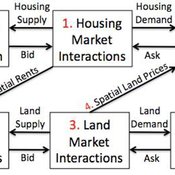
Coupled Housing and Land Markets (CHALMS)
Nicholas Magliocca Virginia Mcconnell Margaret Walls | Published Friday, November 02, 2012 | Last modified Monday, October 27, 2014CHALMS simulates housing and land market interactions between housing consumers, developers, and farmers in a growing ex-urban area.
The NetLogo HIV Spread Model Exploring Impact of PrEP Indication Guidelines
Uri Wilensky Wouter Vermeer Arthur Hjorth | Published Friday, June 05, 2020This agent-based model was built as part of a replication effort of Jeness et al.’s work (linked below). The model simulates an MSM sexual activity network for the purpose of modeling the effects of respectively PrEP and ART on HIV prevention. The purpose of the model is to explore the differences between differerent interpretations of the NIH Indication Guidelines for PrEP.

REHAB: A Role Playing Game to Explore the Influence of Knowledge and Communication on Natural Resources Management
Christophe Le Page Anne Dray Pascal Perez Claude Garcia | Published Monday, July 13, 2015 | Last modified Monday, July 13, 2015REHAB has been designed as an ice-breaker in courses dealing with ecosystem management and participatory modelling. It helps introducing the two main tools used by the Companion Modelling approach, namely role-playing games and agent-based models.
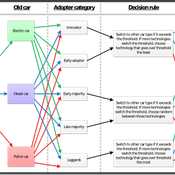
(De-)Stabilising effect of diffusions
Julia Kasmire Bert Van Meeuwen Cornelis Eikelboom | Published Tuesday, August 11, 2015What is stable: the large but coordinated change during a diffusion or the small but constant and uncoordinated changes during a dynamic equilibrium? This agent-based model of a diffusion creates output that reveal insights for system stability.
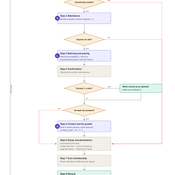
Peer reviewed LSCs-CF: An agent-based model of public space conditions and the collective formation of local sports communities
Yijia JIANG | Published Thursday, August 13, 2026 | Last modified Thursday, August 20, 2026An agent-based model of how public space conditions shape the collective formation of local sports communities in high-mobility cities. A small gathering is already exercising in an abstract, systematically configurable public space; the model asks how strangers join them and whether the loose gathering consolidates into a stable community. Three conditions are manipulated, each acting through exactly one channel: spatial legibility governs whether a passer-by notices the activity, routine compatibility governs whether a member attends in a given week, and social anchor availability governs how much one episode of co-presence builds a tie. Ties carry a continuous strength with two thresholds, so that relationships of differing strength cross their thresholds at different condition levels. Because the model does not represent the origin of an activity, dissolution is irreversible and survival is a clean binary outcome. Across 32,790 runs in eight experiments the model yields two well separated thresholds along routine compatibility — one for survival, one for consolidation — with a wide band between them in which a space is used continuously but no community forms. The tie submodel is adapted from Jin, Girvan and Newman (2001) and verified against it by docking. Robustness is established against the seeded gathering, the pre-existing social network, a joint ±20 per cent perturbation of the behavioural parameters, and the parameters of the tie machinery.
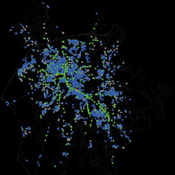
Bicycle encounter model
Gudrun Wallentin | Published Saturday, October 29, 2016 | Last modified Friday, March 29, 2019This Bicycle encounter model builds on the Salzburg Bicycle model (Wallentin & Loidl, 2015). It simulates cyclist flows and encounters, which are locations of potential accidents between cyclists.
Telephone Game
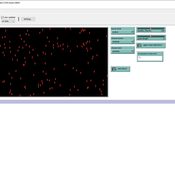
Julia Kasmire | Published Friday, January 10, 2020This is a model of a game of Telephone (also known as Chinese Whishpers in the UK), with agents representing people that can be asked, to play. The first player selects a word from their internal vocabulary and “whispers” it to the next player, who may mishear it depending on the current noise level, who whispers that word to the next player, and so on.
When the game ends, the word chosen by the first player is compared to the word heard by the last player. If they match exactly, all players earn large prize. If the words do not match exactly, a small prize is awarded to all players for each part of the words that do match. Players change color to reflect their current prize-count. A histogram shows the distribution of colors over all the players.
The user can decide on factors like
* how many players there are,
…
Sensitivity of a population submitted to floods to unknown upcoming floods and parameters of the dynamics
Sylvie Huet | Published Wednesday, September 22, 2021This work is a java implementation of a study of the viability of a population submitted to floods. The population derives some benefit from living in a certain environment. However, in this environment, floods can occur and cause damage. An individual protection measure can be adopted by those who wish and have the means to do so. The protection measure reduces the damage in case of a flood. However, the effectiveness of this measure deteriorates over time. Individual motivation to adopt this measure is boosted by the occurrence of a flood. Moreover, the public authorities can encourage the population to adopt this measure by carrying out information campaigns, but this comes at a cost. People’s decisions are modelled based on the Protection Motivation Theory (Rogers1975, Rogers 1997, Maddux1983) arguing that the motivation to protect themselves depends on their perception of risk, their capacity to cope with risk and their socio-demographic characteristics.
While the control designing proper informations campaigns to remain viable every time is computed in the work presented in https://www.comses.net/codebases/e5c17b1f-0121-4461-9ae2-919b6fe27cc4/releases/1.0.0/, the aim of the present work is to produce maps of probable viability in case the serie of upcoming floods is unknown as well as much of the parameters for the population dynamics. These maps are bi-dimensional, based on the value of known parameters: the current average wealth of the population and their actual or possible future annual revenues.
Displaying 10 of 185 results for "Woi Sok Oh" clear search