Our mission is to help computational modelers develop, document, and share their computational models in accordance with community standards and good open science and software engineering practices. Model authors can publish their model source code in the Computational Model Library with narrative documentation as well as metadata that supports open science and emerging norms that facilitate software citation, computational reproducibility / frictionless reuse, and interoperability. Model authors can also request private peer review of their computational models. Models that pass peer review receive a DOI once published.
All users of models published in the library must cite model authors when they use and benefit from their code.
Please check out our model publishing tutorial and feel free to contact us if you have any questions or concerns about publishing your model(s) in the Computational Model Library.
Displaying 10 of 124 results for "Michael Barton" clear search
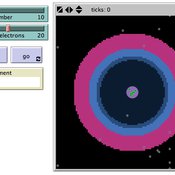
Due to teacher requests to represent changes in atomic radius, we developed a visualization of the first 36 elements in Netlogo
Genetic Algorithm and Food Choice
Diego Martín Díaz Córdova | Published Monday, August 10, 2026This models simulate how people choose their food buyings based on a limited budget and a food quality index. In order to make the choice the agents call a genetic algorithm who optimizes the buying. The agents are distributed randomly and there are 5 store options where agents can buy meat, fruits and vegetables, bread, ultraprocessed and medications. Agents need all of them, each of one has a different price and a different quality index. The genetic algorithm perform an optimization procedure in order to clasiffy what food set is the best for each agent. The agents are coloured based on their budget if the’ve got less than 100, then they are pink otherwise they are white.
Managing networked landscapes: conservation in fragmented, regionally connected world
Jacopo A. Baggio Michael Schoon Sechindra Vallury | Published Monday, December 09, 2019Exploring how learning and social-ecological networks influence management choice set and their ability to increase the likelihood of species coexistence (i.e. biodiversity) on a fragmented landscape controlled by different managers.
Agent-Based Model of a Circular Food Packaging Ecosystem to assess Packaging Waste Dynamics
Annoek Reitsema | Published Friday, October 11, 2024Reducing packaging waste is a critical challenge that requires organizations to collaborate within circular ecosystems, considering social, economic, and technical variables like decision-making behavior, material prices, and available technologies. Agent-Based Modeling (ABM) offers a valuable methodology for understanding these complex dynamics. In our research, we have developed an ABM to explore circular ecosystems’ potential in reducing packaging waste, using a case study of the Dutch food packaging ecosystem. The model incorporates three types of agents—beverage producers, packaging producers, and waste treaters—who can form closed-loop recycling systems.
Beverage Producer Agents: These agents represent the beverage company divided into five types based on packaging formats: cans, PET bottles, glass bottles, cartons, and bag-in-boxes. Each producer has specific packaging demands based on product volume, type, weight, and reuse potential. They select packaging suppliers annually, guided by deterministic decision styles: bargaining (seeking the lowest price) or problem-solving (prioritizing high recycled content).
Packaging Producer Agents: These agents are responsible for creating packaging using either recycled or virgin materials. The model assumes a mix of monopolistic and competitive market situations, with agents calculating annual material needs. Decision styles influence their choices: bargaining agents compare recycled and virgin material costs, while problem-solving agents prioritize maximum recycled content. They calculate recycled content in packaging and set prices accordingly, ensuring all produced packaging is sold within or outside the model.
…
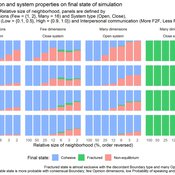
Simulating Components of the Reinforcing Spirals Model and Spiral of Silence
František Kalvas Michael D. Slater Ashley Sanders-Jackson | Published Friday, November 05, 2021Communication processes occur in complex dynamic systems impacted by person attitudes and beliefs, environmental affordances, interpersonal interactions and other variables that all change over time. Many of the current approaches utilized by Communication researchers are unable to consider the full complexity of communication systems or the over time nature of our data. We apply agent-based modeling to the Reinforcing Spirals Model and the Spiral of Silence to better elucidate the complex and dynamic nature of this process. Our preliminary results illustrate how environmental affordances (i.e. social media), closeness of the system and probability of outspokenness may impact how attitudes change over time. Additional analyses are also proposed.
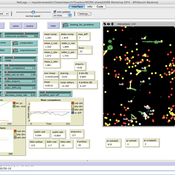
Inquisitiveness in ad hoc teams
Davide Secchi | Published Sunday, October 18, 2015 | Last modified Thursday, June 11, 2020This model builds on inquisitiveness as a key individual disposition to expand the bounds of their rationality. It represents a system where teams are formed around problems and inquisitive agents integrate competencies to find ‘emergent’ solutions.
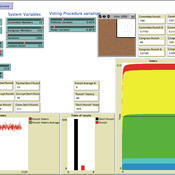
Sunshine or Shield?: Secret Voting Procedures and Legislative Accountability
Matthew Taylor Michele Buttò Carlos Pereira | Published Tuesday, June 24, 2014 | Last modified Monday, April 08, 2019An agent-based model is used to simulate legislators’ behavior under secret voting rules, as influenced by the power of the accused politician, the composition of the voting body, and the publicity of the accusations.
The Pampas Model: An agent-based model of agricultural systems in the Argentinean Pampas
Michael North Federico Bert Guillermo P Podestá Santiago L Rovere Charles Macal | Published Tuesday, July 16, 2013 | Last modified Tuesday, February 17, 2015The Pampas Model is an Agent-Based Model intended to explore the dynamics of structural and land use changes in agricultural systems of the Argentine Pampas in response to climatic, technological economic, and political drivers.
MCR Model
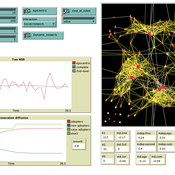
Davide Secchi Nuno R Barros De Oliveira | Published Friday, July 22, 2016 | Last modified Saturday, January 23, 2021The aim of the model is to define when researcher’s assumptions of dependence or independence of cases in multiple case study research affect the results — hence, the understanding of these cases.
Peer reviewed An agent-based model for brain drain
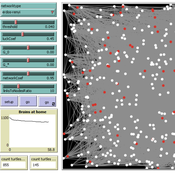
Furkan Gürsoy Bertan Badur | Published Wednesday, March 03, 2021 | Last modified Friday, March 12, 2021An agent-based model for the emigration of highly-skilled labour.
We hypothesise that there are two main factors that impact the decision and ability to move abroad: desire to maximise individual utility and network effects. Accordingly, several factors play role in brain drain such as the overall economic and social differences between the home and host countries, people’s ability and capacity to obtain good jobs and start a life abroad, the barriers of moving abroad, and people’s social network who are already working abroad.
Displaying 10 of 124 results for "Michael Barton" clear search