Our mission is to help computational modelers develop, document, and share their computational models in accordance with community standards and good open science and software engineering practices. Model authors can publish their model source code in the Computational Model Library with narrative documentation as well as metadata that supports open science and emerging norms that facilitate software citation, computational reproducibility / frictionless reuse, and interoperability. Model authors can also request private peer review of their computational models. Models that pass peer review receive a DOI once published.
All users of models published in the library must cite model authors when they use and benefit from their code.
Please check out our model publishing tutorial and feel free to contact us if you have any questions or concerns about publishing your model(s) in the Computational Model Library.
Displaying 10 of 1163 results for "Bin-Tzong Chi" clear search
EU language skills
Marco Civico | Published Sunday, July 07, 2024The objective of this agent-based model is to test different language education orientations and their consequences for the EU population in terms of linguistic disenfranchisement, that is, the inability of citizens to understand EU documents and parliamentary discussions should their native language(s) no longer be official. I will focus on the impact of linguistic distance and language learning. Ideally, this model would be a tool to help EU policy makers make informed decisions about language practices and education policies, taking into account their consequences in terms of diversity and linguistic disenfranchisement. The model can be used to force agents to make certain choices in terms of language skills acquisition. The user can then go on to compare different scenarios in which language skills are acquired according to different rationales. The idea is that, by forcing agents to adopt certain language learning strategies, the model user can simulate policies promoting the acquisition of language skills and get an idea of their impact. In this way the model allows not only to sketch various scenarios of the evolution of language skills among EU citizens, but also to estimate the level of disenfranchisement in each of these scenarios.
PSMED - Patagonia Simple Model of Ethnic Differentiation
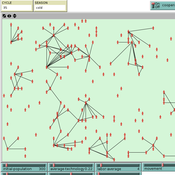
Xavier Vilà Joan A Barceló J A Cuesta Florencia Del Castillo Ricardo Del Olmo José M Galán Laura Mameli Francisco J Miguel David Poza José I Santos | Published Tuesday, December 10, 2013Patagonia PSMED is an agent-based model designed to study a simple case of Evolution of Ethnic Differentiation. It replicates how can hunter-gatherer societies evolve and built cultural identities as a consequence of the way they interacted.
NarrABS
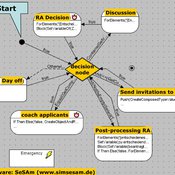
Tilman Schenk | Published Thursday, September 20, 2012 | Last modified Saturday, April 27, 2013An agent based simulation of a political process based on stakeholder narratives
A Replication of Rolf Zieglers Kula Ring Simulation
Rhian Stotts | Published Tuesday, December 16, 2008 | Last modified Saturday, April 27, 2013This model is a simulation of the ceremonial exchange network in Papua New Guinea called the Kula Ring. In the Kula Ring, there are two types of gifts that travel in opposite directions: armshells co
Income Model
Tony Lawson | Published Monday, August 26, 2013This is the code for the model described in an article in the International Journal of Microsimulation. Lawson (2013) ‘Modelling Household Spending Using a Random Assignment Scheme’, International Journal of Microsimulation, 6(2) Autumn 2013, 56-75.
Aqua.MORE
Lisa Ambrosi Nico Bahro | Published Wednesday, November 20, 2019 | Last modified Saturday, July 03, 2021Aqua.MORE (Agent-based MOdelling of REsources in Socio-Hydrological Systems) is an agent based modelling (ABM) approach to simulate the resource flow and social interaction in a coupled natural and social system of water supply and demand. The model is able to simulate the two-way feedback as socio-economic agents influence the natural resource flow and the availability of this resource influences the agents in their behaviour.
A stylized scale model to codesign with villagers an agent-based model of bushmeat hunting in the periphery of Korup National Park (Cameroon)
Social norms and the dominance of Low-doers
Antonio Franco | Published Wednesday, July 13, 2016 | Last modified Sunday, December 02, 2018The code for the paper “Social norms and the dominance of Low-doers”
Peer reviewed Agent-based Renewables model for Integrated Sustainable Energy (ARISE)
Anthony Halog Muhammad Indra Al Irsyad Rabindra Nepal | Published Wednesday, November 29, 2017 | Last modified Friday, October 05, 2018ARISE is a hybrid energy model incorporating macroeconomic data, micro socio-economic data, engineering data and environmental data. This version of ARISE can simulate scenarios of solar energy policy for Indonesia case.
Peer reviewed Flibs'NLogo - An elementary form of evolutionary cognition
Cosimo Leuci | Published Thursday, January 30, 2020 | Last modified Monday, June 15, 2026Flibs’NLogo implements in NetLogo modelling environment, a genetic algorithm whose purpose is evolving a perfect predictor from a pool of digital creatures constituted by finite automata or flibs (finite living blobs) that are the agents of the model. The project is based on the structure described by Alexander K. Dewdney in “Exploring the field of genetic algorithms in a primordial computer sea full of flibs” from the vintage Scientific American column “Computer Recreations”.
As Dewdney summarized: “Flibs […] attempt to predict changes in their environment. In the primordial computer soup, during each generation, the best predictor crosses chromosomes with a randomly selected flib. Increasingly accurate predictors evolve until a perfect one emerges. A flib […] has a finite number of states, and for each signal it receives (a 0 or a 1) it sends a signal and enters a new state. The signal sent by a flib during each cycle of operation is its prediction of the next signal to be received from the environment”
Displaying 10 of 1163 results for "Bin-Tzong Chi" clear search