Our mission is to help computational modelers develop, document, and share their computational models in accordance with community standards and good open science and software engineering practices. Model authors can publish their model source code in the Computational Model Library with narrative documentation as well as metadata that supports open science and emerging norms that facilitate software citation, computational reproducibility / frictionless reuse, and interoperability. Model authors can also request private peer review of their computational models. Models that pass peer review receive a DOI once published.
All users of models published in the library must cite model authors when they use and benefit from their code.
Please check out our model publishing tutorial and feel free to contact us if you have any questions or concerns about publishing your model(s) in the Computational Model Library.
Displaying 10 of 530 results from clear search
Evolution of cooperation with strangers
Marco Janssen | Published Friday, October 15, 2010 | Last modified Wednesday, November 13, 2013The model is used to study the conditions under which agents will cooperate in one-shot two-player Prisoner’s Dilemma games if they are able to withdraw from playing the game and can learn to recogniz
Simulating the Cinema Market: How Cross-Cultural Differences in Social Influence Explain Box Office Distributions
Sebastiano Delre | Published Thursday, February 11, 2010 | Last modified Saturday, April 27, 2013This model simulates the motion picture industry and tests how social influences affect market shares. It is empirically validated at the micro level by a cross-cultural survey.
Evolution of cooperative strategies from first principles
Marco Janssen | Published Monday, January 04, 2010 | Last modified Saturday, April 27, 2013The purpose of this model is to study the evolution of cooperation when agents are endowed with a limited set of receptors, a set of elementary actions and a neural network agents use to make decision
Replicating the Macy & Sato Model: Trust, Cooperation and Market Formation in the U.S. and Japan
Oliver Will | Published Saturday, August 29, 2009 | Last modified Saturday, April 27, 2013A replication of the model “Trust, Cooperation and Market Formation in the U.S. and Japan” by Michael W. Macy and Yoshimichi Sato.
The Effect of Merger and Acquisitions on the IS Function: An Agent Based Simulation Model
Andrea Genovese | Published Tuesday, June 23, 2009 | Last modified Saturday, April 27, 2013Merger and acquisition (M&A) activity has many strategic and operational objectives. One operational objective is to develop common and efficient information systems that maybe the source of creating
The dynamic agent-based model of market of single commodity and process of setting of prices
Mark Voronovitsky | Published Saturday, January 24, 2009 | Last modified Saturday, April 27, 2013The dynamic agent based model of system which turn out the self-adjusting system, are considered in this text.
An agent-based model to study the effects of urban sprawl on bird distribution
Yun Ouyang | Published Tuesday, December 16, 2008 | Last modified Saturday, April 27, 2013This model was programmed for a class project, which studied the effects of urban sprawl on bird distribution. For the urban sprawl part of the model, we started from the model in (udhira, H. S., 200
Organizational Bundle Theory
Alhaji Cherif | Published Monday, December 15, 2008 | Last modified Saturday, April 27, 2013This model demonstrates the spread of collapse through a network. The model is abstract but has many applications in various fields.
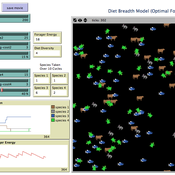
Diet breadth model from Optimal Foraging Theory (Human Behavioral Ecology)
C Michael Barton | Published Wednesday, November 26, 2008 | Last modified Thursday, March 12, 2015Diet breadth is a classic optimal foraging theory (OFT) model from human behavioral ecology (HBE). Different resources, ranked according to their food value and processing costs, are distributed in th
Patch choice model from Optimal Foraging Theory (Human Behavioral Ecology)
C Michael Barton | Published Saturday, November 22, 2008 | Last modified Saturday, April 27, 2013NetLogo model of patch choice model from optimal foraging theory (human behavioral ecology).
Displaying 10 of 530 results from clear search