Our mission is to help computational modelers develop, document, and share their computational models in accordance with community standards and good open science and software engineering practices. Model authors can publish their model source code in the Computational Model Library with narrative documentation as well as metadata that supports open science and emerging norms that facilitate software citation, computational reproducibility / frictionless reuse, and interoperability. Model authors can also request private peer review of their computational models. Models that pass peer review receive a DOI once published.
All users of models published in the library must cite model authors when they use and benefit from their code.
Please check out our model publishing tutorial and feel free to contact us if you have any questions or concerns about publishing your model(s) in the Computational Model Library.
Displaying 10 of 876 results for "Momme Von Sydow" clear search
Peer reviewed Mission Cattle
Isaac Ullah | Published Monday, December 15, 2025The model examines cattle herd dynamics on a patchy grassland subject to two exogenous pressures: periodic raiding events that remove animals and scheduled management culling that can target males and/or females. It is intended for comparative experiments on how raiding frequency, culling schedules, vegetation dynamics, and life-history parameters interact to shape herd persistence. The model was specifically designed to test the scenario of cattle herding in the arid grasslands of southern Arizona and northern Sonora during the mission period (late 17th through late 18th centuries, CE). In this period, herds were locally managed by Spanish mission personnel and local O’odham groups. Herds were culled mostly for local consumption of meat, hides, and tallow, but the mission herds were often targets for raiding by neighboring groups. The main purpose of the model is to examine herd dynamics in a seasonally variable, arid environment where herds are subject to both intentional internal harvest (culling) and external harvest (raiding).
The emergence of new market logics in sustainable food
César García-Díaz | Published Friday, October 30, 2026The model represents a large, traditional firm competing with small, sustainable food producers. The large firm operates under conventional assumptions, pursuing monopoly profits maximized through standard economic principles. Its behavior is driven by economies of scale, which compel small firms to strategically differentiate themselves to deliver added value to consumers. Consequently, small firms focus on offering higher-quality products—a factor that matters significantly to consumers.
The gains achieved by small firms represent social profits that hinge upon establishing co-participation schemes with farmers and building trustworthy relationships with consumers. Cooperation with farmers directly shapes production processes and product quality. Because a firm trusted by one consumer becomes visible to neighbors, trust can diffuse and evolve into a collective identity. Ultimately, population-level legitimation occurs when the organizational form of the organic food producer gains widespread acceptance within the consumer community.
The model’s behavior depends on three key factors: a trust parameter, a legitimation intensity parameter, and an aspiration-level weight (for the large firm).
Hegmon's Model of Sharing
Sean Bergin | Published Thursday, May 02, 2013The purpose of Hegmon’s Sharing model is to develop an understanding of the effect sharing strategies have on household survival.
Tuberculosis and helminthes
Marco Janssen Nathan Rollins Alhaji Cherif Marcel Hurtado | Published Saturday, June 05, 2010 | Last modified Saturday, April 27, 2013The purpose of this model is to investigate the consequences of helminthes in public health policy to eradicate tuberculosis. Helminthes surprise immune system responses and without changes in hygiene
Spread of COVID-19 in University Dormitory Setting
sunnyxjy | Published Sunday, August 16, 2020NetLogo agent-based model to simulate the transmission of COVID-19 in a university dormitory. User can set the number of initial students, buildings, floors, rooms, number of initially infected, and transmission rate. They can also test the effect of masks, sanitizations, elevator allowance, and visits on the effect of the SEIR curve.
PSMED - Patagonia Simple Model of Ethnic Differentiation
Joan A Barceló J A Cuesta Florencia Del Castillo Ricardo Del Olmo José M Galán Laura Mameli Francisco J Miguel David Poza José I Santos Xavier Vilà | Published Tuesday, December 10, 2013Patagonia PSMED is an agent-based model designed to study a simple case of Evolution of Ethnic Differentiation. It replicates how can hunter-gatherer societies evolve and built cultural identities as a consequence of the way they interacted.
Political Participation
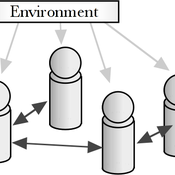
Didier Ruedin | Published Saturday, April 12, 2014 | Last modified Sunday, September 28, 2025Implementation of Milbrath’s (1965) model of political participation. Individual participation is determined by stimuli from the political environment, interpersonal interaction, as well as individual characteristics.
Scientific Collaboration and Knowledge Production
sciknowledgeprod | Published Wednesday, November 04, 2026A holistic, agent-based model of scientific knowledge production to simulate large-scale collaborative research processes. The model represents the scientific process as a stochastic, cooperative task-completion game where agents repeatedly collaborate on projects that can yield publications.
The model is implemented in Python as an environment in the popular Gymnasium reinforcement learning library.
Peer reviewed An agent-based implementation of the optimal foraging patch choice model for multiple individuals
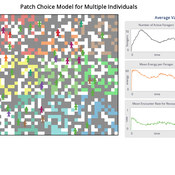
C Michael Barton | Published Sunday, September 20, 2026patch_choice_enhanced.nlogox is an agent-based model (ABM) implementing the patch choice model from optimal foraging theory (OFT) in a multi-agent simulation environment. It extends the classical single-forager, equation-based Marginal Value Theorem (MVT) formulation to support multiple competing foragers, demographic processes, bounded memory, and stochastic resource dynamics on a spatially heterogeneous landscape.
TechNet_04: Cultural Transmission in a Spatially-Situated Network
Andrew White | Published Monday, October 08, 2012 | Last modified Saturday, April 27, 2013The TechNet_04 is an abstract model that embeds a simple cultural tranmission process in an environment where interaction is structured by spatially-situated networks.
Displaying 10 of 876 results for "Momme Von Sydow" clear search