Our mission is to help computational modelers develop, document, and share their computational models in accordance with community standards and good open science and software engineering practices. Model authors can publish their model source code in the Computational Model Library with narrative documentation as well as metadata that supports open science and emerging norms that facilitate software citation, computational reproducibility / frictionless reuse, and interoperability. Model authors can also request private peer review of their computational models. Models that pass peer review receive a DOI once published.
All users of models published in the library must cite model authors when they use and benefit from their code.
Please check out our model publishing tutorial and feel free to contact us if you have any questions or concerns about publishing your model(s) in the Computational Model Library.
Displaying 10 of 264 results for "Marcel Hurtado" clear search
IDEAL
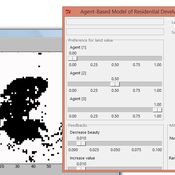
Arika Ligmann-Zielinska | Published Thursday, August 07, 2014IDEAL: Agent-Based Model of Residential Land Use Change where the choice of new residential development in based on the Ideal-point decision rule.
Tuberculosis and helminthes
Marco Janssen Nathan Rollins Alhaji Cherif Marcel Hurtado | Published Saturday, June 05, 2010 | Last modified Saturday, April 27, 2013The purpose of this model is to investigate the consequences of helminthes in public health policy to eradicate tuberculosis. Helminthes surprise immune system responses and without changes in hygiene
Market for Protection
Steven Doubleday | Published Monday, July 01, 2013 | Last modified Monday, August 19, 2013Simulation to replicate and extend an analytical model (Konrad & Skaperdas, 2010) of the provision of security as a collective good. We simulate bandits preying upon peasants in an anarchy condition.
Transfer of Development Rights (TDR) Simulation for Compact Urban Growth in Dublin: An Agent-Based Model in NetLogo
ajithvyas | Published Wednesday, May 14, 2025This agent-based model simulates the implementation of a Transfer of Development Rights (TDR) mechanism in a stylized urban environment inspired by Dublin. It explores how developer agents interact with land parcels under spatial zoning, conservation protections, and incentive-based policy rules. The model captures emergent outcomes such as compact growth, green and heritage zone preservation, and public cost-efficiency. Built in NetLogo, the model enables experimentation with variable FSI bonuses, developer behavior, and spatial alignment of sending/receiving zones. It is intended as a policy sandbox to test market-aligned planning tools under behavioral and spatial uncertainty.
Flocking 3D Market: Social Proof and Congestion in a Multi-Floor Market
mmjqaq | Published Saturday, November 14, 2026A NetLogo 3D 7.0 model of a market with several floors. Buyers walk, keep their distance from one another, choose among the stalls they can see and change floors. Social proof acts on where buyers go (attraction) and on whether they buy (conversion), and crowding lowers the chance of a purchase. The model tests whether social proof is sufficient to congest such a market and separates the roles of influence, layout and local density. The archive contains the model with every BehaviorSpace experiment of the companion paper, all simulation outputs, the pre-analysis plan, an ODD+D description and the Python code that reproduces every reported number, table and figure.
Quality uncertainty and market failure
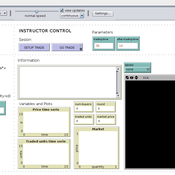
María Pereda David Poza José Manuel Galán José Santos | Published Wednesday, May 14, 2014 | Last modified Wednesday, April 25, 2018Quality uncertainty and market failure: an interactive model to conduct classroom experiments
Adoption as a social marker
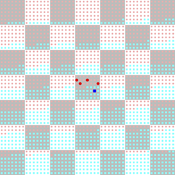
Paul Smaldino | Published Monday, October 17, 2016A model of innovation diffusion in a structured population with two groups who are averse to adopting a produce popular with the outgroup.
Investor-based electricity market model
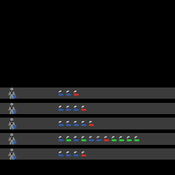
Oscar Kraan | Published Monday, January 02, 2017 | Last modified Friday, October 12, 2018The model is a representation of a liberalised electricity market designed as an energy-only market and consists of large scale investors and their power generation assets in the electricity market.
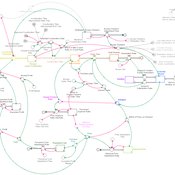
Endogenous Dynamics of Housing Market Cycles
Birnur Özbaş Onur Özgün Yaman Barlas | Published Monday, September 09, 2013 | Last modified Wednesday, January 08, 2014The purpose of this model is to analyze the dynamics of endogenously created oscillations in housing prices using a system dynamics simulation model, built from the perspective of construction companies.
A simple agent-based spatial model of the economy
Bernardo Alves Furtado Isaque Daniel Rocha Eberhardt | Published Thursday, March 10, 2016 | Last modified Tuesday, November 22, 2016The modeling includes citizens, bounded into families; firms and governments; all of them interacting in markets for goods, labor and real estate. The model is spatial and dynamic.
Displaying 10 of 264 results for "Marcel Hurtado" clear search