Our mission is to help computational modelers develop, document, and share their computational models in accordance with community standards and good open science and software engineering practices. Model authors can publish their model source code in the Computational Model Library with narrative documentation as well as metadata that supports open science and emerging norms that facilitate software citation, computational reproducibility / frictionless reuse, and interoperability. Model authors can also request private peer review of their computational models. Models that pass peer review receive a DOI once published.
All users of models published in the library must cite model authors when they use and benefit from their code.
Please check out our model publishing tutorial and feel free to contact us if you have any questions or concerns about publishing your model(s) in the Computational Model Library.
Displaying 10 of 906 results for "Jes%C3%BAs M Zamarre%C3%B1o" clear search
Forager mobility and interaction
L S Premo | Published Thursday, January 10, 2013 | Last modified Saturday, April 27, 2013This is a relatively simple foraging-radius model, as described first by Robert Kelly, that allows one to quantify the effect of increased logistical mobility (as represented by increased effective foraging radius, r_e) on the likelihood that 2 randomly placed central place foragers will encounter one another within 5000 time steps.
Eliminating hepatitis C virus as a public health threat among HIV-positive men who have sex with men
Nick Scott Mark Stoove David P Wilson Olivia Keiser Carol El-Hayek Joseph Doyle Margaret Hellard | Published Wednesday, October 12, 2016 | Last modified Sunday, December 16, 2018We compare three model estimates for the time and treatment requirements to eliminate HCV among HIV-positive MSM in Victoria, Australia: a compartmental model; an ABM parametrized by surveillance data; and an ABM with a more heterogeneous population.
Implementation of 'satisficing’ as a model for farmers’ decision-making in an agent-based model of groundwater over-exploitation
Marvin Nebel | Published Monday, May 20, 2013This model uses ’satisficing’ as a model for farmers’ decision making to learn about influences of alternative decision-making models on simulation results and to exemplify a way to transform a rather theoretical concept into a feasible decision-making model for agent-based farming models.

Classical Swine Fever in wild boars
Volker Grimm Stephanie Kramer-Schadt Cédric Scherer Martin Lange Hans-Hermann Thulke | Published Friday, September 06, 2019The model is a combination of a spatially explicit, stochastic, agent-based model for wild boars (Sus scrofa L.) and an epidemiological model for the Classical Swine Fever (CSF) virus infecting the wild boars.
The original model (Kramer-Schadt et al. 2009) was used to assess intrinsic (system immanent host-pathogen interaction and host life-history) and extrinsic (spatial extent and density) factors contributing to the long-term persistence of the disease and has further been used to assess the effects of intrinsic dynamics (Lange et al. 2012a) and indirect transmission (Lange et al. 2016) on the disease course. In an applied context, the model was used to test the efficiency of spatiotemporal vaccination regimes (Lange et al. 2012b) as well as the risk of disease spread in the country of Denmark (Alban et al. 2005).
References: See ODD model description.
Peer reviewed Price Evolution with Expectations
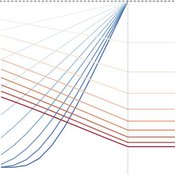
J M Applegate Gesine Steudel Armin Haas Carlo Jaeger | Published Friday, September 10, 2021The Price Evolution with Expectations model provides the opportunity to explore the question of non-equilibrium market dynamics, and how and under which conditions an economic system converges to the classically defined economic equilibrium. To accomplish this, we bring together two points of view of the economy; the classical perspective of general equilibrium theory and an evolutionary perspective, in which the current development of the economic system determines the possibilities for further evolution.
The Price Evolution with Expectations model consists of a representative firm producing no profit but producing a single good, which we call sugar, and a representative household which provides labour to the firm and purchases sugar.The model explores the evolutionary dynamics whereby the firm does not initially know the household demand but eventually this demand and thus the correct price for sugar given the household’s optimal labour.
The model can be run in one of two ways; the first does not include money and the second uses money such that the firm and/or the household have an endowment that can be spent or saved. In either case, the household has preferences for leisure and consumption and a demand function relating sugar and price, and the firm has a production function and learns the household demand over a set number of time steps using either an endogenous or exogenous learning algorithm. The resulting equilibria, or fixed points of the system, may or may not match the classical economic equilibrium.
PaCE Austria Pilot Model
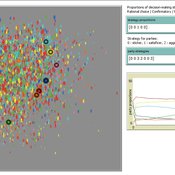
Ruth Meyer | Published Tuesday, June 30, 2020The objective of building a social simulation in the Populism and Civic Engagement (PaCE) project is to study the phenomenon of populism by mapping individual level political behaviour and explain the influence of agents on, and their interdependence with the respective political parties. Voters, political parties and – to some extent – the media can be viewed as forming a complex adaptive system, in which parties compete for citizens’ votes, voters decide on which party to vote for based on their respective positions with regard to particular issues, and the media may influence the salience of issues in the public debate.
This is the first version of a model exploring voting behaviour in Austria. It focusses on modelling the interaction of voters and parties in a political landscape; the effects of the media are not yet represented. Austria was chosen as a case study because it has an established populist party (the “Freedom Party” FPO), which has even been part of the government over the years.
A model to explore the link between the gender-gap reversal in education and relative divorce risks
Jan Van Bavel Christine Schnor André Grow | Published Thursday, June 30, 2016 | Last modified Wednesday, September 13, 2017This model explores a social mechanism that links the reversal of the gender gap in education with changing patterns in relative divorce risks in 12 European countries.
Vaccine adoption with outgroup aversion using Cleveland area data
bruce1809 | Published Monday, July 31, 2023 | Last modified Sunday, August 06, 2023This model takes concepts from a JASSS paper this is accepted for the October, 2023 edition and applies the concepts to empirical data from counties surrounding and including Cleveland Ohio. The agent-based model has a proportional number of agents in each of the counties to represent the correct proportions of adults in these counties. The adoption decision probability uses the equations from Bass (1969) as adapted by Rand & Rust (2011). It also includes the Outgroup aversion factor from Smaldino, who initially had used a different imitation model on line grid. This model uses preferential attachment network as a metaphor for social networks influencing adoption. The preferential network can be adjusted in the model to be created based on both nodes preferred due to higher rank as well as a mild preference for nodes of a like group.
Agent-based model for the socio-economic monitoring of visitor streams
Stefan Mohr | Published Saturday, January 20, 2018Due to the large extent of the Harz National Park, an accurate measurement of visitor numbers and their spatiotemporal distribution is not feasible. This model demonstrates the possibility to simulate the streams of visitors with ABM methodology.
Societal Simulator v203 fertility graph fix
Tim Gooding | Published Wednesday, November 26, 2014This is the same model as used in the article ‘Modelling Society’s Evolutionary Forces’ except the Fertility graph has been corrected. The Fertility graph was not used in the published article.
Displaying 10 of 906 results for "Jes%C3%BAs M Zamarre%C3%B1o" clear search