Our mission is to help computational modelers develop, document, and share their computational models in accordance with community standards and good open science and software engineering practices. Model authors can publish their model source code in the Computational Model Library with narrative documentation as well as metadata that supports open science and emerging norms that facilitate software citation, computational reproducibility / frictionless reuse, and interoperability. Model authors can also request private peer review of their computational models. Models that pass peer review receive a DOI once published.
All users of models published in the library must cite model authors when they use and benefit from their code.
Please check out our model publishing tutorial and feel free to contact us if you have any questions or concerns about publishing your model(s) in the Computational Model Library.
Displaying 10 of 174 results for "K De Boo" clear search
Tiebout sorting
Marco Janssen | Published Thursday, January 24, 2019This Netlogo replication of Kollman, K., J.H. Miller and S.E. Page (1997) Political Institutions and Sorting in a Tiebout Model, American Economic Review 87(5): 977-992. The model consists of of citizens who can vote for partie and move to other jurisdictions if they expect their preferences are better served. Parties adjust their positions to increase their share in the elections.
HOSS(-5): Human Organizations Simulations Start
José Quintás Alonso | Published Friday, October 09, 2026HOSS(-5) is an exploratory agent-based prototype of a small artificial society, written in Python. Each agent is a “ph” (punto humano, “human point”) that is born, is educated, works, consumes and dies. Its yearly decisions depend on a psychological profile (archetype × character), its economic status and its intentionality. Agents interact indirectly through families, firms in 10 sectors, a labour market with about 200 job categories, and a State that provides public services, employment and a Universal Basic Income, adjusting taxes and UBI each year to seek fiscal balance.
The model simulates a few thousand agents over decades of virtual time and records yearly aggregates (population, GDP, income, Gini index, HDI). A separate analysis script explores the results and fits Gamma distributions to individual incomes, comparing the shape parameter with Gini and HDI.
HOSS does not aim to predict real societies or claim empirical validation. It is a sandbox for comparing scenarios and thinking about the organizational design of society from an engineering perspective. Known limitations: no direct social relations between agents, prices and production follow simple rules rather than supply-demand dynamics, and organizations are black boxes.
…
MERCURY extension: transport-cost
Tom Brughmans | Published Monday, July 23, 2018This is extended version of the MERCRUY model (Brughmans 2015) incorporates a ‘transport-cost’ variable, and is otherwise unchanged. This extended model is described in this publication: Brughmans, T., 2019. Evaluating the potential of computational modelling for informing debates on Roman economic integration, in: Verboven, K., Poblome, J. (Eds.), Structural Determinants in the Roman World.
Brughmans, T., 2015. MERCURY: an ABM of tableware trade in the Roman East. CoMSES Comput. Model Libr. URL https://www.comses.net/codebases/4347/releases/1.1.0/
Model supporting the interactive simulation Phu Cu 2050
Léo Biré | Published Tuesday, November 03, 2026This agent-based model is supporting a simulation that has been used in participatory workshop in Vietnam. It was designed to foster discussion about the joint reading of territorial evolutions and the decrease of investment in the maintenance of hydraulic works, especially irrigation pumping station in a case study territory in the Red River Delta.
The code comprises a number of different experiment to facilitate discussion on specific variables during workshops. One of the experiment has been developped to allow users to interact with hydraulic works and decide to prioritise or de-prioritise their maintenance.
This model has been implemented using the GAMA platform, relying on the gaml language.
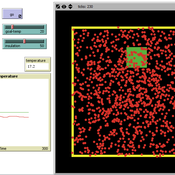
Thermostat II
María Pereda Jesús M Zamarreño | Published Thursday, June 12, 2014 | Last modified Monday, June 16, 2014A thermostat is a device that allows to have the temperature in a room near a desire value.
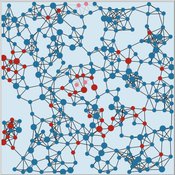
Peer reviewed Virus Transmission with Super-spreaders
J M Applegate | Published Saturday, September 11, 2021A curious aspect of the Covid-19 pandemic is the clustering of outbreaks. Evidence suggests that 80\% of people who contract the virus are infected by only 19% of infected individuals, and that the majority of infected individuals faile to infect another person. Thus, the dispersion of a contagion, $k$, may be of more use in understanding the spread of Covid-19 than the reproduction number, R0.
The Virus Transmission with Super-spreaders model, written in NetLogo, is an adaptation of the canonical Virus Transmission on a Network model and allows the exploration of various mitigation protocols such as testing and quarantines with both homogenous transmission and heterogenous transmission.
The model consists of a population of individuals arranged in a network, where both population and network degree are tunable. At the start of the simulation, a subset of the population is initially infected. As the model runs, infected individuals will infect neighboring susceptible individuals according to either homogenous or heterogenous transmission, where heterogenous transmission models super-spreaders. In this case, k is described as the percentage of super-spreaders in the population and the differing transmission rates for super-spreaders and non super-spreaders. Infected individuals either recover, at which point they become resistant to infection, or die. Testing regimes cause discovered infected individuals to quarantine for a period of time.
CITMOD A Tax-Benefit Modeling System for the average citizen
Philip Truscott | Published Monday, August 15, 2011 | Last modified Saturday, April 27, 2013Must tax-benefit policy making be limited to the ‘experts’?
MTC_Model_Pilditch&Madsen
Toby Pilditch | Published Friday, October 09, 2020Micro-targeted vs stochastic political campaigning agent-based model simulation. Written by Toby D. Pilditch (University of Oxford, University College London), in collaboration with Jens K. Madsen (University of Oxford, London School of Economics)
The purpose of the model is to explore the various impacts on voting intention among a population sample, when both stochastic (traditional) and Micto-targeted campaigns (MTCs) are in play. There are several stages of the model: initialization (setup), campaigning (active running protocols) and vote-casting (end of simulation). The campaigning stage consists of update cycles in which “voters” are targeted and “persuaded” - updating their beliefs in the campaign candidate / policies.
Peer reviewed Boundary crossings as a minimal mechanism for global connectivity in structured landscapes
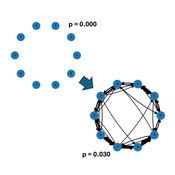
Fabio Nelli | Published Sunday, May 17, 2026 | Last modified Thursday, November 05, 2026This repository contains the Python implementation of an agent-based model investigating how heterogeneous mobility and boundary-crossing dynamics generate large-scale connectivity in structured multi-attractor landscapes. A small fraction of higher-mobility agents explores the environment while the remaining agents stay locally constrained. The model compares pure random-walk exploration, interface-sensitive dynamics, novelty-biased exploration, and a flat-landscape control. The release includes the complete simulation framework, the experimental pipeline used in the associated paper, multi-K and population-scaling robustness analyses, network-snapshot and transition-slope analyses, and reproducibility documentation. Transition networks are analysed using graph density, connected components, and giant weakly connected components. The implementation is compatible with Python 3.11 and is released under the MIT License.
Peer reviewed Modelling value change; An exploratory approach
Tristan de Wildt Ibo van de Poel | Published Tuesday, June 20, 2023 | Last modified Tuesday, December 12, 2023This model has been developed together with the publication ‘Modelling Value Change - An Exploratory Approach’
Value change and moral change have increasingly become topics of interest in the philosophical literature. Several theoretical accounts have been proposed. Such accounts are usually based on certain theoretical and conceptual assumptions and their strengths and weaknesses are often hard to determine and compare, also because they are based on limited empirical evidence.
We propose that a step forward can be made with the help of agent-based modelling (ABM). ABM can be used to investigate whether a simulation model based on a specific account of value change can reproduce relevant phenomena. To illustrate this approach, we built a model based on the pragmatist account of value change proposed in van de Poel and Kudina (2022). We show that this model can reproduce four relevant phenomena, namely 1) the inevitability and stability of values, 2) how different societies may react differently to external shocks, 3) moral revolutions, and 4) lock-in.
Displaying 10 of 174 results for "K De Boo" clear search