Our mission is to help computational modelers develop, document, and share their computational models in accordance with community standards and good open science and software engineering practices. Model authors can publish their model source code in the Computational Model Library with narrative documentation as well as metadata that supports open science and emerging norms that facilitate software citation, computational reproducibility / frictionless reuse, and interoperability. Model authors can also request private peer review of their computational models. Models that pass peer review receive a DOI once published.
All users of models published in the library must cite model authors when they use and benefit from their code.
Please check out our model publishing tutorial and feel free to contact us if you have any questions or concerns about publishing your model(s) in the Computational Model Library.
Displaying 10 of 140 results for "Edward L Boone" clear search
Essential Workers at Risk: An Agent-Based Model (SAFE-ABM) with Uncertainty Quantification
Elizabeth Amona Edward L Boone | Published Sunday, November 01, 2026This archive contains the SAFE-ABM computational model developed to evaluate targeted intervention strategies for protecting essential workers during epidemic conditions, accompanying the published article “Essential Workers at Risk: An Agent-Based Model (SAFE-ABM) with Uncertainty Quantification” in the Journal of Artificial Societies and Social Simulation, 29(4), Article 7 (2026). https://doi.org/10.18564/jasss.6276. SAFE-ABM is an agent-based model that simulates disease transmission through structured interactions across households, workplaces, and schools, while incorporating stochastic disease progression and uncertainty in transmission, recovery, and mortality parameters.
The model evaluates five intervention scenarios: Scenario 1, no restrictions; Scenario 2, school-from-home; Scenario 3, essential-workers-only movement; Scenario 4, rotational shifts among essential workers with quarantine of symptomatic active workers; and Scenario 5, rotational shifts among essential workers without quarantine. The archive includes scenario-specific simulation scripts, comparison-analysis scripts, saved derived outputs, README documentation, software requirements, and reproducibility notes.
The included comparison scripts reproduce the main numerical summaries and manuscript outputs, including median epidemic trajectories, predictive-uncertainty plots, cumulative recovery and death summaries, inflection-point summaries, Welch-test comparisons, and mutual-information sensitivity rankings. Saved derived outputs are included so that the main figures and tables can be reproduced without rerunning all large-scale simulations.
…
SLUCEII LUXE (Land Use in an eXurban Environment)
Shipeng Sun Dawn Parker Qingxu Huang Dan Brown Rick L Riolo Derek Robinson Meghan Hutchins Tatiana Filatova | Published Tuesday, September 10, 2013 | Last modified Saturday, October 22, 2022LUXE is a land-use change model featuring different levels of land market implementation. It integrates utility measures, budget constraints, competitive bidding, and market interactions to model land-use change in exurban environment.
Gender differentiation model
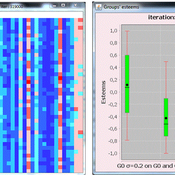
Sylvie Huet | Published Monday, April 20, 2020 | Last modified Thursday, April 23, 2020This is a gender differentiation model in terms of reputations, prestige and self-esteem (presented in the paper https://journals.plos.org/plosone/article?id=10.1371/journal.pone.0236840). The model is based on the influence function of the Leviathan model (Deffuant, Carletti, Huet 2013 and Huet and Deffuant 2017) considering two groups.
This agent-based model studies how inequalities can be explained by the difference of open-mindness between two groups of interacting agents. We consider agents having an opinion/esteem about each other and about themselves. During dyadic meetings, agents change their respective opinion about each other and possibly about other agents they gossip about, with a noisy perception of the opinions of their interlocutor. Highly valued agents are more influential in such encounters. We study an heterogeneous population of two different groups: one more open to influence of others, taking less into account their perceived difference of esteem, called L; a second one less prone to it, called S, who designed the credibility they give to others strongly based on how higher or lower valued than themselves they perceive them.
We show that a mixed population always turns in favor to some agents belonging to the group of less open-minded agents S, and harms the other group: (1) the average group self-opinion or reputation of S is always better than the one of L; (2) the higher rank in terms of reputation are more frequently occupied by the S agents while the L agents occupy more the bottom rank; (3) the properties of the dynamics of differentiation between the two groups are similar to the properties of the glass ceiling effect proposed by Cotter et al (2001).
Hybrid Agent-Based and Equation Based Model for Infectious Disease Spread
Elizabeth Hunter Brian Mac Namee John Kelleher | Published Sunday, April 19, 2020Our model is hybrid agent-based and equation based model for human air-borne infectious diseases measles. It follows an SEIR (susceptible, exposed,infected, and recovered) type compartmental model with the agents moving be-tween the four state relating to infectiousness. However, the disease model canswitch back and forth between agent-based and equation based depending onthe number of infected agents. Our society model is specific using the datato create a realistic synthetic population for a county in Ireland. The modelincludes transportation with agents moving between their current location anddesired destination using predetermined destinations or destinations selectedusing a gravity model.
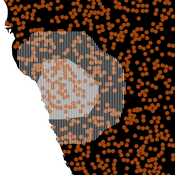
FoxNet is an individual-based modelling framework that can be customised to generate high-resolution red fox Vulpes vulpes population models for both northern and southern hemispheres. FoxNet predicts red fox population dynamics, including responses to control and landscape productivity. Model landscapes (up to ~15,000 km^2 and bait layouts can be generated within FoxNet or imported as GIS layers.
If you use FoxNet, please cite:
Hradsky BA, Kelly L, Robley A, Wintle BA (in review). FoxNet: an individual-based modelling framework to support red fox management. Journal of Applied Ecology.
Forager mobility and interaction
L S Premo | Published Thursday, January 10, 2013 | Last modified Saturday, April 27, 2013This is a relatively simple foraging-radius model, as described first by Robert Kelly, that allows one to quantify the effect of increased logistical mobility (as represented by increased effective foraging radius, r_e) on the likelihood that 2 randomly placed central place foragers will encounter one another within 5000 time steps.
NRDCPI v17.0 — NATO-Russia Direct Conflict Probability Index
Edward Ozhiganov | Published Thursday, September 03, 2026This model implements a bidirectional coupling between micro-level agent decisions and macro-level system dynamics, with an additional diagnostic layer based on Stafford Beer’s Viable System Model.
Key features:
- Six types of agents (Household, Firm, Bank, Government, Foreign, Innovation)
- Continuous SDM core integrated with Runge-Kutta 4
- Robust GDELT data handling with multi-level fallback
…
Eco-Evolutionary Pathways Toward Industrial Cities
Handi Chandra Putra | Published Thursday, May 21, 2020Industrial location theory has not emphasized environmental concerns, and research on industrial symbiosis has not emphasized workforce housing concerns. This article brings jobs, housing, and environmental considerations together in an agent-based model of industrial
and household location. It shows that four classic outcomes emerge from the interplay of a relatively small number of explanatory factors: the isolated enterprise with commuters; the company town; the economic agglomeration; and the balanced city.
Classical Swine Fever in wild boars
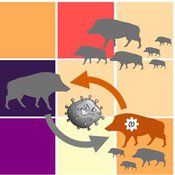
Cédric Scherer Martin Lange Volker Grimm Hans-Hermann Thulke Stephanie Kramer-Schadt | Published Friday, September 06, 2019The model is a combination of a spatially explicit, stochastic, agent-based model for wild boars (Sus scrofa L.) and an epidemiological model for the Classical Swine Fever (CSF) virus infecting the wild boars.
The original model (Kramer-Schadt et al. 2009) was used to assess intrinsic (system immanent host-pathogen interaction and host life-history) and extrinsic (spatial extent and density) factors contributing to the long-term persistence of the disease and has further been used to assess the effects of intrinsic dynamics (Lange et al. 2012a) and indirect transmission (Lange et al. 2016) on the disease course. In an applied context, the model was used to test the efficiency of spatiotemporal vaccination regimes (Lange et al. 2012b) as well as the risk of disease spread in the country of Denmark (Alban et al. 2005).
References: See ODD model description.
Mesoscopic Effects in an Agent-Based Bargaining Model in Regular Lattices
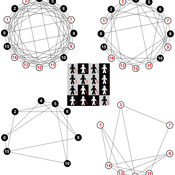
David Poza José Santos José Manuel Galán Ordax Adolfo López-Paredes | Published Thursday, February 02, 2017 | Last modified Wednesday, April 25, 2018We propose an agent-based model where a fixed finite population of tagged agents play iteratively the Nash demand game in a regular lattice. The model extends the bargaining model by Axtell, Epstein and Young.
Displaying 10 of 140 results for "Edward L Boone" clear search