MOSAIC: Mission-Oriented Self-Organization through Auctions, Incentives, and Coalitions (1.1.0)
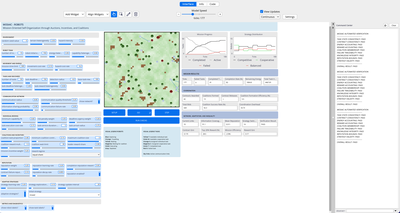
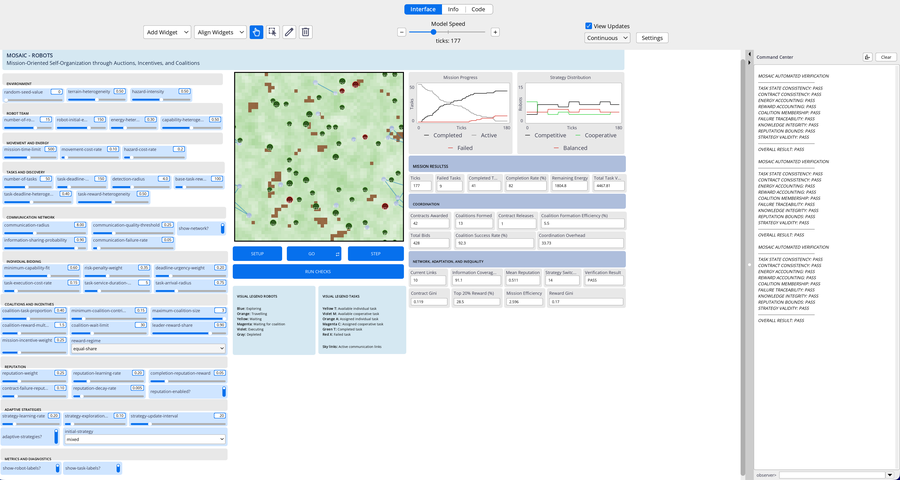
MOSAIC is an agent-based NetLogo model of decentralized mission coordination among heterogeneous robots operating under partial observability, limited energy, spatially variable risk, dynamic communication, and individual and cooperative task requirements. Robots discover tasks locally, exchange task information through temporary communication links, submit capability-, energy-, deadline-, and risk-aware bids, compete for individual contracts, and form temporary coalitions for cooperative tasks.
The model integrates decentralized auctions, greedy capability-based coalition formation, contract release and reassignment, four reward regimes, reputation, adaptive bidding strategies, failure traceability, and mission-, network-, information-, inequality-, and coalition-level metrics. It operates without a centralized mission planner or global combinatorial assignment solver.
Seven paired-seed BehaviorSpace experiments comprising 690 official simulation runs evaluate baseline mission viability, reward regimes, communication structure, capability heterogeneity, cooperative-task demand, reputation and adaptive strategies, and mission-incentive strength. The results indicate that structural coordination capacity—particularly information reach, capability compatibility, and feasible coalition construction—has a stronger effect on mission completion than increasing incentive intensity within the tested architecture and parameter ranges.
MOSAIC includes nine automated verification invariants covering task-state consistency, contract consistency, energy accounting, reward accounting, coalition membership, failure traceability, knowledge integrity, reputation bounds, and strategy validity. The associated repository contains the NetLogo model, ODD Protocol, User Manual, raw and processed experimental data, statistical analyses, Technical Report, manuscript, figures, manifests, and checksums.
Release Notes
MOSAIC v0.4.0 is the first public archival release of the model.
This release provides a complete decentralized mission-coordination workflow for heterogeneous robot teams, including local task discovery, distributed task knowledge, dynamic communication links, capability-aware auctions, individual task allocation, temporary coalition formation for cooperative tasks, contract release and reassignment, reputation updates, adaptive bidding strategies, and four reward-allocation regimes.
The release includes:
a NetLogo 7.0.4 executable model;
individual and cooperative task mechanisms;
heterogeneous sensing, manipulation, transport, and communication capabilities;
energy, deadline, and spatial-risk constraints;
mission, auction, communication, information, coalition, inequality, and failure metrics;
seven BehaviorSpace experimental designs;
690 official paired-seed simulation runs;
nine automated model-verification invariants;
an ODD Protocol;
a User Manual;
experimental design and results documentation;
a Technical Report;
a consolidated simulation-output dataset.
This version was used for the analyses reported in the associated MOSAIC manuscript. The model does not require external input datasets or third-party NetLogo extensions.
Associated Publications
Gerkey, B. P., and Matarić, M. J. (2004). A Formal Analysis and Taxonomy of Task Allocation in Multi-Robot Systems. The International Journal of Robotics Research, 23(9), 939–954. https://doi.org/10.1177/0278364904045564
Smith, R. G. (1980). The Contract Net Protocol: High-Level Communication and Control in a Distributed Problem Solver. IEEE Transactions on Computers, C-29(12), 1104–1113. https://doi.org/10.1109/TC.1980.1675516
Dias, M. B., Zlot, R., Kalra, N., and Stentz, A. (2006). Market-Based Multirobot Coordination: A Survey and Analysis. Proceedings of the IEEE, 94(7), 1257–1270. https://doi.org/10.1109/JPROC.2006.876939
Shehory, O., and Kraus, S. (1998). Methods for Task Allocation via Agent Coalition Formation. Artificial Intelligence, 101(1–2), 165–200. https://doi.org/10.1016/S0004-3702(98)00045-9
Grimm, V., et al. (2020). The ODD Protocol for Describing Agent-Based and Other Simulation Models: A Second Update to Improve Clarity, Replication, and Structural Realism. Journal of Artificial Societies and Social Simulation, 23(2), 7. https://doi.org/10.18564/jasss.4259
Wilensky, U., and Rand, W. (2015). An Introduction to Agent-Based Modeling: Modeling Natural, Social, and Engineered Complex Systems with NetLogo. MIT Press.
MOSAIC: Mission-Oriented Self-Organization through Auctions, Incentives, and Coalitions 1.1.0
Submitted byKatherin MolinaPublished Aug 20, 2026
Last modified Aug 20, 2026
MOSAIC is an agent-based NetLogo model of decentralized mission coordination among heterogeneous robots operating under partial observability, limited energy, spatially variable risk, dynamic communication, and individual and cooperative task requirements. Robots discover tasks locally, exchange task information through temporary communication links, submit capability-, energy-, deadline-, and risk-aware bids, compete for individual contracts, and form temporary coalitions for cooperative tasks.
The model integrates decentralized auctions, greedy capability-based coalition formation, contract release and reassignment, four reward regimes, reputation, adaptive bidding strategies, failure traceability, and mission-, network-, information-, inequality-, and coalition-level metrics. It operates without a centralized mission planner or global combinatorial assignment solver.
Seven paired-seed BehaviorSpace experiments comprising 690 official simulation runs evaluate baseline mission viability, reward regimes, communication structure, capability heterogeneity, cooperative-task demand, reputation and adaptive strategies, and mission-incentive strength. The results indicate that structural coordination capacity—particularly information reach, capability compatibility, and feasible coalition construction—has a stronger effect on mission completion than increasing incentive intensity within the tested architecture and parameter ranges.
MOSAIC includes nine automated verification invariants covering task-state consistency, contract consistency, energy accounting, reward accounting, coalition membership, failure traceability, knowledge integrity, reputation bounds, and strategy validity. The associated repository contains the NetLogo model, ODD Protocol, User Manual, raw and processed experimental data, statistical analyses, Technical Report, manuscript, figures, manifests, and checksums.
Release Notes
MOSAIC v0.4.0 is the first public archival release of the model.
This release provides a complete decentralized mission-coordination workflow for heterogeneous robot teams, including local task discovery, distributed task knowledge, dynamic communication links, capability-aware auctions, individual task allocation, temporary coalition formation for cooperative tasks, contract release and reassignment, reputation updates, adaptive bidding strategies, and four reward-allocation regimes.
The release includes:
a NetLogo 7.0.4 executable model;
individual and cooperative task mechanisms;
heterogeneous sensing, manipulation, transport, and communication capabilities;
energy, deadline, and spatial-risk constraints;
mission, auction, communication, information, coalition, inequality, and failure metrics;
seven BehaviorSpace experimental designs;
690 official paired-seed simulation runs;
nine automated model-verification invariants;
an ODD Protocol;
a User Manual;
experimental design and results documentation;
a Technical Report;
a consolidated simulation-output dataset.
This version was used for the analyses reported in the associated MOSAIC manuscript. The model does not require external input datasets or third-party NetLogo extensions.
Cite this Model
Katherin Molina, Lorena Holguin (2026, August 20). “MOSAIC: Mission-Oriented Self-Organization through Auctions, Incentives, and Coalitions” (Version 1.1.0). CoMSES Computational Model Library. Retrieved from: https://doi.org/10.25937/8xe2-ev86
Replication of a previously described model
Molina, K., and Holguin, L. (2026). Structural Coordination Capacity, Not Incentive Intensity, Governs Decentralized Heterogeneous Multi-Robot Missions: Evidence from the MOSAIC Agent-Based Model. Zenodo. https://doi.org/10.5281/zenodo.21718799
Associated Publication(s)
Gerkey, B. P., and Matarić, M. J. (2004). A Formal Analysis and Taxonomy of Task Allocation in Multi-Robot Systems. The International Journal of Robotics Research, 23(9), 939–954. https://doi.org/10.1177/0278364904045564
Smith, R. G. (1980). The Contract Net Protocol: High-Level Communication and Control in a Distributed Problem Solver. IEEE Transactions on Computers, C-29(12), 1104–1113. https://doi.org/10.1109/TC.1980.1675516
Dias, M. B., Zlot, R., Kalra, N., and Stentz, A. (2006). Market-Based Multirobot Coordination: A Survey and Analysis. Proceedings of the IEEE, 94(7), 1257–1270. https://doi.org/10.1109/JPROC.2006.876939
Shehory, O., and Kraus, S. (1998). Methods for Task Allocation via Agent Coalition Formation. Artificial Intelligence, 101(1–2), 165–200. https://doi.org/10.1016/S0004-3702(98)00045-9
Grimm, V., et al. (2020). The ODD Protocol for Describing Agent-Based and Other Simulation Models: A Second Update to Improve Clarity, Replication, and Structural Realism. Journal of Artificial Societies and Social Simulation, 23(2), 7. https://doi.org/10.18564/jasss.4259
Wilensky, U., and Rand, W. (2015). An Introduction to Agent-Based Modeling: Modeling Natural, Social, and Engineered Complex Systems with NetLogo. MIT Press.
References
Gerkey, B. P., and Matarić, M. J. (2004). A Formal Analysis and Taxonomy of Task Allocation in Multi-Robot Systems. The International Journal of Robotics Research, 23(9), 939–954. https://doi.org/10.1177/0278364904045564
Smith, R. G. (1980). The Contract Net Protocol: High-Level Communication and Control in a Distributed Problem Solver. IEEE Transactions on Computers, C-29(12), 1104–1113. https://doi.org/10.1109/TC.1980.1675516
Dias, M. B., Zlot, R., Kalra, N., and Stentz, A. (2006). Market-Based Multirobot Coordination: A Survey and Analysis. Proceedings of the IEEE, 94(7), 1257–1270. https://doi.org/10.1109/JPROC.2006.876939
Shehory, O., and Kraus, S. (1998). Methods for Task Allocation via Agent Coalition Formation. Artificial Intelligence, 101(1–2), 165–200. https://doi.org/10.1016/S0004-3702(98)00045-9
Grimm, V., et al. (2020). The ODD Protocol for Describing Agent-Based and Other Simulation Models: A Second Update to Improve Clarity, Replication, and Structural Realism. Journal of Artificial Societies and Social Simulation, 23(2), 7. https://doi.org/10.18564/jasss.4259
Wilensky, U., and Rand, W. (2015). An Introduction to Agent-Based Modeling: Modeling Natural, Social, and Engineered Complex Systems with NetLogo. MIT Press.
Create an Open Code Badge that links to this model more info
This website uses cookies and Google Analytics to help us track user engagement and improve our site. If
you'd like to know more information about what data we collect and why, please see
our data privacy policy. If you continue to use this site, you consent to
our use of cookies.