Our mission is to help computational modelers develop, document, and share their computational models in accordance with community standards and good open science and software engineering practices. Model authors can publish their model source code in the Computational Model Library with narrative documentation as well as metadata that supports open science and emerging norms that facilitate software citation, computational reproducibility / frictionless reuse, and interoperability. Model authors can also request private peer review of their computational models. Models that pass peer review receive a DOI once published.
All users of models published in the library must cite model authors when they use and benefit from their code.
Please check out our model publishing tutorial and feel free to contact us if you have any questions or concerns about publishing your model(s) in the Computational Model Library.
Displaying 10 of 1056 results for "M Van Den Hoven" clear search
Investor-based electricity market model
Oscar Kraan | Published Monday, January 02, 2017 | Last modified Friday, October 12, 2018The model is a representation of a liberalised electricity market designed as an energy-only market and consists of large scale investors and their power generation assets in the electricity market.
A Simple Model of Anxiety in Students
Bruce Edmonds | Published Tuesday, August 18, 2026A simple theoretical agent-based model intending to represent anxiety in students is presented. In this, agents make two decisions each simulation tick, whether to: socialise and go to school (on school days). Circular causation can result in some agents entering a negative loop of high-anxiety and avoidance, even whilst most improve their skills and develop lower levels of anxiety. We compare three different mechanisms that may lie behind decision-making under anxiety: expect the worst, avoid uncertainty and avoid anxiety. Results indicate that, although these are often indistinguishable in terms of some obvious aggregate measures on the outcomes, they do exhibit different underlying dynamics.
Denatocracy: Allocating Opportunity by Potential and Will
Nicholas Harkiolakis | Published Wednesday, November 04, 2026This model compares rules for allocating a fixed budget of opportunity (places, training, funding) among people who differ in potential and will. Each agent’s effective potential, its denatotita, is potential multiplied by will. Realisation is denatotita multiplied by the opportunity received, and an agent succeeds when realisation reaches a threshold. Nine allocation regimes are compared: equal shares; shares proportional to denatotita; three threshold rules that reclaim and redistribute the allocations of those who would fail; an efficient benchmark that maximises successes; and three forward-looking rules (foresight, will-aware foresight and hindsight). A mixed regime blends targeting with equal shares. Over time, opportunity develops potential through a skill-formation technology, and will rises with success and falls when an agent is passed over. The model reproduces the article’s results: a closed-form crossover between equal and proportional allocation; a reversal in favour of broad allocation when development is productive; a hollowing-out of potential under success-maximising allocation; and the failure of mixtures of targeting and equal shares. Written in Python (NumPy, pandas, Matplotlib), with fixed random seeds so results are exactly reproducible.
Citizenship competences and conflict resolution styles
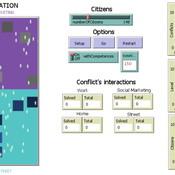
Cecilia Avila Manuel Balaguera Valentina Tabares | Published Monday, February 03, 2020This model represents an agent-based social simulation for citizenship competences. In this model people interact by solving different conflicts and a conflict is solved or not considering two possible escenarios: when individual citizenship competences are considered and when not. In both cases the TKI conflict resolution styles are considered. Each conflict has associated a competence and the information about the conflicts and their competences is retrieved from an ontology which was developed in Protégé. To do so, a NetLogo extension was developed using the Java programming language and the JENA API (to make queries over the ontology).
Peer reviewed Agent-Based Ramsey growth model with Brown and Green capital (ABRam-BG)
Aida Sarai Figueroa Alvarez Sarah Wolf | Published Monday, December 09, 2024The purpose of the ABRam-BG model is to study belief dynamics as a potential driver of green (growth) transitions and illustrate their dynamics in a closed, decentralized economy populated by utility maximizing agents with an environmental attitude. The model is built using the ABRam-T model (for model visit: https://doi.org/10.25937/ep45-k084) and introduces two types of capital – green (low carbon intensity) and brown (high carbon intensity) – with their respective technological progress levels. ABRam-BG simulates a green transition as an emergent phenomenon resulting from well-known opinion dynamics along the economic process.
HeatSupply
Jonathan Busch | Published Tuesday, May 17, 2016 | Last modified Tuesday, March 15, 2022HeatSupply models the development of district heat networks in cities by three types of instigators: Local Authorities, Commercial developers and Community organisations.
MERCURY extension: population
Tom Brughmans | Published Thursday, May 23, 2019This model is an extended version of the original MERCURY model (https://www.comses.net/codebases/4347/releases/1.1.0/ ) . It allows for experiments to be performed in which empirically informed population sizes of sites are included, that allow for the scaling of the number of tableware traders with the population of settlements, and for hypothesised production centres of four tablewares to be used in experiments.
Experiments performed with this population extension and substantive interpretations derived from them are published in:
Hanson, J.W. & T. Brughmans. In press. Settlement scale and economic networks in the Roman Empire, in T. Brughmans & A.I. Wilson (ed.) Simulating Roman Economies. Theories, Methods and Computational Models. Oxford: Oxford University Press.
…
Income Model
Tony Lawson | Published Monday, August 26, 2013This is the code for the model described in an article in the International Journal of Microsimulation. Lawson (2013) ‘Modelling Household Spending Using a Random Assignment Scheme’, International Journal of Microsimulation, 6(2) Autumn 2013, 56-75.
Peer reviewed The Archaeological Sampling Experimental Laboratory (tASEL)
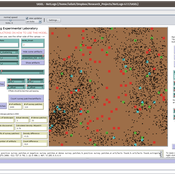
Isaac Ullah | Published Friday, March 11, 2022 | Last modified Wednesday, June 01, 2022The Archaeological Sampling Experimental Laboratory (tASEL) is an interactive tool for setting up and conducting experiments about sampling strategies for archaeological excavation, survey, and prospection.
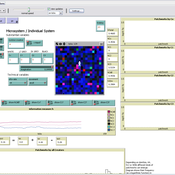
CRESY-I stands for CREativity from a SYstems perspetive, Model I. This is the base model in a series designed to describe a systems approach to creativity in terms of variation, selection and retention (VSR) subprocesses.
Displaying 10 of 1056 results for "M Van Den Hoven" clear search