Our mission is to help computational modelers develop, document, and share their computational models in accordance with community standards and good open science and software engineering practices. Model authors can publish their model source code in the Computational Model Library with narrative documentation as well as metadata that supports open science and emerging norms that facilitate software citation, computational reproducibility / frictionless reuse, and interoperability. Model authors can also request private peer review of their computational models. Models that pass peer review receive a DOI once published.
All users of models published in the library must cite model authors when they use and benefit from their code.
Please check out our model publishing tutorial and feel free to contact us if you have any questions or concerns about publishing your model(s) in the Computational Model Library.
Displaying 7 of 17 results social science clear search
The uFUNK Model
Davide Secchi | Published Monday, August 31, 2020The agent-based simulation is set to work on information that is either (a) functional, (b) pseudo-functional, (c) dysfunctional, or (d) irrelevant. The idea is that a judgment on whether information falls into one of the four categories is based on the agent and its network. In other words, it is the agents who interprets a particular information as being (a), (b), (c), or (d). It is a decision based on an exchange with co-workers. This makes the judgment a socially-grounded cognitive exercise. The uFUNK 1.0.2 Model is set on an organization where agent-employee work on agent-tasks.
Peer reviewed An extended replication of Abelson's and Bernstein's community referendum simulation
Klaus G. Troitzsch | Published Friday, October 25, 2019 | Last modified Friday, August 25, 2023This is an extended replication of Abelson’s and Bernstein’s early computer simulation model of community referendum controversies which was originally published in 1963 and often cited, but seldom analysed in detail. This replication is in NetLogo 6.3.0, accompanied with an ODD+D protocol and class and sequence diagrams.
This replication replaces the original scales for attitude position and interest in the referendum issue which were distributed between 0 and 1 with values that are initialised according to a normal distribution with mean 0 and variance 1 to make simulation results easier compatible with scales derived from empirical data collected in surveys such as the European Value Study which often are derived via factor analysis or principal component analysis from the answers to sets of questions.
Another difference is that this model is not only run for Abelson’s and Bernstein’s ten week referendum campaign but for an arbitrary time in order that one can find out whether the distributions of attitude position and interest in the (still one-dimensional) issue stabilise in the long run.
ABM Household Decision Making on Solar Energy using Theory of Planned Behaviour
Tatiana Filatova Hannah Muelder | Published Tuesday, May 21, 2019The model aims at estimating household energy consumption and the related greenhouse gas (GHG) emissions reduction based on the behavior of the individual household under different operationalizations of the Theory of Planned Behaviour (TPB).
The original model is developed as a tool to explore households decisions regarding solar panel investments and cumulative consequences of these individual choices (i.e. diffusion of PVs, regional emissions savings, monetary savings). We extend the model to explore a methodological question regarding an interpretation of qualitative concepts from social science theories, specifically Theory of Planned Behaviour in a formal code of quantitative agent-based models (ABMs). We develop 3 versions of the model: one TPB-based ABM designed by the authors and two alternatives inspired by the TPB-ABM of Schwarz and Ernst (2009) and the TPB-ABM of Rai and Robinson (2015). The model is implemented in NetLogo.
Peer reviewed MigrAgent
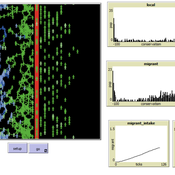
Wander Jager Rocco Paolillo | Published Friday, October 05, 2018 | Last modified Wednesday, November 28, 2018MigrAgent simulates migration flows of a population from a home country to a host country and mutual adaptation of a migrant and local population post-migration. Agents accept interactions in intercultural networks depending on their degree of conservatism. Conservatism is a group-level parameter normally distributed within each ethnic group. Individual conservatism changes as function of reciprocity of interaction in intergroup experiences of acceptance or rejection.
The aim of MigrAgent is to unfold different outcomes of integration, assimilation, separation and marginalization in terms of networks as effect of different degrees of conservatism in each group and speed of migration flows.
Peer Review Game
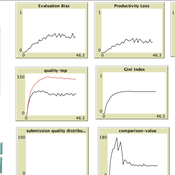
Giangiacomo Bravo Flaminio Squazzoni Francisco Grimaldo Federico Bianchi | Published Monday, April 30, 2018NetLogo software for the Peer Review Game model. It represents a population of scientists endowed with a proportion of a fixed pool of resources. At each step scientists decide how to allocate their resources between submitting manuscripts and reviewing others’ submissions. Quality of submissions and reviews depend on the amount of allocated resources and biased perception of submissions’ quality. Scientists can behave according to different allocation strategies by simply reacting to the outcome of their previous submission process or comparing their outcome with published papers’ quality. Overall bias of selected submissions and quality of published papers are computed at each step.
Homophily-driven Network Evolution and Diffusion
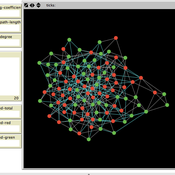
Gönenç Yücel Mustafa Yavaş | Published Thursday, January 08, 2015The model is an experimental ground to study the impact of network structure on diffusion. It allows to construct a social network that already has some measurable level of homophily, and simulate a diffusion process over this social network.
Political Participation
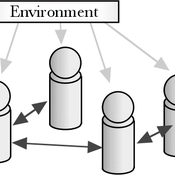
Didier Ruedin | Published Saturday, April 12, 2014 | Last modified Sunday, September 28, 2025Implementation of Milbrath’s (1965) model of political participation. Individual participation is determined by stimuli from the political environment, interpersonal interaction, as well as individual characteristics.
Displaying 7 of 17 results social science clear search