Our mission is to help computational modelers develop, document, and share their computational models in accordance with community standards and good open science and software engineering practices. Model authors can publish their model source code in the Computational Model Library with narrative documentation as well as metadata that supports open science and emerging norms that facilitate software citation, computational reproducibility / frictionless reuse, and interoperability. Model authors can also request private peer review of their computational models. Models that pass peer review receive a DOI once published.
All users of models published in the library must cite model authors when they use and benefit from their code.
Please check out our model publishing tutorial and feel free to contact us if you have any questions or concerns about publishing your model(s) in the Computational Model Library.
Displaying 4 of 4 results intervention strategies clear search
Essential Workers at Risk: An Agent-Based Model (SAFE-ABM) with Uncertainty Quantification
Elizabeth Amona Edward L Boone | Published Sunday, November 01, 2026This archive contains the SAFE-ABM computational model developed to evaluate targeted intervention strategies for protecting essential workers during epidemic conditions, accompanying the published article “Essential Workers at Risk: An Agent-Based Model (SAFE-ABM) with Uncertainty Quantification” in the Journal of Artificial Societies and Social Simulation, 29(4), Article 7 (2026). https://doi.org/10.18564/jasss.6276. SAFE-ABM is an agent-based model that simulates disease transmission through structured interactions across households, workplaces, and schools, while incorporating stochastic disease progression and uncertainty in transmission, recovery, and mortality parameters.
The model evaluates five intervention scenarios: Scenario 1, no restrictions; Scenario 2, school-from-home; Scenario 3, essential-workers-only movement; Scenario 4, rotational shifts among essential workers with quarantine of symptomatic active workers; and Scenario 5, rotational shifts among essential workers without quarantine. The archive includes scenario-specific simulation scripts, comparison-analysis scripts, saved derived outputs, README documentation, software requirements, and reproducibility notes.
The included comparison scripts reproduce the main numerical summaries and manuscript outputs, including median epidemic trajectories, predictive-uncertainty plots, cumulative recovery and death summaries, inflection-point summaries, Welch-test comparisons, and mutual-information sensitivity rankings. Saved derived outputs are included so that the main figures and tables can be reproduced without rerunning all large-scale simulations.
…
Spread of COVID-19 in University Dormitory Setting
sunnyxjy | Published Sunday, August 16, 2020NetLogo agent-based model to simulate the transmission of COVID-19 in a university dormitory. User can set the number of initial students, buildings, floors, rooms, number of initially infected, and transmission rate. They can also test the effect of masks, sanitizations, elevator allowance, and visits on the effect of the SEIR curve.
Peer reviewed COMOKIT
Alexis Drogoul Benoit Gaudou Patrick Taillandier Kevin Chapuis Nghi Huyng Quang Doanh Nguyen Ngoc Arthur Brugière Pierre Larmande Marc Choisy Damien Philippon | Published Tuesday, May 26, 2020 | Last modified Wednesday, July 01, 2020In the face of the COVID-19 pandemic, public health authorities around the world have experimented, in a short period of time, with various combinations of interventions at different scales. However, as the pandemic continues to progress, there is a growing need for tools and methodologies to quickly analyze the impact of these interventions and answer concrete questions regarding their effectiveness, range and temporality.
COMOKIT, the COVID-19 modeling kit, is such a tool. It is a computer model that allows intervention strategies to be explored in silico before their possible implementation phase. It can take into account important dimensions of policy actions, such as the heterogeneity of individual responses or the spatial aspect of containment strategies.
In COMOKIT, built using the agent-based modeling and simulation platform GAMA, the profiles, activities and interactions of people, person-to-person and environmental transmissions, individual clinical statuses, public health policies and interventions are explicitly represented and they all serve as a basis for describing the dynamics of the epidemic in a detailed and realistic representation of space.
…
Peer reviewed MHMSLeptoDy (Multi-host, multi-serovar Leptospira Dynamics Model)
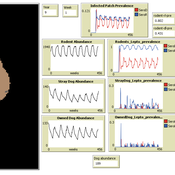
Aniruddha Belsare Meghan Mason Matthew Gompper Claudia Munoz-Zanzi | Published Tuesday, January 29, 2019 | Last modified Tuesday, March 12, 2019Leptospirosis is a neglected, bacterial zoonosis with worldwide distribution, primarily a disease of poverty. More than 200 pathogenic serovars of Leptospira bacteria exist, and a variety of species may act as reservoirs for these serovars. Human infection is the result of direct or indirect contact with Leptospira bacteria in the urine of infected animal hosts, primarily livestock, dogs, and rodents. There is increasing evidence that dogs and dog-adapted serovar Canicola play an important role in the burden of leptospirosis in humans in marginalized urban communities. What is needed is a more thorough understanding of the transmission dynamics of Leptospira in these marginalized urban communities, specifically the relative importance of dogs and rodents in the transmission of Leptospira to humans. This understanding will be vital for identifying meaningful intervention strategies.
One of the main objectives of MHMSLeptoDy is to elucidate transmission dynamics of host-adapted Leptospira strains in multi-host system. The model can also be used to evaluate alternate interventions aimed at reducing human infection risk in small-scale communities like urban slums.