Our mission is to help computational modelers develop, document, and share their computational models in accordance with community standards and good open science and software engineering practices. Model authors can publish their model source code in the Computational Model Library with narrative documentation as well as metadata that supports open science and emerging norms that facilitate software citation, computational reproducibility / frictionless reuse, and interoperability. Model authors can also request private peer review of their computational models. Models that pass peer review receive a DOI once published.
All users of models published in the library must cite model authors when they use and benefit from their code.
Please check out our model publishing tutorial and feel free to contact us if you have any questions or concerns about publishing your model(s) in the Computational Model Library.
Displaying 10 of 90 results for "Mark Stoove" clear search
Eliminating hepatitis C virus as a public health threat among HIV-positive men who have sex with men
Nick Scott Mark Stoove David P Wilson Olivia Keiser Carol El-Hayek Joseph Doyle Margaret Hellard | Published Wednesday, October 12, 2016 | Last modified Sunday, December 16, 2018We compare three model estimates for the time and treatment requirements to eliminate HCV among HIV-positive MSM in Victoria, Australia: a compartmental model; an ABM parametrized by surveillance data; and an ABM with a more heterogeneous population.
Port of Mars simplified
Marco Janssen | Published Tuesday, January 14, 2020This is a simulation model to explore possible outcomes of the Port of Mars cardgame. Port of Mars is a resource allocation game examining how people navigate conflicts between individual goals and common interests relative to shared resources. The game involves five players, each of whom must decide how much of their time and effort to invest in maintaining public infrastructure and renewing shared resources and how much to expend in pursuit of their individual goals. In the game, “Upkeep” is a number that represents the physical health of the community. This number begins at 100 and goes down by twenty-five points each round, representing resource consumption and wear and tear on infrastructure. If that number reaches zero, the community collapses and everyone dies.
Simulating Water, Individuals, and Management (SWIM)
John Murphy | Published Friday, July 05, 2019SWIM is a simulation of water management, designed to study interactions among water managers and customers in Phoenix and Tucson, Arizona. The simulation can be used to study manager interaction in Phoenix, manager and customer messaging and water conservation in Tucson, and when coupled to the Water Balance Model (U New Hampshire), impacts of management and consumer choices on regional hydrology.
Publications:
Murphy, John T., Jonathan Ozik, Nicholson T. Collier, Mark Altaweel, Richard B. Lammers, Alexander A. Prusevich, Andrew Kliskey, and Lilian Alessa. “Simulating Regional Hydrology and Water Management: An Integrated Agent-Based Approach.” Winter Simulation Conference, Huntington Beach, CA, 2015.
Simulating the Transmission of Foot-And-Mouth Disease Among Mobile Herds in the Far North Region, Cameroon
Mark Moritz Hyeyoung Kim Ningchuan Xiao Rebecca Garabed Laura W Pomeroy | Published Wednesday, April 13, 2016This model simulates movements of mobile pastoralists and their impacts on the transmission of foot-and-mouth disease (FMD) in the Far North Region of Cameroon.
The dynamic agent-based model of market of single commodity and process of setting of prices
Mark Voronovitsky | Published Saturday, January 24, 2009 | Last modified Saturday, April 27, 2013The dynamic agent based model of system which turn out the self-adjusting system, are considered in this text.
The Agent-Based Model of the Closed Market( similar to Stock Market) with One Commodity and with careful and risky mechanisms
Mark Voronovitsky | Published Sunday, March 15, 2015 | Last modified Sunday, March 22, 2015The model of market of one commodity , in which there are in each moment of time the same quantity and the same quantity of money was formulated and researched in this text. We also study this system as a game of automata.
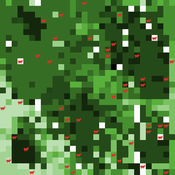
Peer reviewed Ideal Free Distribution of Mobile Pastoralists in the Logone Floodplain, Cameroon
Jeff Cronley Andrew Yoak Mark Moritz Hongyang Pi Ian M Hamilton Paul Maddock | Published Thursday, June 19, 2014 | Last modified Saturday, January 06, 2018The purpose of the model is to examine whether and how mobile pastoralists are able to achieve an Ideal Free Distribution (IFD).
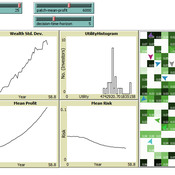
Peer reviewed Integrating Reinforcement Learning in Agent-Based Modeling for Dynamic Investment Decisions
Muhammad Khurram Ali Haider Ali Hafiz Mohammad | Published Tuesday, May 05, 2026This model is a part of an ongoing research project on Multiagent Reinforcement Learning (MARL). The ODD protocol is included in the model. In this version of the model, Proximal Policy Optimization (PPO) is designed in the agent behaviors. It also includes a designed experiment in its Behavior Space which is used in the Response Surface Methodology and training of an Artificial Neural Network (ANN) based Recommender System.

Artificial Anasazi: Baseline Fixes, Dynamic Soil and Plot Crowding
Thomas Tuoti | Published Sunday, October 04, 2026Artificial Anasazi is an agent-based model of farming households in the Long House Valley, Arizona, from 800 to 1350 CE. Each household chooses where to farm and settle based on expected harvest, water sources and stored maize, and simulated household counts are compared with the archaeological record.
This release adapts the NetLogo Models Library version (Stonedahl & Wilensky 2010) of Janssen’s (2009) NetLogo replication of the original Ascape model (Dean et al. 2000; Axtell et al. 2002). It contains four configurations in one NetLogo 7.0.4 file, selected with two switches:
- Both switches off: the baseline, which is the Models Library model with small fixes that make it work as intended (the arable-uplands zone name, the setup base yield, the initial household count, one-tick-lag capacity reporting, and seed control with observation-only instruments).
soil-on?: dynamic soil quality that depletes under cultivation and regrows, following Janssen (2010, eq. 4).
…
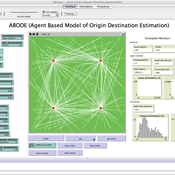
ABODE - Agent Based Model of Origin Destination Estimation
D Levinson | Published Monday, August 29, 2011 | Last modified Saturday, April 27, 2013The agent based model matches origins and destinations using employment search methods at the individual level.
Displaying 10 of 90 results for "Mark Stoove" clear search