Our mission is to help computational modelers develop, document, and share their computational models in accordance with community standards and good open science and software engineering practices. Model authors can publish their model source code in the Computational Model Library with narrative documentation as well as metadata that supports open science and emerging norms that facilitate software citation, computational reproducibility / frictionless reuse, and interoperability. Model authors can also request private peer review of their computational models. Models that pass peer review receive a DOI once published.
All users of models published in the library must cite model authors when they use and benefit from their code.
Please check out our model publishing tutorial and feel free to contact us if you have any questions or concerns about publishing your model(s) in the Computational Model Library.
Displaying 10 of 44 results uncertainty clear search
PA/C model with affinity
N. Leticia Abrica-Jacinto Evguenii Kurmyshev Héctor Juárez | Published Thursday, October 27, 2016We expose RA agent-based model of the opinion and tolerance dynamics in artificial societies. The formal mathematical model is based on the ideas of Social Influence, Social Judgment, and Social Identity theories.
MixFarm ABM Model
Leigh Anderson | Published Thursday, March 03, 2016MixFarmABM Model examines the competitiveness of second-generation biofuel crops with existing crops and beef cows at the farm level and their impact on the farm structure.
Collective Behavior of In-group Favoritism
Meysam Alizadeh Andrew Crooks Claudio Cioffi-Revilla | Published Tuesday, September 01, 2015We investigate the interplay of homophily, differentiation, and in-group cooperation mechanisms on the formation of opinion clusters and emergence of radical opinions.
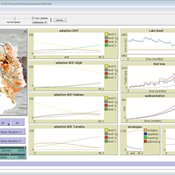
CONSERVAT
Pieter Van Oel | Published Monday, April 13, 2015The CONSERVAT model evaluates the effect of social influence among farmers in the Lake Naivasha basin (Kenya) on the spatiotemporal diffusion pattern of soil conservation effort levels and the resulting reduction in lake sedimentation.
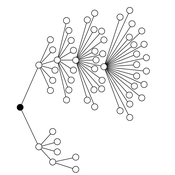
Environmental uncertainty affects the optimal structure of information-sharing networks
Marco Janssen Takao Sasaki Zachary Joseph Shaffer Stephen Pratt | Published Monday, March 16, 2015We used a computer simulation to measure how well different network structures (fully connected, small world, lattice, and random) find and exploit resource peaks in a variable environment.
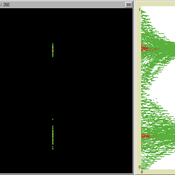
Peak-seeking Adder
Julia Kasmire Janne M Korhonen | Published Tuesday, December 02, 2014 | Last modified Friday, February 20, 2015Continuing on from the Adder model, this adaptation explores how rationality, learning and uncertainty influence the exploration of complex landscapes representing technological evolution.
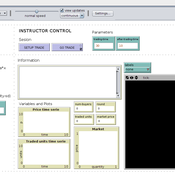
Quality uncertainty and market failure
David Poza José Manuel Galán María Pereda José Santos | Published Wednesday, May 14, 2014 | Last modified Wednesday, April 25, 2018Quality uncertainty and market failure: an interactive model to conduct classroom experiments
The various technologies used inside a Dutch greenhouse interact in combination with an external climate, resulting in an emergent internal climate, which contributes to the final productivity of the greenhouse. This model examines how differing technology development styles affects the overall ability of a community of growers to approach the theoretical maximum yield.
The Travel-tour case study
Christophe Sibertin-Blanc Françoise Adreit Joseph El Gemayel | Published Sunday, May 19, 2013 | Last modified Friday, June 14, 2013This model describes and analyses the Travel-Tour Case study.
Digital divide and opinion formation
Dongwon Lim | Published Friday, November 02, 2012 | Last modified Monday, May 20, 2013This model extends the bounded confidence model of Deffuant and Weisbuch. It introduces online contexts in which a person can deliver his or her opinion to several other persons. There are 2 additional parameters accessibility and connectivity.
Displaying 10 of 44 results uncertainty clear search