Our mission is to help computational modelers develop, document, and share their computational models in accordance with community standards and good open science and software engineering practices. Model authors can publish their model source code in the Computational Model Library with narrative documentation as well as metadata that supports open science and emerging norms that facilitate software citation, computational reproducibility / frictionless reuse, and interoperability. Model authors can also request private peer review of their computational models. Models that pass peer review receive a DOI once published.
All users of models published in the library must cite model authors when they use and benefit from their code.
Please check out our model publishing tutorial and feel free to contact us if you have any questions or concerns about publishing your model(s) in the Computational Model Library.
Displaying 10 of 167 results networks clear search
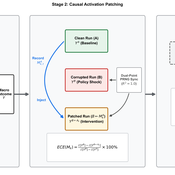
ACD-ABM: mechanism circuit tracing demonstrated on three agent-based simulators (network SIR, interbank contagion, NearshoreABM_XAI)
Alejandro Platas López | Published Wednesday, November 25, 2026Three stochastic simulators and the code that traces causal mechanisms in them. (1) Network SIR: a susceptible-infected-recovered process on a Barabási-Albert network of 100 agents. (2) Interbank contagion: 100 banks in which distress spreads through DebtRank dynamics and through fire sales of a common illiquid asset, with two policy instruments, emergency liquidity assistance and a market-maker of last resort. (3) NearshoreABM_XAI: the NearshoreABM model of anchor and supplier firms in the 32 Mexican states, instrumented so that the outputs of its credit, matching and infrastructure mechanisms can be recorded and injected.
The three are analyzed with ACD-ABM, a gradient-free method that attributes the effect of a policy on an aggregate outcome to the model’s mechanisms and to the simulation steps at which they act. It records the output of each mechanism in a baseline run, injects it into a policy run whose random number generator is synchronized with the baseline, and measures the share of the policy effect that the patch undoes (Expected Causal Effect), with paired bootstrap intervals, a coverage check of the mechanism partition and a rule that declines attribution when the policy effect cannot be distinguished from zero. The method is implemented in a simulator-independent Julia module.
All scripts, input data and reference outputs needed to reproduce the tables and figures of the associated article are included.
Trust, but Verify: An Agent-Based Model of How Grading Shapes Students' Reliance on Generative AI
Karina Galimnurova Sofiia Buianova Viktoriia Beliavskaia | Published Wednesday, November 25, 2026Trust, but Verify: an agent-based model of how university grading shapes whether students use generative AI and check its answers. Students in a network of study groups update their stance through graded work and peer influence. Includes NumPy and Mesa implementations, and an interactive Solara dashboard.
Peer reviewed MUTUS (Mutualism in Texts and Understanding of Students)
Yevgeny Patarakin | Published Sunday, November 22, 2026MUTUS: A Mutualistic-Network Agent-Based Model of Pollinators and Flowers, Students and Wiki Texts
MUTUS (Mutualism in Texts and Understanding of Students) is a minimal agent-based model of a mutualistic network between two guilds. One computational core supports two worlds. In the meadow, pollinators visit flowering plants; in the wiki, students of a course read and improve the articles of a course wiki. Trait matching is the shared mechanism: proboscis length vs. corolla depth in the meadow, and competence vs. conceptual difficulty, read as the zone of proximal development (ZPD), in the wiki. The two worlds differ only in a small set of fixed world constants: the width and asymmetry of the ZPD band, the efficiency of transfer between clusters (species or topics), scaffolding of difficulty by text quality, and the decay of novelty and quality. The model asks which regularities of plant–pollinator networks transfer to collaborative text production, and which are changed by processes that are slow or absent in ecology: learning, scaffolding, and authoring of new texts by the learners themselves
Epistemic Bubbles in Adaptive Social Networks
Omar al-Magharebi | Published Monday, November 16, 2026How can people come to agree with their neighbors while remaining divided across a social network?
Epistemic Bubbles is an exploratory NetLogo model in which people revise their beliefs and change their social ties. Agents start in a randomly connected network. At each time step, they move toward their neighbors’ average belief according to their openness to influence. A tie can dissolve when disagreement exceeds either agent’s tolerance. Agents can also form new ties with people whose beliefs fall within their tolerance.
To try the model, open Epistemic_Bubbles.nlogox in NetLogo 7.0.4. Click SETUP and GO to run the saved settings. Then set mean-tolerance to 0.15, click SETUP again, and rerun with the same seed. Compare the number of connected components, the spread of beliefs across the population, and the average belief gap between people who are directly connected.
…
Lingo: A Networked Naming-Game Model of Emergent Shared Language
Tabish Ahmad | Published Saturday, November 14, 2026Shared vocabularies are not designed by any central authority; they emerge from the bottom up as communities of speakers repeatedly try to understand one another. We study this process with an agent-based Naming Game in which a population that begins with no common vocabulary self-organises a shared language through local pairwise interaction, and we ask how the social network governs the outcome under communication noise and under selection on communicative strategy. The study combines baseline experiments with an extended suite built specifically to meet the standards of replication and statistical inference: every reported quantity is averaged over many independent seeded runs with confidence intervals, and the central claim is tested with a formal interaction statistic. Convergence time scales with population size as a power law with exponent close to four-thirds, matching analytical results for the Naming Game on networks. Restricted networks sustain many coexisting regional dialects, which we quantify with a cluster-based metric and show to be metastable, decaying to a single language as the interaction budget grows. Our central methodological contribution concerns noise robustness. A naive comparison suggests that denser networks simply tolerate more noise, but by comparing topologies at matched mean degree and by sweeping degree directly we separate two effects: connectivity raises robustness with sharply diminishing returns, while at identical degree locally clustered topologies remain significantly less robust than well-mixed ones. The effect of topology therefore survives the removal of the degree confound. Finally, an evolutionary extension shows that selection for communicative success drives inventiveness towards a low level that a frequency-dependent reward for useful innovation raises only slightly, so conservatism is robust rather than an artefact of the fitness function.
Peer reviewed Trifold Community Model, version 1.0
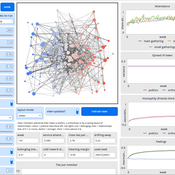
Eric Fernandes de Mello Araujo Miriam Crisman Damaris Parsitau Beth Dykstra | Published Friday, November 13, 2026An agent-based model of one community whose members meet every week. Members decide whether to attend the community’s gatherings, meet partners there, reveal or withhold their views on two topics, and judge each partner as “like me” or as one of “those people”. Views move toward accepted voices and are held by each member’s starting view. Each conversation has a feeling, which updates the member’s warmth toward her own side and toward the other side and strengthens or weakens the tie between the two partners; ties decide belonging, and belonging decides attendance. Listening enters as one trait, conversational receptiveness. The release includes the BehaviorSpace setup file and the output of every run reported in the accompanying paper.
Agent-Based Simulation of Operational and Fare Integration in Multi-Operator Bus Networks: Institutional Trade-offs and Robustness Analysis
Lorenzo Ros-McDonnell María Victoria de-la-Fuente-Aragon Salvador Martinez-Artero-Martinez Khaoula El Bied | Published Tuesday, November 03, 2026This study separates operational interoperability, fare integration and revenue-sharing governance in a stylised multi-operator bus network. An agent-based model implemented in NetLogo 7.0.3 represents passengers, buses and stations across 14 stations, nine routes and three operators. A 2 × 2 institutional design is complemented by financial clearing comparisons and 43,200 robustness runs: behavioural sensitivity (E1), a 243-configuration operational factorial (E2), and targeted joint behavioural–operational stress testing (E3). The audited experiment records show favourable interoperability effects on waiting, total travel time, transfers and realised generalised cost in all 1,944 E2 and 768 E3 configuration-level primary comparisons. Fare integration substantially reduces passenger expenditure but produces an aggregate deficit under the assumed accounting coefficients. Revenue-sharing rules redistribute operator-level outcomes without changing aggregate profit or passenger trajectories by construction. The model is intended to identify mechanisms and test conditional robustness, not predict city-specific policy effects. The paper contributes an explicit separation of access, pricing and settlement mechanisms coupled with reproducible factorial and stress-test comparisons.
When should professional-development places be concentrated
yuhouchunsun | Published Sunday, October 25, 2026This Python agent-based model simulates the diffusion of instructional practices among primary-school science teachers connected through within-school and cross-school networks. It represents teachers as agents nested in schools and compares five adoption mechanisms: simple contagion, proportion thresholds, count thresholds, adaptive norm conformity, and an individual-only baseline. The model evaluates fixed-budget training allocations, including concentrated and distributed policies, and estimates when school-level dose-response evidence can support targeted allocation. Experiments examine peer interference, cross-school contact intensity, global critical transitions, allocation stability, and the distinction between participant-level and system-level outcomes. Teacher attributes are informed by a de-identified Beijing questionnaire, whereas team sizes and contact networks are explicit model assumptions. The package includes executable Python scripts, ODD documentation, parameter tables, experiment metadata, simulation outputs, and the authorized questionnaire workbook required to reproduce the questionnaire-informed analyses. Results are intended as model-based design evidence for future longitudinal research rather than forecasts of adoption rates.
Mobility Sharing for Social Integration: A Reverse Schelling Model
Hongmou Zhang | Published Thursday, October 15, 2026This model extends Schelling’s segregation model with mobility sharing. Agents of two groups occupy cells of a 32 × 32 grid and repeatedly choose activity destinations subject to a preference threshold, the minimum share of ingroup neighbours they accept. Trips are matched into shared rides between members of different groups, using one of four matching algorithms on a shareability network (maximal cross-group matching, maximum weight matching on contact time, maximum cardinality matching, or random greedy matching) with a maximum detour constraint. After each trip, an agent’s preference threshold changes with the time spent in contact with outgroup members.
Starting from complete segregation, the model examines under which conditions contact during shared trips leads to integration. Besides the main scenario, in which contact always lowers the threshold, it includes two extensions. In the first, a share of adversarial agents becomes less tolerant with contact, and this share grows or shrinks with the current level of segregation, governed by a branching dissimilarity index and a conversion rate. In the second, each contact raises or lowers the threshold with a probability that depends on the agent’s current attitude relative to a compatibility threshold.
Segregation is measured with the index of dissimilarity and the Gini coefficient. The model file includes BehaviorSpace experiments for each analysis in the associated article. The matching step uses the NetworkX library through the Python extension of NetLogo (requires Python 3 with numpy and networkx 3.x).
From Population Diversity to Contact Diversity: A Network-Based Generalization of the Greenberg Index
Marco Civico | Published Tuesday, October 13, 2026This repository contains a Python simulation script for studying network-based linguistic diversity. The model extends the classic Greenberg Diversity Index by introducing diversity measures defined over social ties rather than only over population shares. It also includes two extensions: a competence-conditioned version and a multilayer version.
Displaying 10 of 167 results networks clear search