Our mission is to help computational modelers develop, document, and share their computational models in accordance with community standards and good open science and software engineering practices. Model authors can publish their model source code in the Computational Model Library with narrative documentation as well as metadata that supports open science and emerging norms that facilitate software citation, computational reproducibility / frictionless reuse, and interoperability. Model authors can also request private peer review of their computational models. Models that pass peer review receive a DOI once published.
All users of models published in the library must cite model authors when they use and benefit from their code.
Please check out our model publishing tutorial and feel free to contact us if you have any questions or concerns about publishing your model(s) in the Computational Model Library.
Displaying 10 of 1008 results for "Ibo van de Poel" clear search
SAFARI: Simulating Agroforestry Adoption in Rural Indonesia
Beatrice Nöldeke Etti Winter Yves Laumonier Trifosa Simamora | Published Tuesday, July 20, 2021The Simulating Agroforestry Adoption in Rural Indonesia (SAFARI) model aims at exploring the adoption of illipe rubber agroforestry systems by farming households in the case study region in rural Indonesia. Thereby, the ABM simulates the interdependencies of agroforestry systems and local livelihoods, income, land use, biodiversity, and carbon fixation. The model contrasts development paths without agroforestry (business as usual (BAU) scenario), corresponding to a scenario where the government promotes rubber monoculture, with the introduction of illipe rubber agroforestry systems (IRA scenario) as an alternative. It aims to support policy-makers to assess the potential of IRA over larger temporal and spatial scales.
AMIRIS
Ulrich Frey Felix Nitsch Christoph Schimeczek Johannes Kochems Kristina Nienhaus Evelyn Sperber Aboubakr Achraf El Ghazi Seyedfarzad Sarfarazi | Published Thursday, February 03, 2022AMIRIS is the Agent-based Market model for the Investigation of Renewable and Integrated energy Systems.
It is an agent-based simulation of electricity markets and their actors.
AMIRIS enables researches to analyse and evaluate energy policy instruments and their impact on the actors involved in the simulation context.
Different prototypical agents on the electricity market interact with each other, each employing complex decision strategies.
AMIRIS allows to calculate the impact of policy instruments on economic performance of power plant operators and marketers.
…
NRDCPI v17.0 — NATO-Russia Direct Conflict Probability Index
Edward Ozhiganov | Published Thursday, September 03, 2026This model implements a bidirectional coupling between micro-level agent decisions and macro-level system dynamics, with an additional diagnostic layer based on Stafford Beer’s Viable System Model.
Key features:
- Six types of agents (Household, Firm, Bank, Government, Foreign, Innovation)
- Continuous SDM core integrated with Runge-Kutta 4
- Robust GDELT data handling with multi-level fallback
…
HCAM: A Hybrid Climate Assessment Model
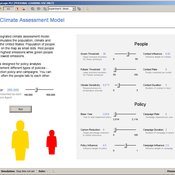
Peer-Olaf Siebers | Published Wednesday, November 06, 2019This model is part of a JASSS article that introduce a conceptual framework for developing hybrid (system dynamics and agent-based) integrated assessment models, which focus on examining the human impacts on climate change. This novel modelling approach allows to reuse existing rigid, but well-established integrated assessment models, and adds more flexibility by replacing aggregate stocks with a community of vibrant interacting entities. The model provides a proof-of-concept of the application of this conceptual framework in form of an illustrative example. taking the settings of the US. It is solely created for the purpose of demonstrating our hybrid modelling approach; we do not claim that it has predictive powers.
Peer reviewed TRANSOPE: a multi-agent model to simulate outsourcing networks in road freight transport.
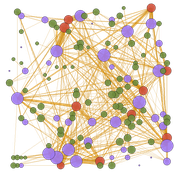
Aitor Salas-Peña Blanca Rosa Cases Gutiérrez | Published Friday, October 21, 2022A road freight transport (RFT) operation involves the participation of several types of companies in its execution. The TRANSOPE model simulates the subcontracting process between 3 types of companies: Freight Forwarders (FF), Transport Companies (TC) and self-employed carriers (CA). These companies (agents) form transport outsourcing chains (TOCs) by making decisions based on supplier selection criteria and transaction acceptance criteria. Through their participation in TOCs, companies are able to learn and exchange information, so that knowledge becomes another important factor in new collaborations. The model can replicate multiple subcontracting situations at a local and regional geographic level.
The succession of n operations over d days provides two types of results: 1) Social Complex Networks, and 2) Spatial knowledge accumulation environments. The combination of these results is used to identify the emergence of new logistics clusters. The types of actors involved as well as the variables and parameters used have their justification in a survey of transport experts and in the existing literature on the subject.
As a result of a preferential selection process, the distribution of activity among agents shows to be highly uneven. The cumulative network resulting from the self-organisation of the system suggests a structure similar to scale-free networks (Albert & Barabási, 2001). In this sense, new agents join the network according to the needs of the market. Similarly, the network of preferential relationships persists over time. Here, knowledge transfer plays a key role in the assignment of central connector roles, whose participation in the outsourcing network is even more decisive in situations of scarcity of transport contracts.
IDEAL
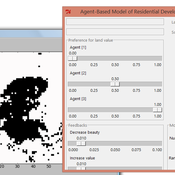
Arika Ligmann-Zielinska | Published Thursday, August 07, 2014IDEAL: Agent-Based Model of Residential Land Use Change where the choice of new residential development in based on the Ideal-point decision rule.
Irrigation game
Marco Janssen | Published Monday, July 23, 2012 | Last modified Saturday, April 27, 2013Irrigation game calibrated on experimental data
Demand Planning Model
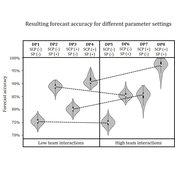
Iris Lorscheid Jonas Hauke Matthias Meyer | Published Wednesday, October 04, 2017Demand planning requires processing of distributed information. In this process, individuals, their properties and interactions play a crucial role. This model is a computational testbed to investigate these aspects with respect to forecast accuracy.
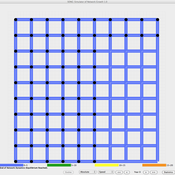
SONG - Simulation of Network Growth
D Levinson | Published Monday, August 29, 2011 | Last modified Saturday, April 27, 2013SONG is a simulator designed for simulating the process of transportation network growth.
Model to assess factors that influence local communities compliance with protected areas policies
Gustavo Andrade | Published Monday, November 21, 2011 | Last modified Saturday, April 27, 2013We built a model using R,polr package, to assess 55 published case studies from developing countries to determine what factors influence the level of compliance of local communities with protected area regulations.
Displaying 10 of 1008 results for "Ibo van de Poel" clear search